
Carrier Global: Portfolio Transformation, Impairment Headwinds, and the Next Phase of Climate Solutions Leadership
Carrier Global’s transition to a pure-play climate and energy solutions provider is reshaping its value proposition, but recent goodwill impairment and a net loss highlight the challenges of integrating acquisitions and navigating competitive and supply chain headwinds. The company’s innovation focus and capital deployment signal long-term ambition, but its ability to realize operational leverage and defend margins will define whether it can convert secular tailwinds into durable shareholder value.
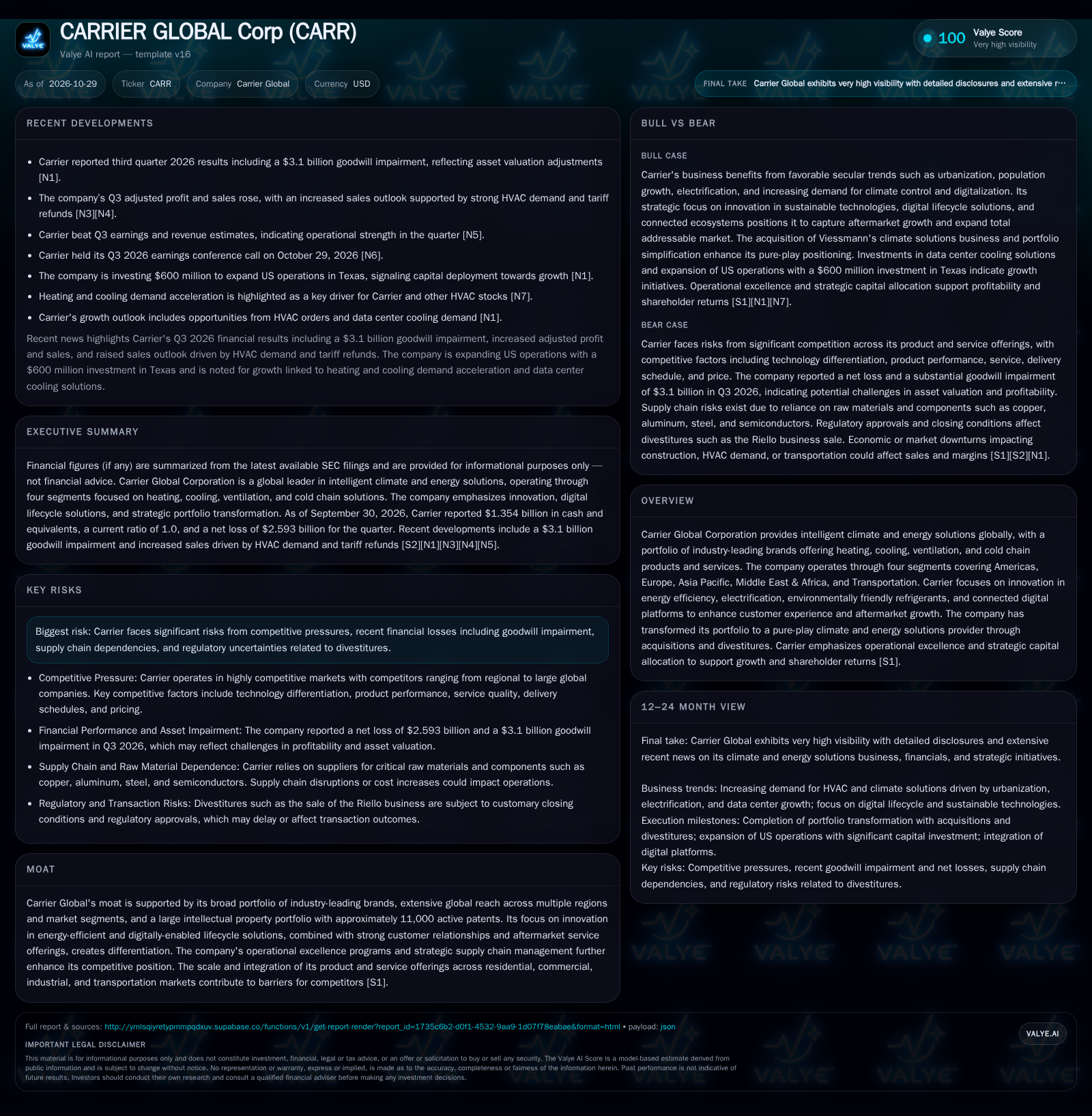
Carrier Global has repositioned itself as a focused climate and energy solutions company, acquiring Viessmann’s climate business and divesting non-core segments. Despite strong Q3 sales and aftermarket growth, a $3.1 billion goodwill impairment and a $2.6 billion net loss raise questions about asset valuation and integration execution. The company’s $600 million Texas expansion and digital platform investments reflect confidence in long-term demand, but execution risk remains high given supply chain, competitive, and regulatory challenges. Watch margin recovery, integration progress, and aftermarket uptake to gauge the company’s ability to capitalize on energy transition trends. [S1] [S2] [N1] [N3] [N5]
Carrier Global’s evolution from a diversified industrial conglomerate to a focused climate and energy solutions player is reaching a critical juncture. While the company’s recent moves—such as acquiring Viessmann’s climate business and divesting legacy segments—position it to capture growth from electrification and sustainability trends, a $3.1 billion goodwill impairment and Q3 net loss underscore the risks of portfolio transformation. The next phase will test Carrier’s ability to integrate acquisitions, extract operational leverage, and defend its competitive position as the climate solutions market matures and digitizes.
Recent Impairment and Portfolio Shift Define Carrier’s 2026 Operating Backdrop
Carrier Global reported a $3.1 billion goodwill impairment and a net loss of $2.593 billion for Q3 2026, following its major acquisition of Viessmann’s climate solutions business and ongoing divestitures of non-core assets. These headline numbers reflect both the company’s bold bet on a focused climate and energy portfolio and the valuation recalibration that often follows such transformative deals. The impairment highlights integration and asset valuation challenges at a time when Carrier is investing heavily—such as the $600 million Texas expansion—to capture secular growth in HVAC, data center cooling, and electrified building systems. The company reported cash and liquidity metrics for the period; these figures do not by themselves establish operating runway, investment capacity, financial flexibility, or financing capacity. [S2] [N1] [N5]
How Carrier’s Revenue Mix and Cost Structure May Evolve Post-Transformation
Carrier’s economics are shaped by its blend of equipment sales (HVAC, heat pumps, cold chain units), aftermarket parts and services, and increasingly, digitally-enabled lifecycle solutions. Historically, the company’s profitability has depended on balancing lower-margin equipment with higher-margin aftermarket and service revenues. The recent focus on digital platforms like Abound and Lynx suggests an ambition to deepen customer engagement, drive recurring revenue, and expand wallet share through analytics, predictive maintenance, and energy management.
The Viessmann acquisition brings exposure to premium European heating and electrification trends, but integration could increase near-term SG&A and R&D costs. Meanwhile, Carrier’s significant fixed-cost base—manufacturing, R&D, and global footprint—implies that operating leverage should improve with scale and successful integration. However, impairment and restructuring charges may obscure underlying margin dynamics in the near term. Investment in US expansion (e.g., Texas facility) signals confidence in volume growth, but success depends on execution and demand realization in target segments like data centers and electrified buildings.
Defending Share in a Crowded, Digitizing Climate Solutions Arena
Carrier faces formidable competition from global diversified peers, regional HVAC specialists, and new entrants in digital building management. The company’s moat is rooted in its portfolio breadth (including brands like Carrier, Viessmann, Toshiba, Automated Logic), global distribution, and an 11,000-strong patent portfolio. These assets help defend share in both mature and fast-growing segments.
However, technology differentiation is increasingly transient as electrification, IoT, and AI-driven controls become table stakes. Carrier’s strategy to build out digital platforms and integrated service offerings could create higher switching costs and retention if successful, but customer price sensitivity and the ease of integrating third-party solutions in building management systems can erode these advantages. Aftermarket service and parts, long a source of sticky revenue, may face margin pressure if independent service providers or digital-only challengers gain traction.
Supply chain resilience—highlighted as a focus area—remains a potential vulnerability, especially for semiconductors, metals, and critical HVAC components. Regulatory dynamics, especially around refrigerants and energy standards, could shift the competitive landscape abruptly, favoring those with rapid compliance adaptation and innovation cycles. [S1]
If Integration Unlocks Synergies and Digital Drives Aftermarket Expansion
Carrier could outperform if it efficiently integrates the Viessmann business, realizing both revenue and cost synergies—such as cross-selling, supply chain optimization, and harmonized R&D. Successful rollout and adoption of digital platforms (Abound, Lynx) could accelerate aftermarket growth by embedding Carrier deeper into customer operations, enabling predictive maintenance contracts, and creating data-driven upsell opportunities.
A scenario in which US and European HVAC demand remains robust—fueled by electrification mandates, building retrofits, and data center buildouts—would amplify operating leverage, especially as fixed costs are absorbed by higher volumes. The $600 million Texas expansion could serve as a proof point if it comes online on time and at target utilization. Margin expansion would be confirmed by sequential improvement in adjusted operating margin and a rising share of aftermarket and digital services in total revenue.
Evidence for this scenario would include sustained double-digit growth in aftermarket and digital revenues (if disclosed), visible cost takeout from integration, and a reversal of impairment-driven net losses as underlying earnings power is revealed.
Portfolio Realignment Yields Moderate Growth but Margin Pressure Lingers
The most plausible trajectory is that Carrier’s transition to a pure-play climate and energy solutions provider delivers steady—if unspectacular—organic growth in line with global HVAC and cold chain market expansion. Integration of Viessmann proceeds, but synergy realization is incremental and offset by higher near-term costs, including restructuring, digital investment, and regulatory compliance.
Margins remain under pressure from competition, input cost volatility, and the need to invest in both digital platforms and regional expansions. Aftermarket and digital service revenues grow but do not yet transform the profit mix. The Texas facility ramps on schedule but at moderate utilization, contributing to US market share defense but not dramatic share gains.
Confirmation would come from stable or gradually improving adjusted operating margins, continued positive revenue growth, and evidence of customer adoption of digital services. Conversely, persistent impairment charges, flat aftermarket growth, or cost overruns in major projects would challenge this scenario.
Integration Stumbles and Margin Erosion Undermine Value Creation
The adverse scenario unfolds if Carrier struggles to integrate Viessmann, faces further asset impairments, or encounters significant cost overruns in digital and physical expansion projects. Prolonged supply chain disruptions or a downturn in global construction and HVAC demand—especially in Europe or the US—could expose the company’s fixed cost base and lead to operating losses.
Competitive pricing pressure, especially from regional specialists or digital-only entrants, could erode both equipment and aftermarket margins. If new digital platforms fail to gain traction or are commoditized, Carrier’s efforts to build recurring revenue streams may fall short, increasing customer churn and reducing pricing power.
This scenario would be confirmed by continued net losses, additional impairment or restructuring charges, declining or stagnant aftermarket revenues, or missed milestones in capacity expansions such as the Texas project.
Testing Carrier’s Ability to Convert Climate Megatrends into Shareholder Value
Progress on Viessmann integration and realization of announced cost and revenue synergies—if disclosed—would validate the integration thesis.
Quarterly trends in adjusted operating margin and the share of aftermarket and digital service revenues in the total mix would help assess operating leverage and recurring revenue growth.
Utilization ramp and profitability of the new Texas facility should be monitored as a proxy for Carrier’s ability to capitalize on US electrification and data center demand.
Any further goodwill or asset impairments, or restructuring charges, would signal ongoing integration or portfolio valuation issues.
Carrier’s ability to maintain or expand its intellectual property portfolio and defend premium pricing amid regulatory and competitive flux would test its innovation edge.
Supply chain resilience, specifically in critical components like semiconductors and refrigerants, remains a watch area given ongoing global disruptions.
Successful regulatory closure and proceeds from remaining divestitures (such as Riello) would impact capital allocation flexibility and strategic focus.
Disclaimer: This is research-only, informational analysis and not investment advice. It may include AI-generated interpretation and general industry context. Always verify important details using primary sources.

Comments