
DFIN’s Shift to Software: Margin Expansion Amid Structural Headwinds in Compliance and Print
Donnelley Financial Solutions is navigating secular decline in legacy print and services by accelerating growth in software solutions, driving higher margins and operational leverage. The company’s ability to manage costs and execute on technology-driven product expansion is critical as compliance volumes and transactional activity remain pressured by market volatility and regulatory shifts.
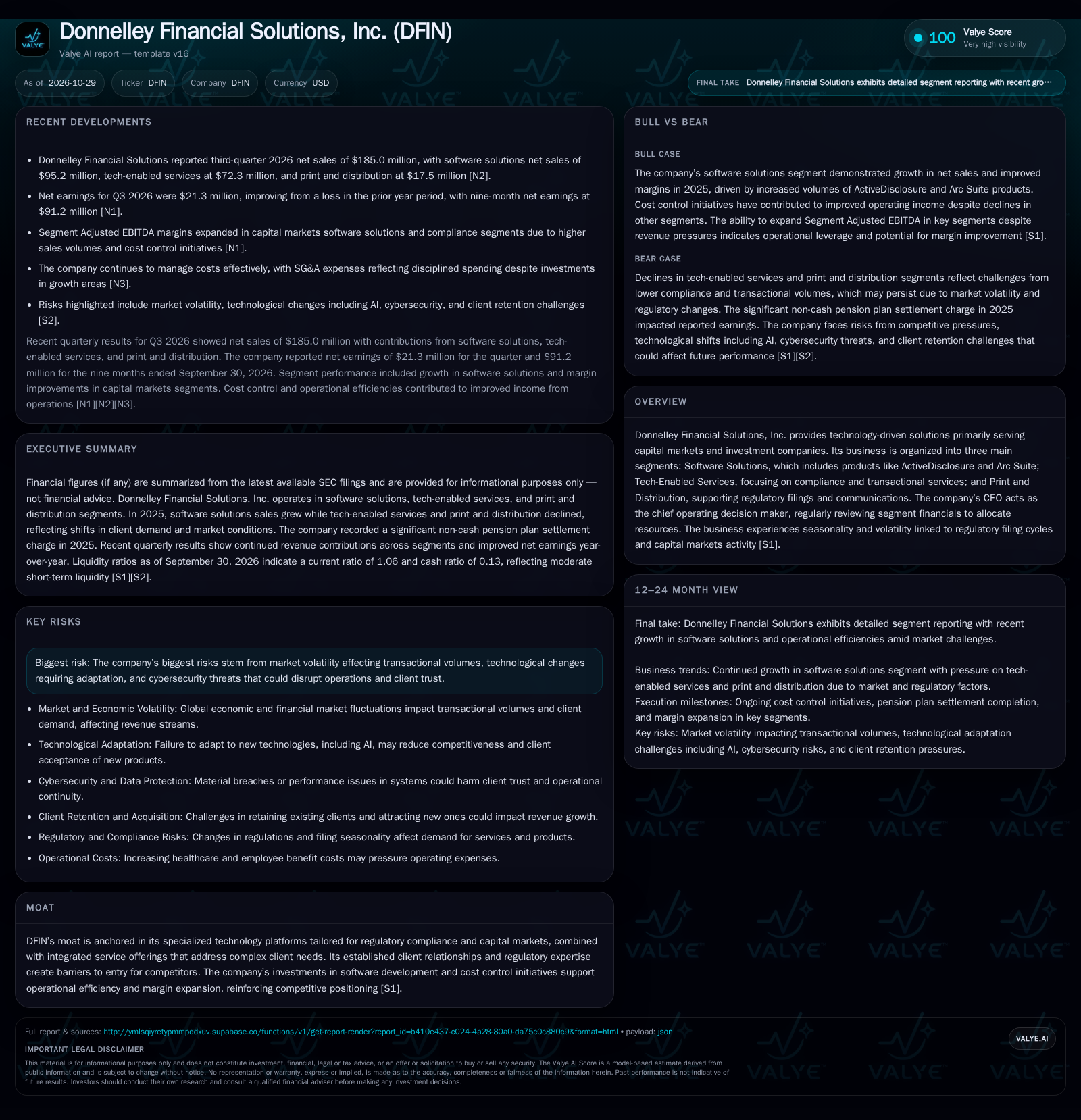
DFIN’s 2025-26 results show software-led growth and margin expansion offsetting ongoing declines in print and tech-enabled services. Cost control and operational leverage underpin improved profitability, but the company faces persistent risks from market cycles, technology disruption, and regulatory changes. The central question is whether software adoption can sustainably outpace the contraction in traditional segments and withstand intensifying competition and evolving client needs. [S1] [S2]
Donnelley Financial Solutions (DFIN) is in the midst of a structural transition, as its legacy print and compliance services face secular pressures from digitization, regulatory change, and volatile capital markets. The company’s 2025-26 financials reveal a clear pivot: software solutions are now the principal growth and margin driver, offsetting persistent declines in tech-enabled services and print. With cost controls supporting operating leverage, DFIN’s near-term resilience is evident. However, the durability of this strategy hinges on continued software adoption, evolving competitive threats, and the company’s capacity to innovate and retain clients in an environment shaped by rapid technological and regulatory change. [S1] [S2]
Software Gains Outpace Legacy Declines: What Recent Results Reveal
DFIN’s 2025 and year-to-date 2026 results highlight a pronounced divergence across its business lines. Software solutions net sales increased by 8.7% in 2025, driven by higher ActiveDisclosure and Arc Suite sales, while tech-enabled services declined by 7.0% and print and distribution fell by 16.1%—the latter reflecting secular contraction in regulatory print communications. Despite a 1.9% overall revenue decline, income from operations rose by 3.3% due to cost discipline and margin expansion in software. The company also absorbed an $82.8 million non-cash pension plan settlement charge in 2025, which skewed reported net income but did not affect cash flow. The company reported cash and liquidity metrics for the period; these figures do not by themselves establish operating runway, investment capacity, financial flexibility, or financing capacity. [S1] [S2]
Margin Structure and Operating Leverage in a Shifting Product Mix
DFIN’s business economics are increasingly shaped by the mix shift toward software solutions. Software carries meaningfully higher gross margins than print or service-based compliance due to low incremental delivery costs and the potential for recurring, subscription-like revenue streams—though the commercial structure is not fully disclosed. The company’s ability to expand Segment Adjusted EBITDA in capital markets software by 18.1% in 2025, despite modest top-line growth, underscores the operating leverage inherent in this segment. Cost control, especially in SG&A, further supports margin expansion even as volumes decline elsewhere.
In contrast, tech-enabled services and print remain volume-sensitive and exposed to fixed cost deleveraging as transactional activity and regulatory print requirements erode. Print’s 16.1% sales drop in 2025 likely reflects both industry-wide decline and a shift to digital filings among clients. The significant non-cash pension settlement, while not an operating outflow, eliminates a future obligation and may simplify future cost structure. Capital intensity is low for software, but ongoing innovation and client integration are required to sustain growth and defend share.
Defensible Niche or Eroding Moat? DFIN’s Place in the Compliance Value Chain
DFIN’s competitive position rests on its specialized regulatory technology platforms and established client relationships in capital markets and investment companies. Integrated offerings—combining software, services, and legacy print—have historically created switching frictions for clients facing complex compliance demands. However, the competitive landscape is intensifying, with software-centric entrants, large enterprise technology vendors, and adjacent compliance solution providers targeting the same client budgets. The rise of AI-driven document preparation, e-filing, and workflow automation may compress the differentiation of traditional platforms.
DFIN’s moat partly reflects regulatory expertise and embeddedness in client processes, but this advantage is vulnerable if clients shift to more modular, best-of-breed, or in-house solutions. The secular decline in print and manual compliance services further exposes the company to share loss if it cannot continue to innovate and integrate new technologies. While cost control and operational efficiency help defend margins, long-term defensibility increasingly depends on the adoption curve and stickiness of its software suite and the strength of its product roadmap relative to emerging threats.
How Sustained Software Adoption Could Unlock Compounding Profitability
The most favorable scenario for DFIN sees software solutions continuing to outpace declines in legacy segments, underpinned by strong client adoption of ActiveDisclosure and Arc Suite. If the company can convert a growing portion of its client base to multiyear contracts, expand product breadth, and deepen workflow integration, recurring revenue and margins could compound, driving higher operational leverage. This would be further supported if compliance complexity increases or regulatory regimes shift in ways that favor technology-based solutions.
Confirmation of this scenario would be evident in sustained double-digit software sales growth, rising software segment EBITDA margins, an increasing share of total revenue from software, and evidence of new product launches or major client wins. Falsification would occur if software growth stalls, if client churn rises, or if competitive pressures force significant price concessions or margin giveback.
Mixed Momentum: Software Growth Balances Persistent Headwinds in Services and Print
The most likely outcome is a continued, gradual shift in revenue mix toward software, with ongoing but slowing declines in tech-enabled services and print. In this scenario, DFIN maintains positive operating leverage through cost discipline and incremental efficiency gains, but faces periodic volatility due to capital markets cycles and regulatory changes. Software growth, while robust, may moderate as penetration rates rise and competition intensifies, limiting the pace of margin expansion.
Evidence supporting this path would include low- to mid-single-digit total revenue declines offset by steady software growth, stable or slightly rising operating income, and EBITDA margin expansion in software even as aggregate margins plateau. Falsification would be indicated by an acceleration in legacy segment declines outpacing software gains, or by a reversal in cost-control effectiveness leading to margin compression.
If Market Volatility and Technology Disruption Outpace DFIN’s Transition
In a more adverse scenario, macro volatility and regulatory uncertainty further depress compliance and transactional volumes, accelerating declines in tech-enabled services and print. Meanwhile, a failure to keep pace with AI-driven automation, cybersecurity incidents, or a loss of key client relationships could stall or reverse software growth. Price competition and client insourcing could further erode margins.
This scenario would be confirmed by a sharp drop in total revenue, negative operating leverage, shrinking software segment sales, and increased client churn. Recovery would require either a structural market rebound or aggressive repositioning of the product suite.
What Will Determine Whether DFIN’s Software-Led Strategy Delivers Durable Value?
Sustained year-over-year growth in software solutions net sales, particularly for ActiveDisclosure and Arc Suite, would demonstrate continued market adoption and revenue mix improvement. [S1] [S2]
Software segment EBITDA margin trajectory: ongoing expansion would confirm operating leverage, while stagnation or contraction could signal competitive or cost pressure. [S1]
Pace of decline in tech-enabled services and print net sales: moderation would support a smoother transition, while acceleration could threaten aggregate profitability. [S1] [S2]
Evidence of new product launches, expanded client integrations, or entry into adjacent compliance categories would indicate innovation and competitive adaptation, if disclosed.
Client retention rates, contract renewal rates, and customer concentration (if disclosed) would help assess the durability of DFIN’s revenue base.
Updates on regulatory changes or market cycles that affect transactional volume and compliance demand could materially impact segment performance.
Cybersecurity incident disclosures or remediation costs (if disclosed) would be early warning signs of operational and reputational risk.
Disclaimer: This is research-only, informational analysis and not investment advice. It may include AI-generated interpretation and general industry context. Always verify important details using primary sources.

Comments