
Millennium Group International Holdings: Streamlining Amid Losses and Opaque Segment Economics
Facing continued net losses and limited segment disclosure, Millennium Group International Holdings Ltd has divested a Hong Kong packaging trading subsidiary in a related-party deal. The core challenge remains: Can operational restructuring and cross-border presence yield sustainable profits in a low-margin, highly competitive packaging sector?
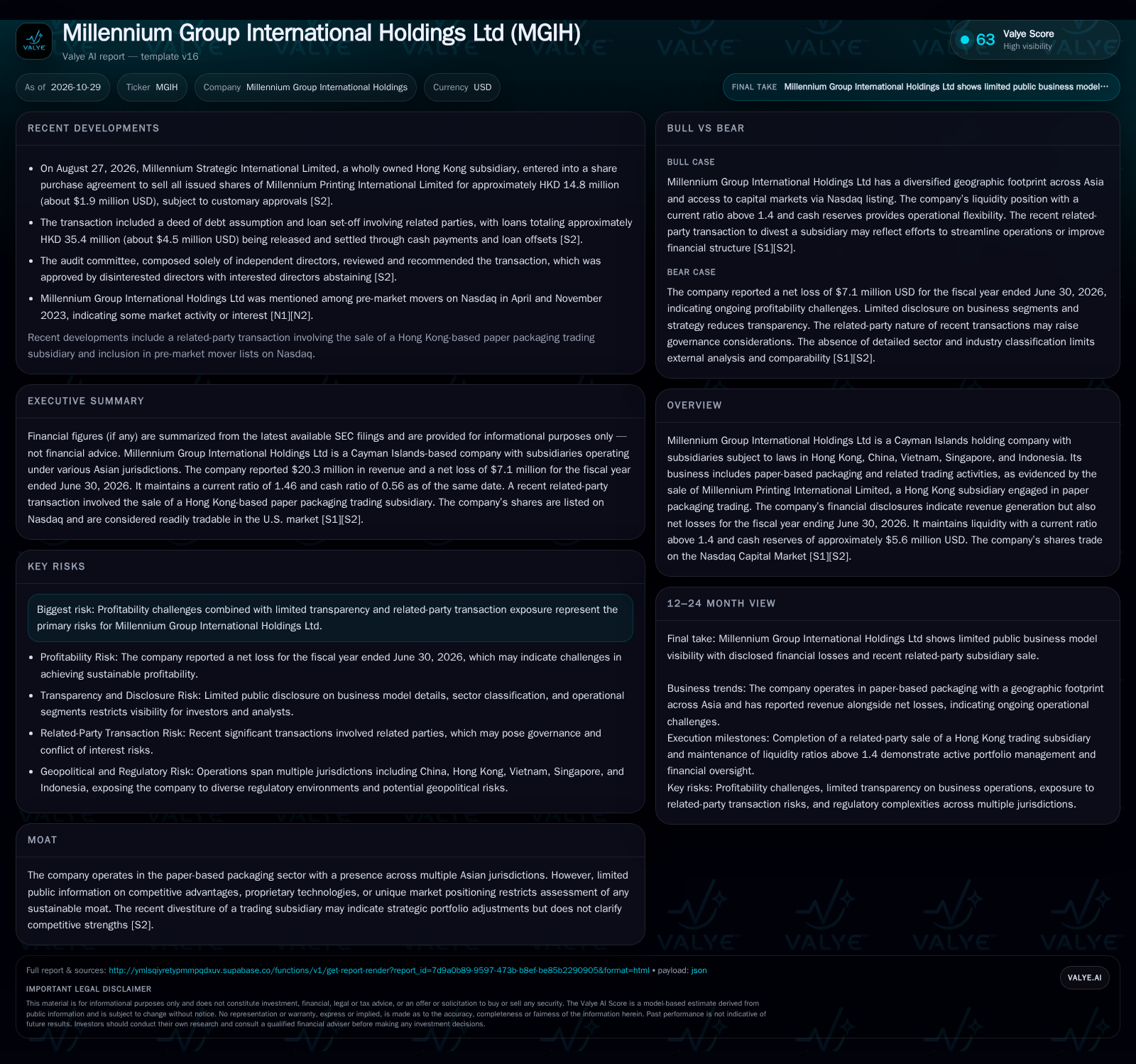
Millennium Group International Holdings Ltd reported $20.3 million in revenue and a $7.1 million net loss for FY2026, raising questions about the sustainability of its business model. The recent related-party sale of a Hong Kong trading subsidiary suggests a move to streamline operations, but limited segment disclosure and persistent losses leave the underlying economics and future trajectory uncertain. The company’s liquidity position is stable for now, but profitability and transparency are key issues for the next phase. [S1] [S2]
Millennium Group International Holdings Ltd, a Cayman Islands holding company active in paper-based packaging across Asia, faces a pivotal moment. With $20.3 million in revenue but a $7.1 million net loss for the latest fiscal year, the company has moved to divest a Hong Kong trading subsidiary through a related-party transaction. While reported liquidity position for now, the underlying business model remains opaque, and persistent losses raise questions about the company’s path to profitability. As competition intensifies in the packaging sector and disclosure remains limited, Millennium’s ability to leverage its regional footprint and recent restructuring will shape its next chapter. [S1] [S2]
Recent Divestiture and Financial Losses Define 2026 Operating Reality
Millennium Group International Holdings Ltd reported revenue of approximately $20.3 million USD and a net loss of $7.1 million USD for the fiscal year ended June 30, 2026. The company completed a related-party sale of Millennium Printing International Limited, a Hong Kong-based paper packaging trading subsidiary, for about $1.9 million USD. This transaction also involved the assumption of related-party debt and loan set-offs totaling roughly $4.5 million USD. While cash and current ratios (1.46) remain above minimum liquidity thresholds, ongoing net losses and the divestiture of an operating entity underscore the company’s efforts to address structural challenges in its business. The lack of detailed segment or customer disclosure, however, limits visibility into which portions of the business are performing and which are being scaled back or repositioned. [S1] [S2]
Paper Packaging: Thin Margins, Fixed Cost Pressures, and Capital Allocation Dilemmas
The paper-based packaging industry is typically characterized by high competition, low product differentiation, and modest margins. Volume-driven economics dominate, with profitability hinging on scale, raw material procurement, and operational efficiency. For a company like Millennium, which operates across multiple Asian jurisdictions, cost structure is likely a blend of fixed manufacturing overhead and variable input costs, with working capital needs tied to inventory and receivables cycles. The sale of a trading subsidiary suggests a pivot away from lower-margin trading activities and a possible attempt to focus on higher-value or more controllable segments, though public disclosures do not clarify the targeted end-state.
Operating leverage may be limited unless Millennium can drive significant volume growth or extract cost synergies from its cross-border footprint. The recurring net losses indicate that current scale is insufficient to cover fixed costs or that pricing power is weak. Without transparency into customer concentration, contract duration, or value-added service mix, it is difficult to assess whether the company can shift its economic profile from volume-dependent to more defensible margin streams. The company reported cash and liquidity metrics for the period; these figures do not by themselves establish operating runway, investment capacity, financial flexibility, or financing capacity.
Capital allocation decisions in a low-margin industry such as paper packaging are critical, especially when balancing the trade-offs between investing in efficiency improvements versus maintaining liquidity. For Millennium, prioritizing capital expenditures on automation or process optimization could reduce unit costs and improve gross margins, but such investments require upfront cash outlays that may be constrained by ongoing losses. Conversely, underinvestment risks perpetuating inefficiencies and limiting competitive positioning. Additionally, managing working capital tightly is essential given the sector’s inventory and receivables cycles; excessive stockpiling or lenient credit terms could exacerbate cash flow pressures, while overly stringent policies might impair customer relationships or sales volumes.
Given the company’s multi-jurisdictional operations, currency fluctuations and differing regulatory environments also introduce complexity to cost management and pricing strategies. Exchange rate volatility can impact the cost of imported raw materials or the competitiveness of export pricing, potentially compressing margins unpredictably. Furthermore, compliance with varying local regulations around packaging standards, environmental policies, and labor laws may impose additional fixed or variable costs, which could disproportionately affect smaller players with less scale and bargaining power. Effective hedging strategies and proactive regulatory monitoring would be necessary to mitigate these risks and sustain operational stability.
Opaque Differentiation in a Crowded Asian Packaging Market
Millennium’s geographic reach across Hong Kong, China, Vietnam, Singapore, and Indonesia could offer access to diverse customer bases and supply chains, but the company’s competitive positioning is unclear. The Asian paper packaging sector is highly fragmented, with numerous regional and local players, as well as global firms with established customer relationships and greater scale. In this context, cost efficiency, logistics integration, and customer service are typical axes of competition.
The recent divestiture of a trading subsidiary may indicate a retreat from lower-margin, commoditized segments, but there is no evidence of proprietary technology, unique product offerings, or established brand equity. Without disclosure on customer retention, contract structure, or integration of upstream/downstream activities, it is difficult to argue for a durable moat. The company may be vulnerable to price competition, input cost volatility, and customer switching if it cannot offer differentiated value or lock in recurring relationships.
In a fragmented market, the ability to integrate vertically or horizontally can be a source of competitive advantage. For Millennium, the absence of disclosed upstream manufacturing capabilities or downstream distribution networks may limit its capacity to capture value across the packaging supply chain. Vertical integration could enable better control over input costs and quality, while horizontal expansion might provide scale benefits and broader market access. However, such moves require strategic clarity and capital commitment, which may be challenging under current financial constraints. Without these structural advantages, the company remains vulnerable to commoditization and margin erosion.
Customer relationship dynamics are another critical factor in a commoditized industry. Long-term contracts, volume commitments, or co-development partnerships can increase switching costs that protect revenue streams and stabilize margins. In the absence of disclosed contract structures or customer retention metrics, it is difficult to ascertain whether Millennium benefits from such protective mechanisms. If customers are primarily price-sensitive or transact on a spot basis, the company’s revenue and profitability will be more susceptible to market fluctuations and competitive pressures. Strengthening customer intimacy through tailored solutions or value-added services could be a pathway to differentiation, but this requires investment in capabilities and a clear strategic focus.
Operational Streamlining Spurs Margin Stabilization and Regional Growth
A favorable scenario would see Millennium’s divestiture of the Hong Kong trading subsidiary as part of a broader restructuring to focus on higher-margin, more defensible business lines—such as specialty packaging, integrated supply contracts, or value-added logistics. If the company can leverage its regional presence to secure larger, longer-term contracts with multinational customers or tap into growth segments (for example, e-commerce packaging or sustainable materials), operating leverage could improve.
Evidence that would confirm this scenario includes a return to profitability, gross margin expansion, disclosure of new strategic customer wins, and capital deployment into core manufacturing or logistics capabilities. Additional transparency on business mix and operating segments would also indicate a shift toward a more focused and sustainable business model.
Modest Revenue Persistence but Structural Profitability Issues Remain
The most plausible trajectory is that Millennium continues to generate modest revenue from its remaining packaging operations but struggles to achieve consistent profitability. The company’s liquidity position allows it to operate in the near term, but absent a clear pivot to higher-margin segments or a step-change in scale, net losses could persist. Competitive pressure in core Asian markets and the absence of disclosed customer or product differentiation suggest that price-based competition and input cost swings will continue to weigh on results.
Confirmation of this scenario would include continued flat or declining revenue, recurring net losses, and limited public disclosure on strategic progress or new business initiatives. Any additional asset sales or related-party transactions without clear reinvestment or restructuring rationale would further support the base case.
Liquidity Pressures and Governance Risks Trigger Further Contraction
If related-party transactions persist or governance concerns mount, investor confidence may weaken, potentially restricting access to capital markets or triggering regulatory scrutiny.
Evidence for this scenario would include a rapid drawdown of cash balances, an increase in short-term borrowings or unfavorable financing arrangements, further divestitures of operating assets, or negative audit or regulatory commentary. Worsening transparency or material related-party dealings without independent oversight would also be a negative signal.
Assessing Millennium’s Restructuring: What Will Reveal the True Direction?
Gross margin trends and operating profit (if disclosed) would clarify whether the remaining packaging business is moving toward profitability.
Disclosure on customer concentration, contract structure, and retention rates would help assess revenue visibility and competitive stickiness.
Segment-level reporting, including the contribution from any non-trading or value-added businesses, would reveal progress (or lack thereof) in business model evolution.
Cash flow from operations versus net loss: divergence would highlight working capital management and underlying earnings quality.
Frequency and terms of related-party transactions, including board and audit committee oversight, would indicate governance robustness.
Any material capital raises, debt issuances, or asset sales would signal liquidity stress or strategic repositioning.
Updates on regulatory or compliance matters in key jurisdictions would help assess external risk exposure.
Disclaimer: This is research-only, informational analysis and not investment advice. It may include AI-generated interpretation and general industry context. Always verify important details using primary sources.

Comments