
TMD Energy Ltd: Strategic Diversification and the Challenge of Sustainable Profitability
The company’s ability to translate its sustainability-driven expansions into recurring, profitable revenue streams remains the central question for investors.
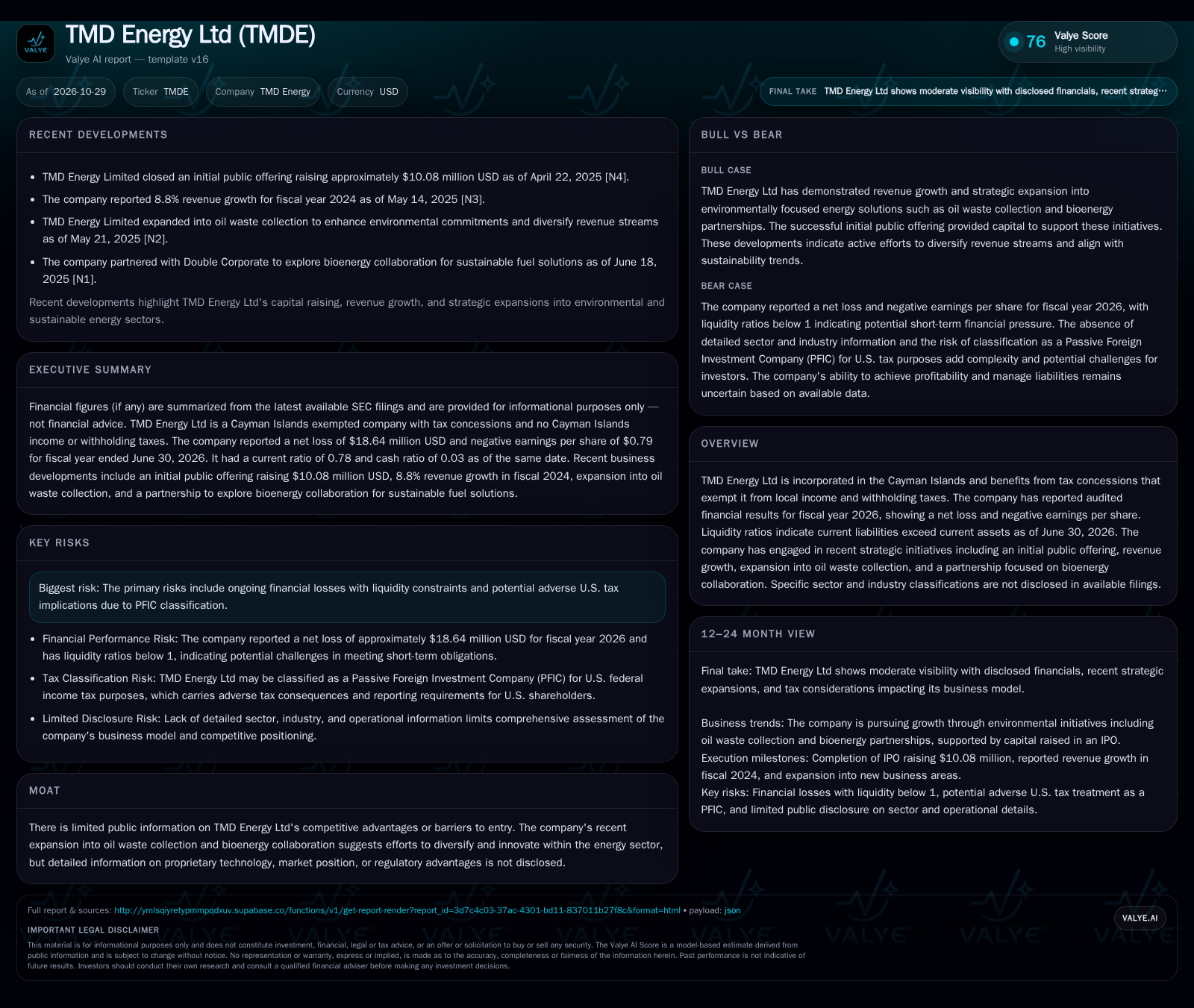
TMD Energy Ltd reported a net loss of $18.64 million and a current ratio well below 1 as of June 2026, despite recent revenue growth and new environmental initiatives. The company’s expansion into oil waste collection and bioenergy collaborations signal a push toward sustainability and revenue diversification, but cash resources remain limited. The main thesis hinges on whether these strategic moves can yield stable, profitable growth before liquidity pressures intensify. [S1] [N1] [N2] [N3]
TMD Energy Ltd is at a strategic crossroads: while it has posted recent revenue gains and taken visible steps to diversify through environmental initiatives, its financial statements reveal persistent losses and a precarious liquidity position. The company’s foray into oil waste collection and bioenergy partnerships could open new growth avenues in a rapidly evolving energy sector, but the success of these moves will depend on execution, capital access, and the ability to convert sustainability commitments into durable, profitable revenue streams.
Current Financial Strains and Strategic Shifts Define TMD Energy’s Position
As of June 30, 2026, TMD Energy Ltd reported a net loss of $18.64 million and negative earnings per share of -$0.79, with cash and cash equivalents at $3.99 million. The company reported cash and liquidity metrics for the period; these figures do not by themselves establish operating runway, investment capacity, financial flexibility, or financing capacity. [S1] These financial constraints are material: they limit operating flexibility and increase the urgency for new revenue sources or external funding.
Despite these pressures, TMD Energy has pursued strategic expansion. It raised $10.08 million in its April 2025 IPO [N4], expanded into oil waste collection to diversify revenue and enhance environmental commitments [N2], and entered a partnership to explore bioenergy solutions [N1]. Meanwhile, fiscal 2024 revenue grew by 8.8% [N3], showing some topline momentum, though not yet translating into profitability.
Revenue Diversification and Margin Uncertainty in an Evolving Energy Model
TMD Energy’s revenue base appears to be transitioning from traditional energy activities toward environmental services such as oil waste collection and bioenergy collaboration. The economics of these new verticals are complex: oil waste collection can generate stable service revenues but often carries significant operational and regulatory costs, and margins depend on scale, contract structure, and local competitive intensity.
Bioenergy partnerships, if commercialized, could create recurring revenue streams—potentially through offtake agreements, technology licensing, or joint ventures. However, these models typically require upfront capital investment and long commercialization timelines, with returns highly sensitive to feedstock costs, energy pricing, and policy incentives.
The company’s fixed costs, reflected in ongoing net losses, suggest limited operating leverage at present scale. Unless revenue growth accelerates or cost structure improves, the company may need further capital infusions to sustain new initiatives or bridge the path to profitability. The recent IPO provided a temporary funding boost, but cash resources remain limited relative to liabilities [S1] [N4].
The transition toward environmental services introduces a shift in capital intensity and operational risk profiles compared to traditional energy production. Oil waste collection, while potentially generating steady cash flows, requires ongoing investments in specialized equipment, compliance systems, and skilled labor to meet evolving environmental regulations. These factors can constrain margin expansion unless scale efficiencies or contractual pricing mechanisms adequately compensate. Moreover, the bioenergy segment’s economics hinge on feedstock availability and cost volatility, which can materially affect gross margins. Policy frameworks such as renewable energy credits or carbon pricing could materially influence profitability, but their uncertain duration and scope add layers of risk to long-term financial planning.
Environmental Pivot Faces Established Players and Policy-Driven Dynamics
TMD Energy’s expansion into oil waste collection and bioenergy places it in a competitive landscape that includes established environmental service providers, integrated energy companies with sustainability divisions, and specialized bioenergy startups. Barriers to entry can be moderate: while local permitting, customer relationships, and regulatory compliance matter, these sectors often see intense price competition and commoditization, especially at smaller scale.
The company’s Cayman Islands incorporation and 20-year tax exemption confer some structural cost advantages, but these do not directly translate into operating or market advantages. Moreover, the risk of classification as a Passive Foreign Investment Company (PFIC) could complicate U.S. capital access by making the stock less attractive to certain U.S. investors [S1].
Differentiation could come from proprietary technology, unique customer relationships, or integrated service offerings—but no such advantages have been disclosed. The open question is whether TMD Energy can establish a defensible niche or will remain subject to the margin and contract pressures that define much of the environmental services sector.
Sustainability Initiatives Drive Profitable Growth and Capital Access
If TMD Energy successfully scales its oil waste collection business, secures recurring contracts, and commercializes bioenergy partnerships, the company could achieve a step-change in revenue quality and margin profile. This upside path would likely require: (1) winning multi-year service contracts with industrial or municipal clients; (2) leveraging technology or process efficiencies to improve unit economics; and (3) attracting further investment or credit based on demonstrated commercial traction.
Confirmation would come from reported backlog, multi-year contract wins, or partnership announcements transitioning from exploratory to revenue-generating. Disclosure of improved gross and operating margins, reduction in net loss, or a move to positive operating cash flow would further validate the thesis. Additionally, evidence of repeat business or expanded market share in targeted segments would indicate durable adoption.
Incremental Progress with Persistent Losses and Funding Needs
The most plausible near-term scenario is one of incremental revenue growth as new initiatives begin to contribute, but with ongoing net losses and continued liquidity constraints. Oil waste collection and bioenergy activities may add to the topline, but margins could remain thin amid competitive pricing and startup costs. The company may need to seek additional capital—whether through equity, debt, or strategic partnerships—to bridge operating deficits.
Confirmation of this scenario would include slow but steady revenue growth, continued negative operating cash flow, and further capital raises or credit arrangements. If disclosed, rising SG&A or R&D expenses without commensurate gross profit improvement would also support this view. Conversely, a rapid acceleration in contract wins or margin expansion would challenge the base-case assumption.
Liquidity Pressures Force Strategic Retrenchment or Dilution
Should revenue growth stall or if new ventures fail to achieve commercial traction, TMD Energy could face acute liquidity stress and be forced to retrench, divest assets, or pursue highly dilutive financings. [S1]
Evidence for this scenario would include delayed or cancelled growth initiatives, layoffs, asset sales, or announcements of urgent capital-raising under unfavorable terms. Escalating accounts payable, covenant breaches (if debt is incurred), or auditor going-concern warnings would further confirm downside risk. A lack of disclosed contract wins or revenue stagnation would also support this thesis.
Performance Benchmarks That Will Test TMD Energy’s Environmental Growth Thesis
Quarterly revenue growth rates for oil waste collection and bioenergy, if disclosed, to assess the traction of new business lines relative to legacy operations.
Gross margin trends and operating cash flow, which would indicate whether new initiatives are improving the company’s underlying economics.
Updates on contract wins, backlog, or long-term service agreements in environmental verticals, as these would signal recurring revenue potential.
Any subsequent capital raising or credit facility announcements, which would reveal the company’s ability to finance ongoing operations and growth.
Disclosure of customer concentration or major client renewals to evaluate revenue visibility and risk.
Progression of the Double Corporate bioenergy partnership from exploratory to commercial stage, including any revenue or investment commitments.
Changes in current and cash ratios, as persistent sub-1.0 levels would highlight ongoing liquidity risk.
Disclaimer: This is research-only, informational analysis and not investment advice. It may include AI-generated interpretation and general industry context. Always verify important details using primary sources.

Comments