
enVVeno Medical: Transitioning from Surgical to Transcatheter Solutions in Chronic Venous Insufficiency
enVVeno Medical Corp's pivot to the enVVe System—a minimally invasive, transcatheter venous valve—marks a strategic attempt to address severe Chronic Venous Insufficiency after regulatory setbacks with its initial VenoValve device.
enVVeno Medical is redirecting its focus from the surgically implanted VenoValve, which encountered FDA hurdles, to the pre-clinical enVVe System, a minimally invasive venous valve. [S2]
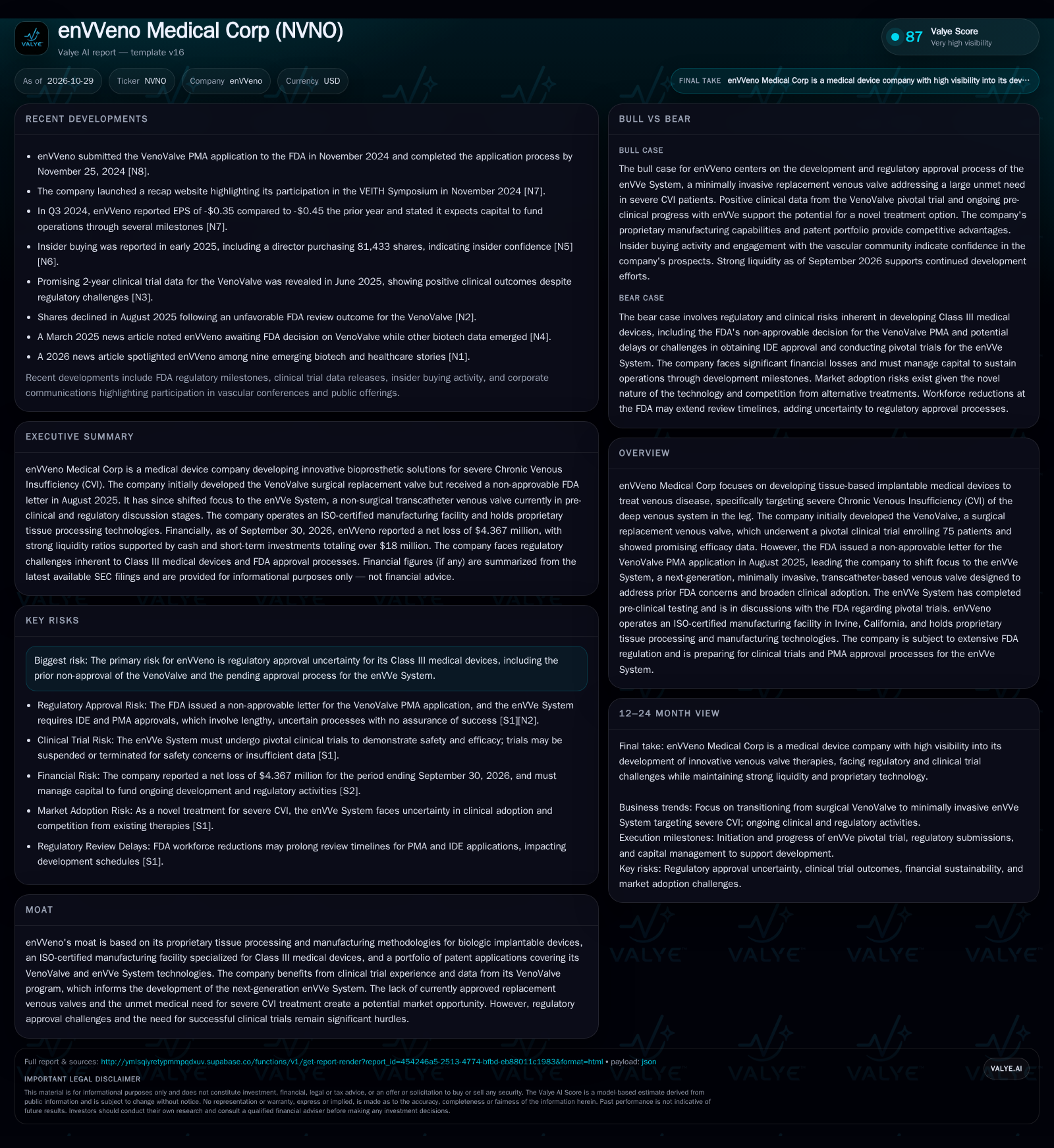
enVVeno Medical Corp stands at a critical juncture in the development of bioprosthetic venous valves for severe Chronic Venous Insufficiency (CVI). After its original VenoValve surgical device faced regulatory headwinds, the company has turned its attention to the enVVe System, a minimally invasive, transcatheter solution. Backed by proprietary tissue processing technology and an ISO-certified manufacturing platform, enVVeno’s prospects now depend on successful navigation of pre-clinical, clinical, and regulatory milestones.
Strategic Reset: From VenoValve Setbacks to enVVe System Ambitions
enVVeno Medical Corp’s most material recent developments center on a strategic shift following regulatory disappointment. The company’s initial product, the surgically implanted VenoValve, completed a pivotal trial with 75 patients but received an unfavorable FDA review in August 2025, stalling its pathway to approval. [N2] As a result, enVVeno is now prioritizing the enVVe System—a minimally invasive, transcatheter venous valve—currently in pre-clinical and regulatory preparation. [S2] [N5] [N6]
Commercialization Pathways and Cost Structure in Bioprosthetic Devices
enVVeno’s business model is typical of high-risk, high-reward medical device development: heavy upfront investment in R&D, clinical trials, and regulatory processes, with the prospect of high-margin product sales upon approval. The company’s ISO-certified facility and proprietary tissue processing technology suggest the potential for differentiated manufacturing economics if commercial scale is reached. In the context of venous valve replacements, pricing is likely to reflect the complexity and unmet need, potentially supporting premium reimbursement—if clinical data and regulatory approval are secured.
The shift from a surgically implanted device (VenoValve) to a minimally invasive, transcatheter system (enVVe) could materially expand the addressable market by lowering procedural risk, reducing hospital stays, and broadening the eligible patient pool. However, this also introduces new R&D and regulatory costs. Fixed costs (facility, specialized talent, regulatory compliance) are high until commercialization, after which operating leverage could be significant if adoption accelerates. Variable costs will likely be dominated by tissue processing and quality assurance. The company’s $18M+ cash balance provides a limited window for advancing enVVe through pre-clinical and early clinical stages, but additional capital raises may be required before commercial revenues materialize. [S2]
The transition to a transcatheter delivery platform not only affects market reach but also reshapes the cost dynamics associated with device deployment. Minimally invasive procedures generally require specialized catheterization labs and trained interventionalists, which may influence hospital adoption rates and reimbursement strategies. If enVVeno can demonstrate reduced overall healthcare costs through shorter hospital stays and faster patient recovery, payers may be more inclined to could support premium pricing. Conversely, if the procedural complexity or required infrastructure limits accessibility, the company may face challenges scaling adoption despite clinical benefits.
Manufacturing scale-up for bioprosthetic venous valves involves critical quality control challenges, especially in tissue sourcing, processing consistency, and sterility assurance. enVVeno’s proprietary tissue processing technology could create barriers to entry, but also necessitates substantial validation to satisfy regulatory scrutiny. The company must balance investment in automation and process optimization against the unpredictability of tissue supply and batch variability. If these factors are not effectively managed, production bottlenecks or cost overruns could erode margins and delay commercial launch.
Positioning Against Conventional Therapies and Emerging Device Rivals
enVVeno is attempting to create a first-mover advantage in an area of high unmet need: severe Chronic Venous Insufficiency (CVI) with no currently approved replacement venous valves. Its competitive position is underpinned by proprietary tissue processing, an ISO-certified Class III device facility, and a portfolio of patent applications covering both the VenoValve and the enVVe System. The company’s clinical trial experience and existing data from VenoValve may accelerate learning curves for the enVVe program.
However, competitive threats are evolving. Conventional therapies—compression, medication, and surgical interventions—remain the standard of care, but device-based solutions are an attractive target for both established medtech firms and startups. Should other entrants successfully navigate regulatory and clinical hurdles, enVVeno could face pressure on both pricing and adoption. The minimally invasive focus of the enVVe System may offer a relative advantage over surgical alternatives, but this will depend on clinical outcomes, ease of use, and demonstrated value to payers and clinicians.
If enVVe’s Clinical and Regulatory Milestones Unlock a New Standard of Care
The favorable scenario unfolds if enVVeno’s enVVe System demonstrates strong safety and efficacy in pivotal clinical trials, enabling smooth progression through IDE and PMA regulatory processes. Success would be confirmed by positive trial readouts, rapid regulatory approvals, and subsequent guideline adoption for severe CVI. In this case, the minimally invasive profile could drive broad adoption, especially among patients unsuitable for open surgery, supporting premium pricing and strong gross margins.
Early evidence of adoption—measured by procedure volumes, reimbursement wins, and clinician endorsements—would validate the commercial model. Confirmation would come from clinical trial milestones (IDE approval, pivotal trial enrollment/completion), regulatory submissions/approvals, and visible partnerships or distribution agreements. Falsification would occur if trials fail to demonstrate benefit or if regulatory agencies raise new safety or efficacy concerns.
Most Likely Trajectory: Incremental Progress Amid Clinical and Regulatory Uncertainty
The base case assumes enVVeno advances the enVVe System through pre-clinical work and secures IDE approval, but encounters the typical delays and iterative feedback that characterize novel device programs. Clinical trials proceed, but timelines extend due to regulatory caution, patient recruitment challenges, or evolving data requirements.
Validation of this scenario would come from steady progress in regulatory submissions, trial enrollment, and occasional positive interim data. Falsification would occur if significant safety issues emerge, if the FDA requires fundamentally new studies, or if the company exhausts its cash runway without reaching pivotal milestones.
Prolonged Delays or Negative Data Jeopardize the enVVe Program
The adverse scenario materializes if the enVVe System encounters significant setbacks: poor safety or efficacy signals in early trials, regulatory holds, or FDA requests for additional, costly studies. Workforce reductions at the FDA may further extend review timelines, compounding cash burn and increasing the risk that enVVeno’s funding is depleted before reaching inflection points.
Evidence supporting this scenario would include trial suspensions, negative safety events, lengthy regulatory holds, or public disclosures of capital constraints. Falsification would occur if the company maintains clinical and regulatory momentum and secures new funding or partnership support before cash becomes a constraint.
Milestones That Will Shape enVVeno’s Ability to Deliver Transformative CVI Solutions
Initiation and enrollment progress of the enVVe System’s pivotal clinical trial, if disclosed, will be critical to assessing development momentum.
Updates on IDE and PMA regulatory submissions and feedback from the FDA will clarify approval timelines and potential hurdles.
Cash utilization rates and runway projections, especially in relation to major development milestones, would help gauge the risk of near-term capital needs.
Insider transaction activity was reported in the cited source; this activity does not by itself establish insider confidence.
Evidence of partnerships or early commercial agreements with vascular surgeons, hospitals, or device distributors would signal external validation.
Published clinical data—interim or final—on the enVVe System’s safety and efficacy will be the primary driver of future value.
Competitive landscape updates, including new device approvals or pivotal data from rival programs, could sharply alter adoption and pricing dynamics.
Reimbursement progress or payer feedback, if disclosed, would help test the commercial viability of enVVe in real-world settings.
Disclaimer: This is research-only, informational analysis and not investment advice. It may include AI-generated interpretation and general industry context. Always verify important details using primary sources.

Comments