
PURE BIOSCIENCE: Proprietary Silver Antimicrobial Platform Versus Severe Liquidity Strain
PURE BIOSCIENCE’s SDC-based disinfectants and processing aids offer broad-spectrum, rapid, and environmentally friendly pathogen control, supported by regulatory approvals.
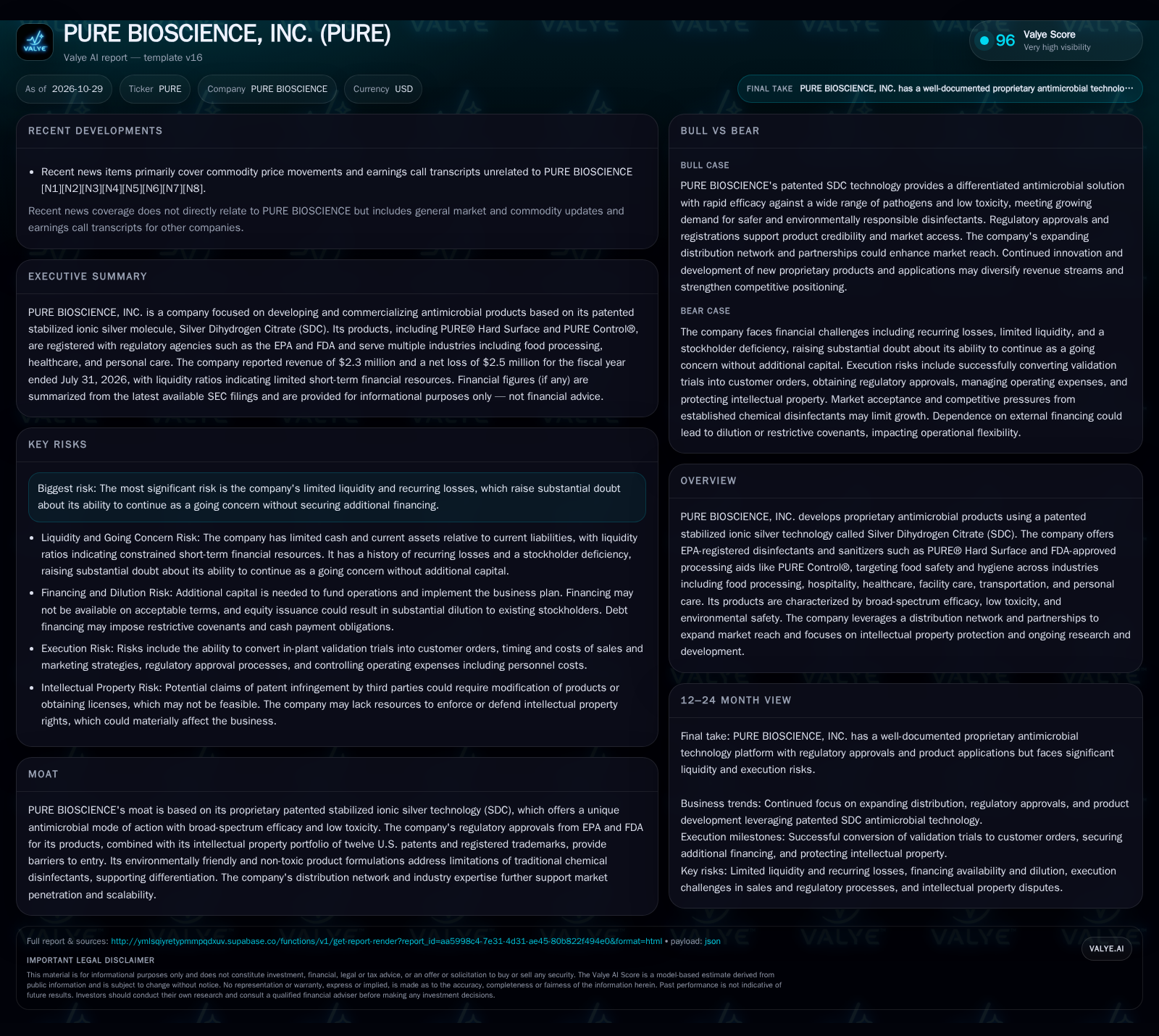
PURE BIOSCIENCE’s SDC-based disinfectants and processing aids offer broad-spectrum, rapid, and environmentally friendly pathogen control, supported by regulatory approvals. Execution risk is high, and the company’s future likely hinges on successful financing and the ability to convert product validation into meaningful recurring orders. [S1]
PURE BIOSCIENCE, INC. stands at a critical juncture: its patented stabilized ionic silver (SDC) platform underpins EPA- and FDA-approved antimicrobials with clear safety and efficacy differentiation, especially in food processing and hygiene markets. However, as of July 2026, the company’s $569,000 cash position and 0.27 current ratio underscore a severe liquidity crisis, with recurring losses and a sizable stockholder deficiency. The company’s near-term viability now rests on its ability to raise capital and execute on converting product trials into sustainable customer orders—while fending off execution, dilution, and competitive threats. [S1]
Liquidity Crisis and Execution Risk Dominate the Immediate Outlook
As of July 31, 2026, PURE BIOSCIENCE reported cash and equivalents of $569,000, current assets of $1,185,000, current liabilities of $4,371,000, and a current ratio of 0.27. Revenue for the fiscal year was $2.3 million, with a net loss of $2.5 million. The company’s stockholder deficiency stood at $5.8 million as of April 2026. These facts elevate going concern risk, make external financing a near-term necessity, and intensify the pressure to convert product validation into scalable commercial orders. [S1]
How Proprietary SDC Technology Could Drive Economics—If Commercialized at Scale
PURE BIOSCIENCE’s core economic engine is its SDC-based antimicrobial platform, which enables differentiated products with broad-spectrum efficacy, rapid pathogen kill, low toxicity, and environmental safety. If commercial adoption widens, the business could benefit from premium pricing relative to commodity disinfectants, especially in regulated or high-safety settings like food processing, healthcare, and hospitality. The cost structure likely features moderate fixed R&D and regulatory compliance costs, with variable costs tied to raw materials, production, and distribution. Margins could be attractive at scale due to the value proposition and IP protection, but current revenue scale is far too low to cover overhead, as evidenced by persistent net losses. The company’s dependence on external financing raises questions about dilution and future capital structure. [S1]
The business model appears to rely on a mix of direct sales and distribution partnerships. If the company can secure multi-year contracts or recurring customer orders, revenue visibility and gross margin leverage could improve. However, the current evidence does not establish contract structures or customer concentration, so the recurring nature of revenue remains to be demonstrated.
The scalability of PURE BIOSCIENCE’s SDC technology is contingent on several interrelated factors that influence unit economics and operational leverage. For instance, the extent to which raw material costs can be optimized through bulk procurement or alternative sourcing strategies will directly affect gross margins. Additionally, manufacturing scale could reduce per-unit costs, but only if fixed overheads such as quality control and compliance infrastructure are efficiently managed. The company’s ability to leverage its intellectual property to negotiate favorable licensing agreements or partnerships might also diversify revenue streams and mitigate capital intensity. However, these economic benefits hinge on successful market penetration and sustained customer adoption, which remain uncertain given the nascent stage of commercialization.
Moreover, the company’s cost structure is likely sensitive to regulatory compliance expenditures, which can fluctuate with the introduction of new product lines or entry into additional jurisdictions. This regulatory overhead may impose a step-function increase in fixed costs, particularly if clinical or environmental impact studies are required. Consequently, the timing and sequencing of product launches will be critical to managing cash flow and avoiding overextension. If the company can establish recurring revenue models—such as subscription-based supply contracts or long-term service agreements—this would enhance predictability and support more aggressive investment in sales and marketing. Without such revenue visibility, capital allocation decisions become riskier, potentially deterring investors and partners.
Differentiation Versus Entrenched Chemical Disinfectants and Market Adoption Barriers
PURE’s competitive advantage stems from its patented SDC molecule, which offers rapid, broad-spectrum antimicrobial efficacy, non-toxicity, and environmental benefits—addressing key limitations of chlorine, quats, and other conventional chemical disinfectants. Regulatory approvals from the EPA and FDA for core products further support credibility and access in regulated markets. The company’s IP portfolio of twelve U.S. patents and registered trademarks creates legal barriers to direct imitation.
However, PURE faces formidable competition from established chemical suppliers with entrenched distribution, customer relationships, and scale advantages. The adoption curve in food processing and healthcare is typically slow, as customers require robust validation, regulatory compliance, and switching assurance. Incumbent chemical products are often cheaper and benefit from familiarity and bulk purchasing agreements. If PURE’s products can demonstrably reduce operational risks or regulatory burdens (e.g., foodborne illness outbreaks, worker safety), they may justify premium pricing and drive adoption—but proof of large-scale customer conversion is still pending.
Substitution risk is moderate; while SDC offers unique benefits, customers may weigh cost, performance, and regulatory compatibility against the switching costs and potential retraining required.
The competitive landscape also shapes PURE’s potential to capture market share and justify premium pricing. While the patented SDC molecule offers unique antimicrobial properties, the entrenched incumbents benefit from established supply chains, volume discounts, and entrenched customer loyalty. This dynamic could increase switching costs for end-users, including retraining personnel, validating new protocols, and potential operational disruptions. Therefore, PURE’s value proposition must not only demonstrate superior efficacy but also quantifiable reductions in total cost of ownership or risk mitigation to overcome inertia. Strategic alliances with key distributors or integrators could be instrumental in lowering these barriers, but such partnerships require careful negotiation to preserve margin and brand integrity.
If Financing and Commercial Traction Align, PURE Could Scale Rapidly in High-Value Segments
A favorable scenario would see PURE swiftly securing sufficient external financing—minimizing dilution or restrictive debt terms—enabling it to fund operations, salesforce expansion, and regulatory initiatives. If the company can convert in-plant validation trials into recurring customer orders, especially with major food processors or healthcare providers, revenue could scale quickly due to the platform nature of SDC.
Upside confirmation would come from: 1) a successful capital raise on favorable terms; 2) public disclosure of new, sizable customer contracts or recurring order commitments; 3) evidence that sales and marketing investments are translating into accelerating revenue growth and improved gross margins; and 4) expansion of regulatory approvals or new product launches targeting adjacent markets. If PURE can demonstrate that its gross margin expands with scale and that cash burn is narrowing, the business could become self-funding and defensible, with its IP portfolio supporting durable differentiation.
Incremental Progress Dependent on Financing and Gradual Market Adoption
The most plausible path forward is one of incremental improvement, contingent on PURE’s ability to raise enough capital to sustain operations over the next twelve months. In this scenario, the company achieves modest success in converting validation trials into customer orders, resulting in slow but steady revenue growth. Operating losses persist but narrow as fixed costs are absorbed across a broader revenue base.
Base-case confirmation would involve: a completed financing round (even if dilutive); a visible uptick in sales to food processing and hospitality customers; and ongoing regulatory and product development milestones. Falsification would be indicated by failure to secure financing, continued stagnation in revenue, or customer attrition in core segments.
Acute Cash Shortfall Forces Strategic Contraction or Restructuring
In a negative scenario, PURE is unable to secure timely external capital, forcing it to curtail operations, delay R&D and regulatory filings, or enter into distressed asset sales or restructuring. The company risks defaulting on obligations and may be forced to accept highly dilutive funding or unfavorable debt terms, eroding shareholder value and operational flexibility.
Downside confirmation would be signaled by: missed payroll or supplier payments; public disclosures of going concern warnings escalating; abrupt reductions in workforce or R&D activity; or asset sales below book value. If PURE loses key IP protections, fails to defend patents, or sees regulatory setbacks, its competitive position could deteriorate further, making recovery challenging.
What Will Determine Whether PURE BIOSCIENCE’s Platform Delivers on Its Potential?
Progress in closing a meaningful financing round or securing non-dilutive external capital—public disclosure of terms, timing, and resulting cash runway would be pivotal.
Conversion rate of validation trials into recurring commercial orders, especially with large food processing or healthcare customers—if disclosed.
Quarterly revenue growth rates and gross margin trends, which would indicate whether scale and mix are improving business economics.
Updates on new or expanded regulatory approvals (domestic and international), which would broaden market access and support growth.
Any announcements of new product launches or expansion into adjacent verticals, signaling platform extensibility and addressable market expansion.
Intellectual property developments, including patent grants, challenges, or litigation outcomes, which directly affect competitive defensibility.
Changes in customer concentration or disclosure of multi-year contracts, which would enhance revenue visibility and test retention/switching cost hypotheses.
Disclaimer: This is research-only, informational analysis and not investment advice. It may include AI-generated interpretation and general industry context. Always verify important details using primary sources.

Comments