
TryHard Holdings: Event Innovation, Capital Flexibility, and the Challenge of Sustained Audience Engagement in Japan’s Entertainment Sector
TryHard Holdings leverages immersive event curation and new capital initiatives to expand its entertainment footprint in Japan, but must navigate a competitive, fast-evolving market and governance concentration amid modest event revenue contraction.
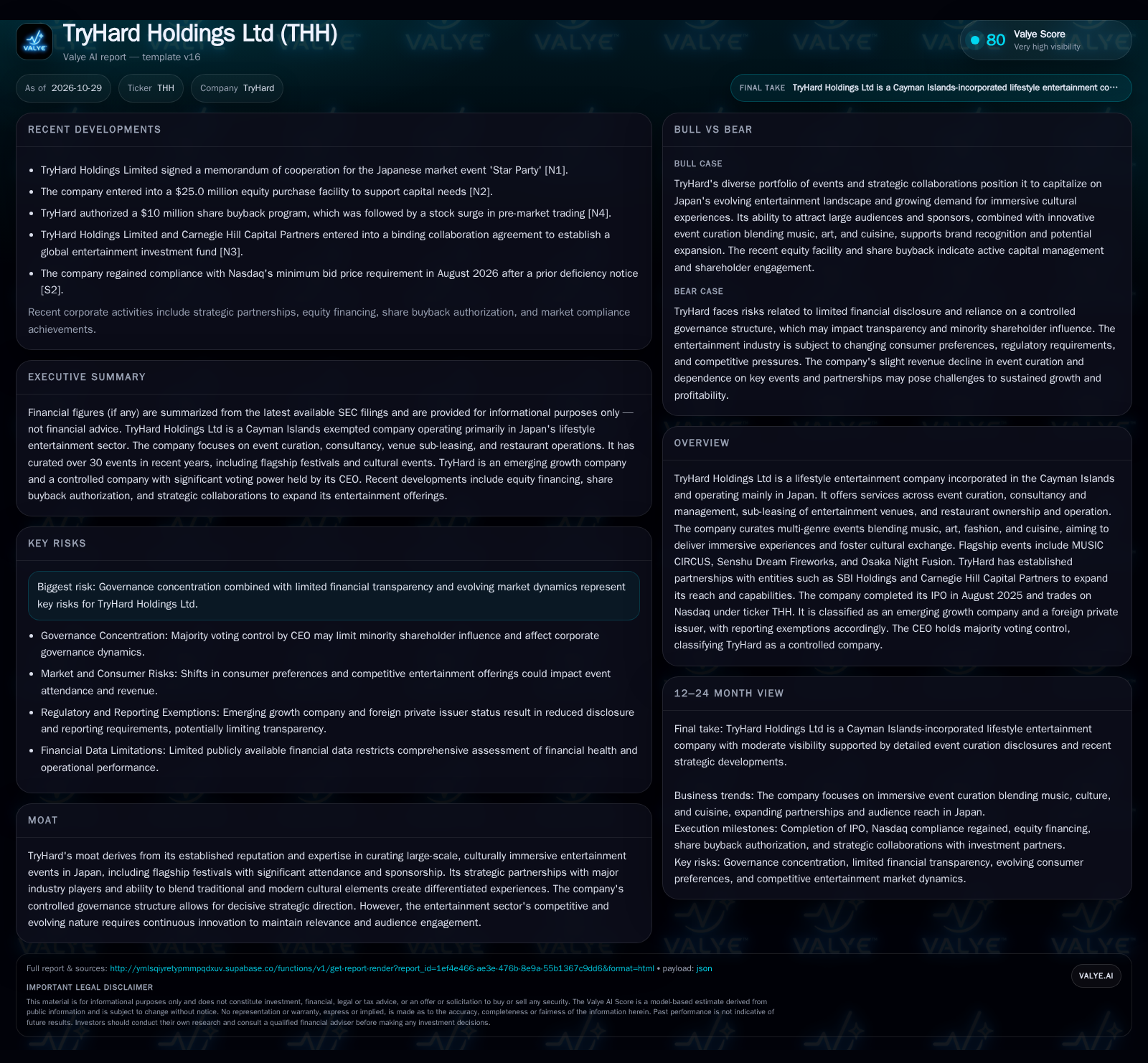
TryHard Holdings Ltd, a Cayman Islands-incorporated entertainment firm operating mainly in Japan, recently entered a $25 million equity facility, authorized a $10 million buyback, and signed new strategic collaborations. While it has a strong track record in large-scale event curation, event revenue slightly declined year-on-year. The company’s growth depends on its ability to innovate, attract audiences, and manage concentrated governance and limited financial transparency. [S1] [N2] [N4] [N3]
TryHard Holdings Ltd stands at the intersection of Japan’s vibrant live entertainment scene and a rapidly evolving capital market strategy. As a newly public company with a strong event curation pedigree—including flagship festivals and cultural showcases—the company is now leveraging new equity facilities and investment partnerships to drive growth. However, a slight decline in event revenue and the realities of concentrated governance highlight the importance of continuous innovation, diversified revenue streams, and transparent execution to achieve lasting relevance and shareholder value.
Recent Financial Moves and Event Revenue Trends Shape TryHard’s Strategic Landscape
TryHard Holdings Ltd generated approximately JPY 894.6 million in revenue from its event curation segment for the year ended June 30, 2026, a slight decrease from the previous year. This signals pressure on the company’s core business, possibly reflecting market competition, changing consumer preferences, or event-specific dynamics. [S1]
To bolster its capital position and support growth initiatives, TryHard recently entered into a $25 million equity purchase facility and authorized a $10 million share buyback. These moves suggest a dual focus on external funding flexibility and shareholder engagement. [N2] [N4]
Strategic collaborations—including a binding agreement with Carnegie Hill Capital Partners to establish a global entertainment investment fund—indicate ambitions beyond Japan and into broader entertainment investment. [N3]
TryHard’s governance remains highly concentrated, with CEO Mr. Otsuki controlling over 70% of voting power, which may impact decision-making speed but also raises questions around minority shareholder influence and transparency. [S1]
How Immersive Events and Diversified Offerings Can Drive Economics—If Execution Delivers
TryHard’s revenue model primarily revolves around curating and operating large-scale live events, providing consultancy and management services, sub-leasing entertainment venues, and running restaurants. Event curation is the largest segment, but its recent revenue contraction underscores the volatility and seasonality of live entertainment, where attendance, sponsorship, and ancillary sales (food, beverage, merchandise) drive top-line results. [S1]
The economics of event curation typically combine high fixed costs (venue, production, talent) with variable revenue tied to ticket sales, sponsorships, and on-site spending. When events are well-attended, operating leverage can be significant; underperformance, however, quickly erodes margins. Restaurant and venue sub-leasing operations can offer steadier, recurring cash flows, but may be lower-margin and more capital-intensive.
The $25 million equity facility suggests a need for flexible capital to fund new events, expand partnerships, or weather periods of lower cash generation. The authorized buyback could signal management’s view of undervaluation, or may simply be a tool for capital allocation in a volatile market. [N2] [N4]
As an emerging growth company and foreign private issuer, TryHard benefits from reduced reporting burdens, but this also limits external visibility into its cost structure, segment profitability, and cash flow resilience.
Differentiation Through Cultural Fusion—But Competitive Pressures and Substitution Loom
TryHard’s apparent moat is built on its ability to curate immersive, culturally rich events that blend music, art, fashion, and cuisine, creating differentiated experiences that stand out in Japan’s crowded entertainment landscape. Strong relationships with sponsors and strategic partners—such as SBI Holdings and Carnegie Hill Capital Partners—can enhance brand credibility and access to new audiences.
However, barriers to entry in event curation are moderate, with established local and international players, as well as digital and hybrid event formats, vying for consumer attention. The rise of online entertainment, streaming, and interactive digital experiences increases substitution risk, particularly among younger audiences. If TryHard cannot consistently deliver must-attend, unique live experiences, retention and pricing power could suffer.
Venue sub-leasing and restaurant operations face additional competition from hospitality and real estate peers, where differentiation is often driven by location, experience design, and operational efficiency rather than brand alone.
The company’s ability to scale successful event formats and leverage partnerships for cross-border expansion will be critical to maintaining relevance and margin.
Expanding the Event Ecosystem: How Strategic Partnerships Could Unlock Growth
A favorable trajectory for TryHard would see the company leveraging its new equity facility and investment fund partnership to curate higher-profile, larger-scale events—both in Japan and potentially abroad. Strategic collaborations could bring new sponsors, creative talent, and cross-promotional opportunities, deepening the moat around flagship events.
If the company can reverse the recent event revenue decline by launching new formats, expanding digital engagement, and capturing premium sponsorships, operating leverage could drive margin expansion. International expansion, particularly via the Carnegie Hill Capital Partners collaboration, could open new revenue streams and diversify geographic risk. [N3]
Confirmation of this scenario would come from a return to year-over-year event revenue growth, increased audience numbers, successful marquee event launches, and evidence of new cross-border ventures or investments. Robust disclosure around segment profitability and cash flow generation would further validate a sustainable growth story.
Maintaining Core Events Amid Modest Growth and Market Volatility
The most plausible trajectory for TryHard is continued reliance on its flagship events, with incremental innovation and ongoing partnerships supporting a stable but unexceptional revenue base. Event curation remains the economic engine, but volumes and pricing are pressured by competitive offerings and the unpredictability of consumer preferences.
New capital from the equity facility is deployed selectively—funding event refreshes, modest venue upgrades, or targeted restaurant investments—without transformative expansion. The buyback may provide some downside support for shares, but does not fundamentally alter operating momentum.
In this scenario, event revenue either stabilizes or declines slightly, with periodic spikes around successful festivals. The company retains brand relevance in Japan but does not achieve meaningful scale or diversification. Confirmation would come from flat or only modestly growing revenue, limited international activity, and continued concentration of governance.
Erosion of Audience Engagement and Governance Frictions Challenge Longevity
In a negative scenario, TryHard fails to offset competitive and substitution pressures, resulting in further declines in event attendance and sponsorship. Flagship events lose their cachet, and new launches struggle to gain traction. Fixed costs remain high, compressing margins and limiting reinvestment capacity.
Governance concentration becomes a liability if strategic missteps or transparency concerns emerge, leading to diminished investor confidence and difficulty raising capital—even with the equity facility in place. Partnerships may falter if performance disappoints or if minority shareholders become more vocal about oversight and disclosure.
Confirmation would include sustained event revenue contraction, declining attendance figures (if disclosed), negative margin trends, and any breakdown in key partnerships or collaborations. Persistent opacity in financial reporting and lack of progress on new initiatives would further support this scenario.
Testing TryHard’s Thesis: Event Health, Capital Deployment, and Strategic Execution
Event curation segment revenue growth or contraction on a year-over-year basis, particularly for flagship events.
Audience attendance data and sponsor participation rates at major events—if disclosed—would help test engagement and relevance.
Utilization and drawdown rate of the $25 million equity purchase facility, indicating actual capital needs and investment pace.
Updates on the launch, scale, and performance of the Carnegie Hill Capital Partners entertainment investment fund.
Progress in developing and monetizing new event formats or digital extensions beyond traditional live experiences.
Disclosure (if any) of segment-level operating margins and cash flow, clarifying fixed vs variable cost leverage.
Evidence of international expansion or cross-border event partnerships, validating the global growth narrative.
Governance or reporting changes that impact minority shareholder rights or transparency.
Disclaimer: This is research-only, informational analysis and not investment advice. It may include AI-generated interpretation and general industry context. Always verify important details using primary sources.

Comments