
Howmet Aerospace: Execution Strength and Cyclical Risks Shape Aerospace Supply Outlook
Howmet Aerospace has delivered robust Q3 2026 results, highlighted by profit growth, a significant new buyback authorization, and continued exposure to aerospace and defense cycles. The company’s ability to manage supply chain dependencies and customer concentration will determine whether recent financial strength translates into durable long-term value.
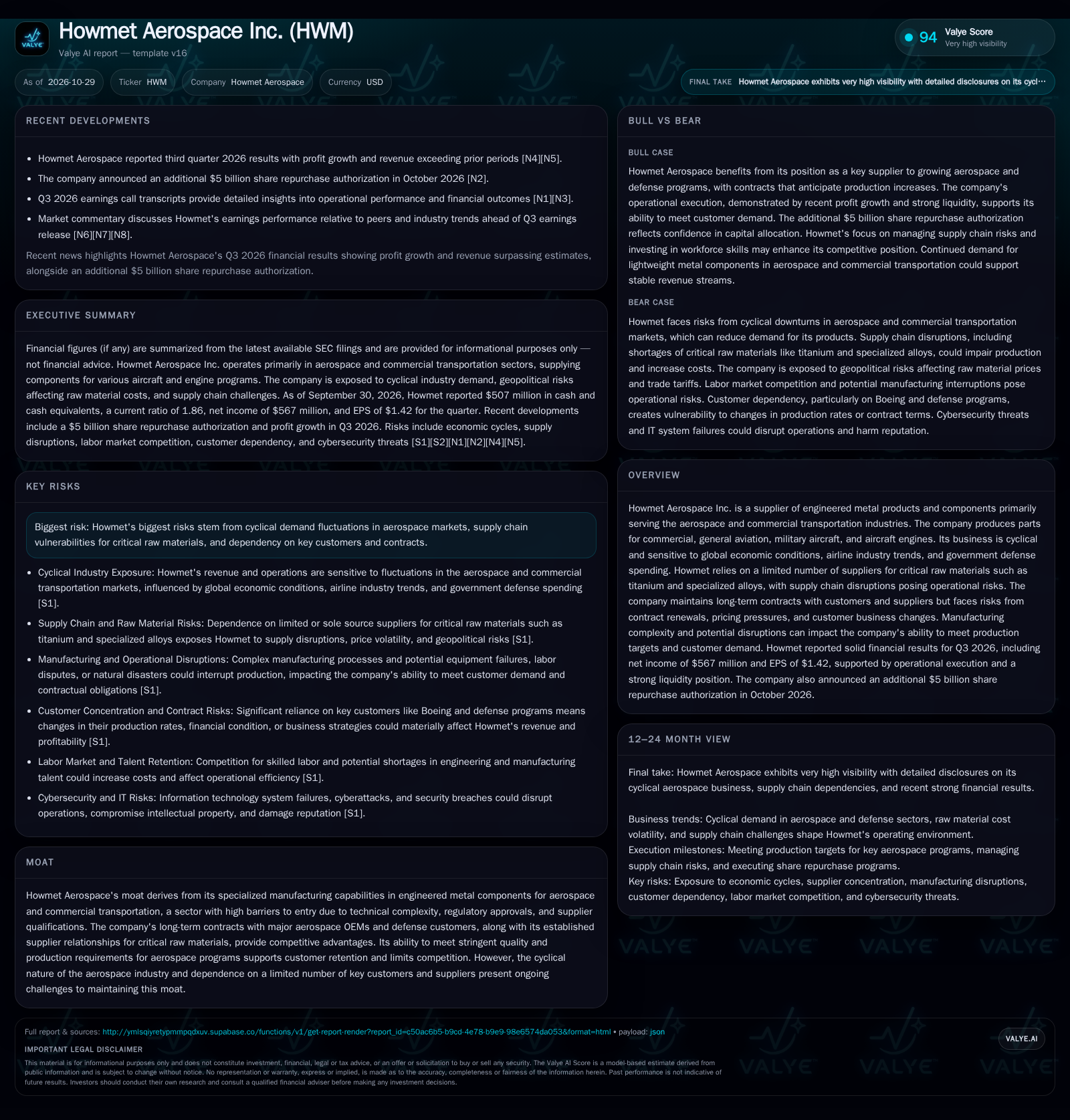
Howmet Aerospace reported strong Q3 2026 profit and exceeded revenue estimates, reflecting operational execution amid ongoing industry cyclicality and supply chain risk. However, the company remains exposed to fluctuations in aerospace demand, raw material sourcing, and key customer dynamics, with performance closely tied to Boeing and defense programs. Howmet's next phase will depend on navigating supplier concentration, manufacturing complexity, and maintaining production reliability in a volatile environment. [S2] [N2] [N4] [N5]
Yet beneath the headline numbers, the company’s fortunes remain closely linked to the cyclical dynamics of commercial and military aircraft production, as well as the ability to manage supply chain dependencies for high-specification metals. Howmet’s challenge is to convert short-term operational wins into sustainable, differentiated performance—even as customer concentration and input volatility persist as structural risks.
Howmet’s 2026 Outlook Shaped by Financial Performance and Capital Strategy
Howmet Aerospace reported Q3 2026 net income of $567 million and EPS of $1.42, surpassing analyst estimates and reflecting solid operational execution. This performance was supported by a current asset base of $4.1 billion against current liabilities of $2.2 billion as of September 30, 2026, resulting in a current ratio of 1.86. In October 2026, the company announced an additional $5 billion share repurchase authorization, following a 20% dividend increase earlier in the year. These capital allocation moves suggest management’s confidence in near-term cash generation and the business’s resilience, but also heighten scrutiny on whether recent momentum can be sustained given the company’s exposure to aerospace cycles, supply chain vulnerabilities, and customer concentration. [S2] [N2] [N4] [N5]
Industry Cyclicality Influences Revenue, Margins, and Investment Choices
Howmet generates revenue primarily by supplying engineered metal components—such as fasteners, castings, and forgings—to commercial, general aviation, and military aircraft programs, as well as commercial transportation. Pricing is generally determined by long-term contracts with major aerospace OEMs and defense customers, with annual or multi-year terms that can provide some revenue visibility but may also limit near-term pricing flexibility. Volume is tightly coupled to aircraft production rates and new program ramps, making the business highly sensitive to end-market demand cycles.
Gross margins in the aerospace components sector are typically driven by scale, manufacturing efficiency, and the ability to manage input costs—especially for critical materials like titanium, nickel, and superalloys, which are subject to price volatility and supply risk. Operating leverage can be significant when volumes rise, as incremental revenue often flows through at higher margins after fixed manufacturing costs are covered. However, the capital intensity of specialized manufacturing, ongoing investment in quality and compliance, and the need to maintain inventory buffers for supply chain security can constrain free cash flow in periods of raw material inflation or production disruption.
The cited source reports dividend-related activity; that disclosure alone does not establish dividend-policy continuity, management confidence, or a material constraint on capital flexibility. However, if aerospace demand softens or supply chain pressures mount, Howmet may need to prioritize working capital, raw material procurement, and capacity investments over further buybacks or dividends.
Evaluating Howmet’s Aerospace Supply Position Amid Competitive Pressures
Howmet’s competitive moat is rooted in its technical expertise, regulatory qualifications, and entrenched relationships with major aerospace and defense OEMs. The company’s ability to meet stringent quality and production requirements for mission-critical components creates switching frictions for customers, who face high costs and long lead times to qualify alternative suppliers. This is particularly true for parts that are integral to safety or performance, where failure is not an option.
However, the moat is not absolute. The cyclical nature of aerospace demand, dependence on a limited number of key customers (notably Boeing and defense programs), and reliance on sole or limited-source suppliers for critical raw materials expose Howmet to counterparty and supply-side shocks. While barriers to entry are high for new competitors, substitution risk exists from alternative materials (such as composites replacing certain metal parts) or vertical integration by large OEMs seeking more control over their supply chains. The company also faces ongoing pressure to improve cost, quality, and delivery in a sector where even established suppliers can lose share if they fail to execute.
Howmet’s competitive position will therefore depend on its ability to maintain preferred-supplier status, invest in manufacturing innovation, and manage customer and supply chain dependencies more effectively than peers.
Growth in Aircraft Production and Supply Chain Efficiencies Could Enhance Value
In a favorable scenario, global commercial air travel demand remains robust, supporting rising production rates for new aircraft platforms and driving sustained order flow to Howmet. Defense spending remains stable or grows, with new program wins offsetting any declines in legacy contracts. Howmet’s investments in supply chain resilience—such as securing long-term material contracts and diversifying supplier relationships—enable it to meet customer schedules without major disruptions or cost overruns.
Operating leverage would come into play as higher volumes absorb fixed costs, potentially expanding margins and free cash flow. If Howmet is able to maintain or grow share with key OEMs, leverage its technical and process expertise, and avoid significant manufacturing or supply chain interruptions, the company could deliver above-trend earnings and support continued capital returns through buybacks and dividends.
Evidence supporting this scenario would include multiple quarters of revenue and profit growth outpacing industry peers, positive commentary from major customers, minimal supply chain disruptions, and continued increases in shareholder returns.
Expected Operating Patterns Reflect Industry Cycles and Company Execution
The most plausible path for Howmet involves moderate growth in line with global aerospace production, tempered by periodic supply chain challenges and customer-driven order volatility. The company continues to fulfill long-term contracts with major OEMs, but faces intermittent pressure on input costs and the need to manage inventory and working capital closely. While Howmet maintains a solid competitive position, any gains in market share are incremental rather than transformative.
Margins remain healthy but fluctuate with raw material pricing and manufacturing efficiency. Customer concentration risk remains, with Howmet’s fortunes still closely tied to Boeing’s production schedules and defense program funding.
Confirmation of this scenario would come from steady, but not dramatic, revenue and profit growth, periodic references to supply chain management in earnings calls, and stable—rather than sharply rising—shareholder returns.
Earnings and Customer Impact Risks from Supply Interruptions and Raw Material Constraints
In an adverse scenario, a downturn in commercial aerospace demand—due to airline financial stress, regulatory delays, or macroeconomic headwinds—leads to lower aircraft build rates and reduced order flow to Howmet. Simultaneously, geopolitical events or supplier failures disrupt access to key raw materials like titanium and nickel, driving up costs and causing delays in fulfilling customer commitments.
If Howmet cannot quickly resolve these disruptions, it risks missing delivery deadlines, incurring penalties, or even losing preferred-supplier status with major OEMs. Fixed manufacturing costs would weigh on margins, and the company could be forced to curtail buybacks or dividends to preserve liquidity. Customer concentration magnifies the impact, as a single large customer’s decision to delay or cancel orders could materially affect results.
Signs this scenario is unfolding would include missed production targets, negative customer commentary, rising input costs not offset by pricing, and a reduction in capital returns to shareholders.
Factors That Will Influence Howmet’s Future Trajectory
Quarterly trends in aircraft production rates at major OEM customers, particularly Boeing, as these directly affect Howmet’s order volumes and revenue trajectory.
Reported supply chain disruptions, raw material shortages, or cost inflation—especially for titanium, nickel, and specialty alloys—which could impact gross margins and delivery schedules.
Any evidence of customer diversification or concentration, such as new long-term contracts with additional OEMs or increased reliance on a single large customer; a useful metric would be revenue share by top customers if disclosed.
Progress on manufacturing efficiency and cost reduction initiatives, as indicated by margin trends or management commentary in earnings calls.
Changes in capital allocation priorities—such as the pace and scale of share repurchases and dividend increases—relative to free cash flow generation and working capital requirements.
Incidents of missed contractual commitments, delivery delays, or penalties that could signal operational stress or risk to customer relationships.
Updates on Howmet’s ability to qualify new suppliers or secure alternative sources for critical raw materials, which would help test supply chain resilience.
Disclaimer: This is research-only, informational analysis and not investment advice. It may include AI-generated interpretation and general industry context. Always verify important details using primary sources.

Comments