
OSI Systems: Margin Expansion and Government Demand Set the Stage for Selective Growth, But Revenue Volatility Lurks
With a dominant security screening business, robust operating cash flow, and recent major government orders, OSI Systems is positioned to benefit from global infrastructure and defense investment. Yet, heavy reliance on project-based contracts and exposure to geopolitical and technological risks mean that revenue and margin swings remain a core reality.
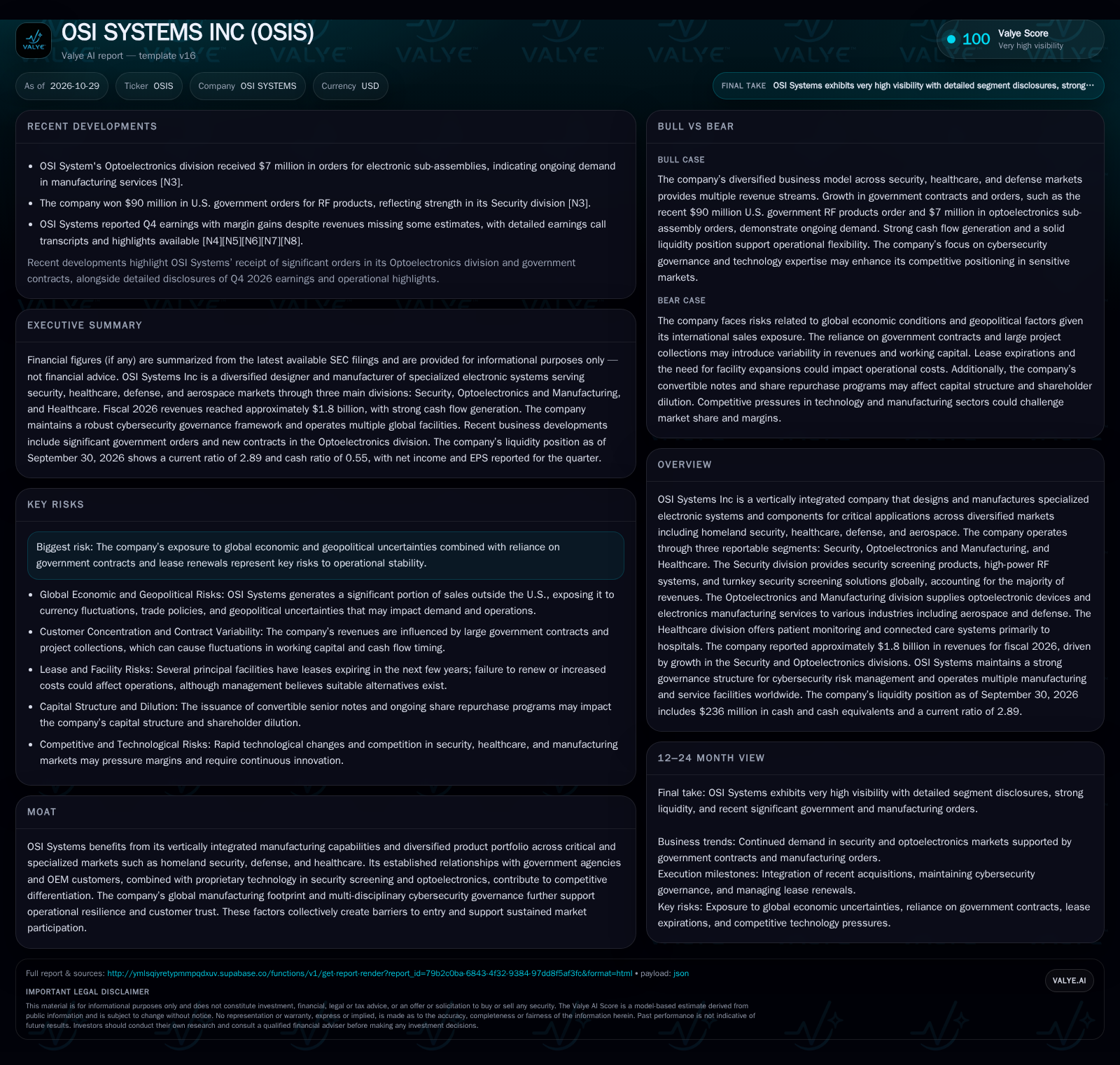
OSI Systems' fiscal 2026 results showcase strong operating cash flow and margin gains, primarily from its Security and Optoelectronics segments, with recent $90 million US government orders and $7 million sub-assembly wins highlighting ongoing demand. However, the company’s dependence on large government contracts, coupled with exposure to global economic and technology risks, means future performance is likely to remain variable and sensitive to external shocks. Margin expansion is a positive signal, but revenue predictability and competitive differentiation are key areas to watch. [S1] [S2] [N4] [N5] [N6] [N7] [N8]
OSI Systems enters late 2026 with clear strengths: a prominent position in global security screening, robust operating cash flow, and new multi-million-dollar government contract wins. The company’s margin gains in Q4 2026, despite revenue shortfalls, reflect disciplined execution and cost management. However, structural reliance on large government and infrastructure projects, plus exposure to volatile geopolitical and technology cycles, make OSI’s revenue trajectory inherently lumpy. The question for investors is whether recent order momentum and margin discipline can offset the persistent unpredictability tied to its project-based business model.
Recent Orders and Margin Gains Redefine OSI’s Near-Term Landscape
OSI Systems reported fiscal 2026 revenues of approximately $1.8 billion, with the Security segment accounting for about 70% of the total, reflecting the company’s heavy orientation toward global security screening and infrastructure projects. Notably, the Optoelectronics division secured $7 million in electronic sub-assembly orders and a significant $90 million in U.S. government contracts for RF products, underscoring persistent demand in defense and high-reliability electronics. Operating cash flow climbed to $275.9 million in fiscal 2026, driven by improved working capital and higher net income. In Q4 2026, OSI delivered margin expansion even though revenues missed some analyst estimates, signaling effective cost management and pricing discipline. [S1] [S2] [N4] [N5] [N6] [N7] [N8]
Project-Driven Economics and Margin Leverage in a Vertically Integrated Model
OSI Systems’ business model is anchored in high-value, project-based contracts—primarily in security screening and RF systems—where contract wins can rapidly shift revenue and margin profiles. The Security segment’s dominance means that government procurement cycles, infrastructure spending, and threat perception directly influence top-line growth. Pricing power in this space is often dictated by regulatory standards, technological sophistication, and the criticality of the application, offering scope for premium pricing but also subjecting the company to periodic rebidding and margin pressure.
Vertically integrated manufacturing allows OSI to control costs and quality, supporting gross margin improvement when volumes are high and mix skews toward proprietary solutions. The company’s operating leverage is evident in its ability to expand margins during periods of robust order activity, as seen in Q4 2026. However, the same leverage can magnify downside risk if large contracts are delayed or lost. The capital base is moderate, with recent convertible note issuance ($575 million due 2031) and share repurchases reflecting a balancing act between growth investment, capital return, and dilution management. Variable working capital needs are a feature, not a bug, of the model—especially given the lumpy nature of government and infrastructure contracts.
A critical factor influencing OSI Systems’ margin leverage is the timing and recognition of revenue from its project-based contracts. Because these contracts often span multiple quarters or years, the company must navigate complex accounting and forecasting challenges that can obscure near-term earnings visibility. The ability to manage contract milestones and cost-to-complete estimates accurately is essential to avoid unexpected margin compressions or earnings surprises. Moreover, the concentration of large contracts means that even minor deviations in project execution or client requirements can disproportionately affect profitability, highlighting the importance of robust project management and risk mitigation practices within the organization.
Defensible Niche, But Competitive and Technological Pressures Never Abate
OSI Systems’ competitive position is anchored by its proprietary technology in security screening, vertically integrated manufacturing, and longstanding relationships with government agencies and OEM customers. These factors create meaningful barriers to entry for smaller or less specialized players and support customer retention in critical infrastructure and defense applications. In optoelectronics and manufacturing, the company’s breadth allows it to serve multiple end-markets, reducing single-sector risk but also exposing it to diverse competitive dynamics.
The risk, however, is twofold: First, global defense and security markets are characterized by entrenched competitors (including large defense contractors and specialized security equipment providers) with deep pockets and aggressive R&D budgets. Second, rapid technological change—driven by advances in imaging, AI, and sensor integration—means that OSI must continuously innovate to avoid margin erosion and obsolescence. Healthcare remains a smaller contributor (about 9% of revenues), and while it offers diversification, it is not yet a core differentiator or growth engine.
In addition to technological innovation, OSI’s competitive resilience depends on its capacity to adapt to evolving procurement frameworks and compliance demands. Government and infrastructure customers increasingly emphasize cybersecurity, supply chain transparency, and sustainability criteria in vendor selection. OSI’s vertically integrated model may offer advantages in traceability and quality control, but it also requires continuous investment to meet these expanding standards. Failure to anticipate or respond effectively to regulatory shifts could constrain market access or increase costs, underscoring the need for proactive engagement with policy developments and customer expectations to sustain competitive advantage.
Sustained Government Infrastructure Investment Drives Multi-Year Growth
If global and US government infrastructure and defense spending remain robust, OSI Systems could experience a virtuous cycle: recurring large-scale orders in Security and Optoelectronics, operating leverage from higher facility utilization, and continued margin gains as proprietary technology maintains pricing power. The company’s strong cybersecurity governance and track record in sensitive applications may position it to win incremental share as digital security requirements intensify.
Falsification would come from a sudden contraction in government spending, loss of key contracts, or evidence of competitive displacement in core segments.
An additional dimension to potential growth lies in OSI’s ability to leverage its existing technology platforms into adjacent markets or applications. Should the company successfully commercialize incremental innovations or modular solutions that address emerging security challenges, it could diversify revenue streams while preserving margin profiles. This would require not only R&D investment but also strategic partnerships and agile go-to-market capabilities to capitalize on fast-evolving customer needs. If executed well, such expansion could reduce reliance on cyclical government spending and smooth revenue volatility inherent in large project wins, creating a more balanced and resilient growth trajectory.
Project Timing and Mix Drive Revenue Volatility, Margin Discipline Remains Key
The most plausible scenario for OSI Systems is continued growth in Security and Optoelectronics, punctuated by periodic revenue and working capital volatility tied to the timing and mix of large orders. The company is likely to maintain disciplined cost control, enabling modest margin improvements even if top-line growth is uneven. Healthcare remains a stabilizing but non-core contributor.
This scenario would be confirmed by ongoing quarterly margin stability or incremental expansion, steady (if lumpy) order flow in Security and Optoelectronics, and working capital management that avoids severe cash flow swings. It would be challenged by a material margin contraction, prolonged order droughts, or evidence that cost discipline cannot offset volume-driven fixed-cost absorption risks.
Contract Delays, Geopolitical Shocks, or Tech Displacement Trigger Margin Compression
Adverse outcomes could materialize if major government or infrastructure contracts are delayed, reduced, or lost—whether due to economic slowdown, geopolitical instability, or changing procurement priorities. Given OSI’s high operating leverage, such disruptions could lead to rapid margin compression and negative cash flow swings. Additionally, failure to keep pace with technological change (e.g., new security screening modalities or AI-driven competitors) could erode pricing power and market share.
Evidence for this scenario would include: a sharp drop in order backlog (if disclosed), significant revenue shortfalls without offsetting cost savings, or rising competitive losses in core segments. Deterioration in working capital metrics, especially if receivables or inventories spike relative to sales, would further confirm downside risk.
Benchmarks for Testing OSI’s Project-Driven Thesis and Margin Sustainability
Order backlog and pipeline visibility, particularly in the Security and Optoelectronics segments—if disclosed—would provide leading indicators of near-term revenue and margin direction.
Quarterly gross and operating margin trends, especially relative to revenue volatility, will test the company’s ability to manage costs and sustain pricing power.
Size, duration, and renewal rate of government contracts: A shift toward shorter or less frequent awards would signal heightened risk.
Working capital efficiency metrics such as days sales outstanding and inventory turnover, given their sensitivity to project timing.
Pace of technology refresh and R&D investment: Evidence of lagging innovation would raise red flags about future competitiveness.
Healthcare segment performance: While small, any acceleration or further contraction could affect the company’s diversification profile.
Capital allocation between share repurchases, debt service, and reinvestment: Shifts could indicate changing management priorities or confidence.
External factors such as changes in government procurement budgets, regulatory standards for security screening, or macroeconomic/geopolitical shocks.
Disclaimer: This is research-only, informational analysis and not investment advice. It may include AI-generated interpretation and general industry context. Always verify important details using primary sources.

Comments