
Dexcom’s Next Growth Phase: G7 Launch, Type 2 Market Expansion, and Strategic Execution
Dexcom’s Q3 2026 results, upcoming Canadian G7 launch, and strong CONNECT study outcomes highlight both the company’s operational momentum and the strategic complexity of scaling CGM adoption in Type 2 diabetes. The next test: Can Dexcom translate product innovation and regulatory wins into durable market share amid rising competition and evolving payer dynamics?
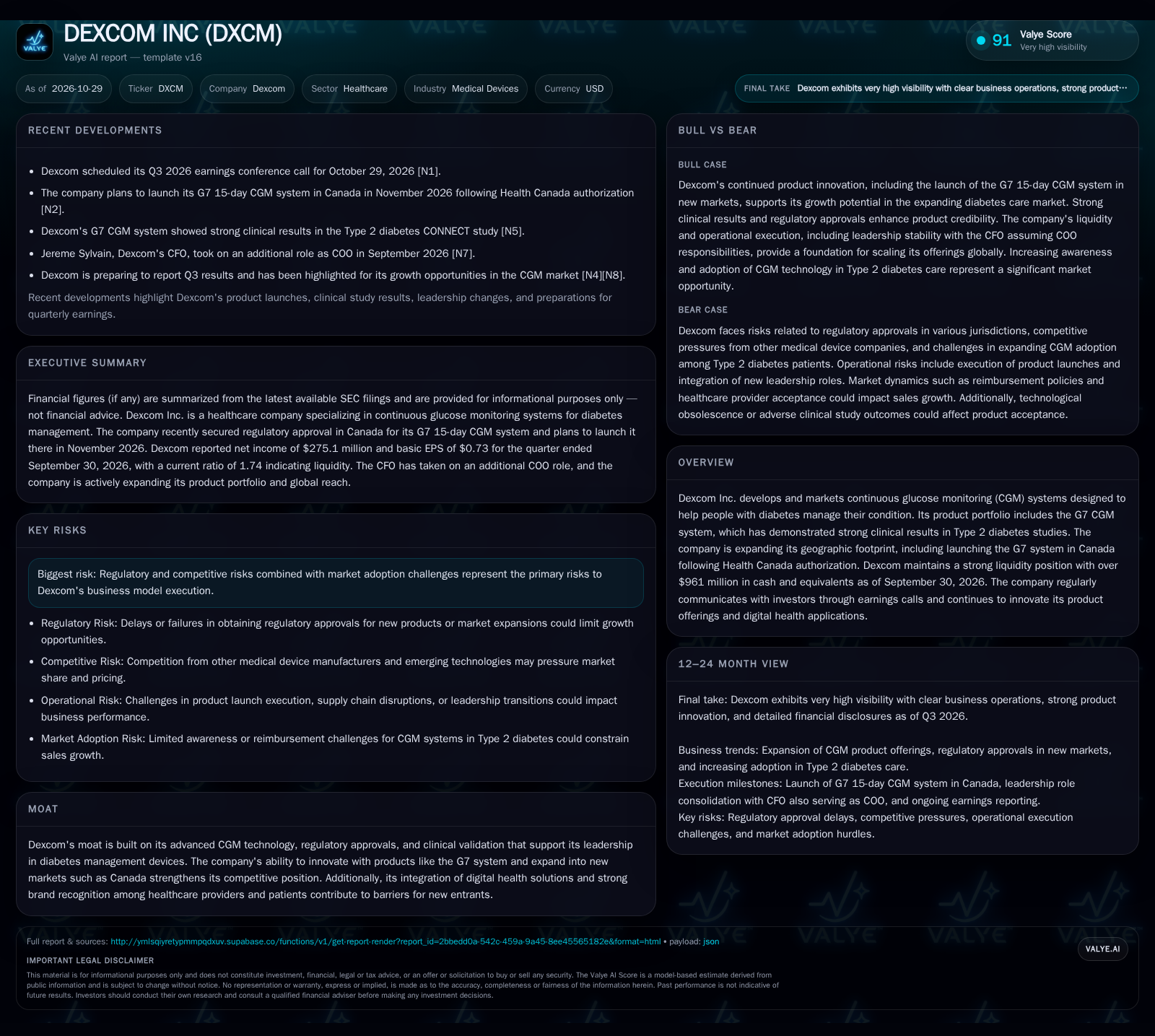
Dexcom is poised to launch its G7 CGM in Canada following Health Canada authorization, building on strong clinical outcomes in Type 2 diabetes and a robust Q3 2026 net income. The company’s liquidity stands out, and it is actively expanding its digital offerings and leadership structure. The central challenge remains: Can Dexcom drive sustained adoption, particularly in the less-penetrated Type 2 diabetes segment, while fending off intensifying competition and reimbursement pressures? [S2] [N2] [N5] [N7]
Dexcom’s latest quarter reflects a company at the intersection of product innovation, regulatory momentum, and the challenge of scaling adoption in a competitive, fast-evolving diabetes management market. With the G7 15-day CGM system set to debut in Canada and strong Type 2 diabetes trial results in hand, Dexcom is pushing aggressively into new geographies and patient populations. The company’s financial position and expanded leadership structure provide a platform for growth—but the real test will be Dexcom’s ability to convert clinical and regulatory wins into sustainable commercial success, particularly as rivals target the same expanding CGM opportunity.
Recent Milestones: Canadian G7 Approval, Type 2 Data, and Leadership Realignment
Dexcom secured Health Canada authorization for its G7 15-day continuous glucose monitoring (CGM) system, with a planned commercial launch in Canada in November 2026. This regulatory achievement represents a significant step in Dexcom’s strategy to grow outside its core U.S. market and address new patient populations. [N2] [S2]
The company’s G7 CGM system delivered strong results in the CONNECT clinical study focused on Type 2 diabetes, providing clinical evidence to support expansion beyond the historically more penetrated Type 1 diabetes segment. [N5]
For Q3 2026, Dexcom reported net income of $275.1 million and basic EPS of $0.73, with cash and equivalents of $961.4 million and a current ratio of 1.74 as of September 30, 2026. [S2]
Leadership structure has been consolidated, with CFO Jereme Sylvain also taking on the COO role as of September 2026, highlighting an internal focus on operational execution during a period of product and market expansion. [N7]
How Dexcom’s CGM Business Model Scales—and Where the Leverage Lies
Dexcom’s revenue model is anchored in the sale of CGM sensors and transmitters, with recurring revenue potential as patients require regular sensor replacements for continuous monitoring. The launch of the G7—which features a 15-day sensor life—may improve per-patient economics by increasing replacement frequency compared to legacy models, though actual realized pricing will depend on reimbursement, channel mix, and competitive discounting.
Gross margins in CGM are typically high due to the consumable nature of sensors, but the business demands significant investment in R&D, regulatory, and commercial infrastructure—especially as Dexcom expands internationally and targets the larger, but less penetrated, Type 2 diabetes market. Fixed costs related to manufacturing scale and digital platform development (such as the planned Stelo app rollout) could create operating leverage if adoption accelerates.
Working capital requirements are substantial, given the need to manage inventory, support large-scale product launches, and navigate reimbursement cycles. The company reported cash and liquidity metrics for the period; these figures do not by themselves establish operating runway, investment capacity, financial flexibility, or financing capacity. [S2]
Payer and provider acceptance is a key variable: the extent of insurance coverage and reimbursement rates will shape both top-line growth and net realized margins, particularly as Dexcom moves into broader Type 2 diabetes use where payer skepticism and lower per-patient spend are common.
Competitive Dynamics: Innovation Edge Versus Intensifying Market Pressure
Dexcom’s competitive position is underpinned by its advanced CGM technology, strong clinical validation (especially in Type 2 diabetes), and regulatory momentum. The Canadian G7 approval and strong CONNECT study data reinforce its innovation credentials and ability to navigate regulatory hurdles.
However, the CGM market is attracting significant competition from both established diabetes device players and new entrants, including those with integrated insulin delivery systems or lower-cost sensor offerings. Competitors are increasingly targeting the same expansion markets—particularly the large, underpenetrated Type 2 diabetes population—putting pressure on pricing, payer negotiations, and differentiation.
Switching costs for patients and providers can be moderate: while clinical workflow integration and patient familiarity create some stickiness, the lack of long-term contracts and the commoditization of CGM hardware could erode barriers if rivals achieve parity in accuracy, ease-of-use, or digital integration.
Dexcom’s digital health ecosystem ambitions, such as expanding app-based services and remote patient monitoring, offer potential for differentiation—but these features are also being pursued by competitors, making sustained product leadership and regulatory agility essential for maintaining share.
What Would It Take for Dexcom to Outpace Expectations?
The most favorable scenario for Dexcom is one in which rapid uptake of the G7 platform—particularly in new international markets and the Type 2 diabetes segment—drives both revenue acceleration and improved operating leverage. Strong payer acceptance and broad reimbursement would enable Dexcom to penetrate large pools of Type 2 patients who are not currently using CGM, expanding the addressable market well beyond historical trends.
Confirmation of this scenario would include evidence of robust G7 adoption in Canada and other new markets, positive updates on payer coverage for Type 2 CGM, and sustained margin expansion as fixed costs are leveraged over a larger revenue base. Additional upside could come from successful digital ecosystem expansion (e.g., Stelo app uptake) and new product launches that further differentiate Dexcom from rivals.
Falsification would occur if G7 adoption lags in new markets, if reimbursement wins are limited, or if competitive responses force Dexcom to cut prices or increase spending to maintain share, eroding margin gains.
Likeliest Trajectory: Growth Amid Adoption and Pricing Frictions
The most plausible outcome is that Dexcom continues to grow by expanding its CGM installed base—particularly as the G7 gains traction in established and select new markets—but faces ongoing friction in the Type 2 diabetes segment due to payer hesitancy and slower patient/provider adoption. Revenue growth may remain healthy, supported by incremental international expansion and ongoing product innovation, but gross margin improvement could be tempered by competitive pricing pressure and the need for higher sales and marketing investment.
Evidence for this scenario would be steady, but not explosive, growth in new market sales, modest increases in Type 2 patient adoption, and relatively stable gross margins. Reports of payer pushback, increased commercial spend, or slower-than-expected adoption in Canada and other new geographies would support this middle path.
A deviation from this scenario could be signaled by either a sharp inflection in adoption (supporting the upside case) or clear evidence of competitive displacement or reimbursement setbacks (supporting the downside).
Risks That Could Derail Dexcom’s Momentum
Dexcom’s thesis could be undermined if regulatory, competitive, or commercial challenges prevent the company from capitalizing on its G7 and Type 2 diabetes opportunities. Key risks include delayed or failed product launches in new markets (such as Canada), unfavorable reimbursement decisions that limit CGM coverage for Type 2 patients, and aggressive competitor actions that compress pricing or accelerate commoditization.
Confirmation of the downside scenario would include missed launch targets, negative clinical or real-world evidence undermining the G7’s value proposition, significant price erosion, or persistent inability to penetrate the Type 2 segment despite clinical validation. Operational missteps—such as supply chain disruptions, poor integration of new leadership roles, or failed digital health initiatives—could also contribute to underperformance.
A partial falsification of this scenario would be rapid, successful launches with strong payer support and evidence that Dexcom is maintaining or growing share despite competitive and reimbursement headwinds.
Milestones and Evidence That Will Shape Dexcom’s Next Chapter
Actual G7 adoption rates in Canada and subsequent international markets, especially in the first two quarters post-launch. [N2] [S2]
Updates on payer coverage and reimbursement wins for CGM in Type 2 diabetes populations, particularly in new geographies—if disclosed.
Reported growth or churn in the Type 2 diabetes user base for Dexcom’s CGM systems—a useful metric would be the proportion of new users from this segment.
Gross margin trends in the wake of G7 launches, as an indicator of pricing discipline versus competitive pressure—if disclosed.
Progress and uptake of Dexcom’s digital health applications, such as the Stelo app, and their impact on patient engagement and retention.
Evidence of operational execution and supply chain reliability during global rollouts, especially under the new CFO/COO dual leadership structure. [N7]
Any regulatory or clinical setbacks that could slow the pace of new product approvals or undermine confidence in CGM efficacy and safety.
Disclaimer: This is research-only, informational analysis and not investment advice. It may include AI-generated interpretation and general industry context. Always verify important details using primary sources.

Comments