
Rise Gold Corp.: Legal Battles, Asset Potential, and the Uncertain Path to Mine Redevelopment
Rise Gold Corp.’s Idaho-Maryland Mine project is at a legal crossroads: while the company controls a historically significant gold and tungsten asset and has secured new exploration and strategic partnerships, its future depends on the outcome of ongoing litigation after local permit denials. The interplay of regulatory hurdles, litigation strategy, and the broader U.S. critical minerals agenda will determine whether Rise Gold’s property becomes a productive mine or a legal claim for compensation.
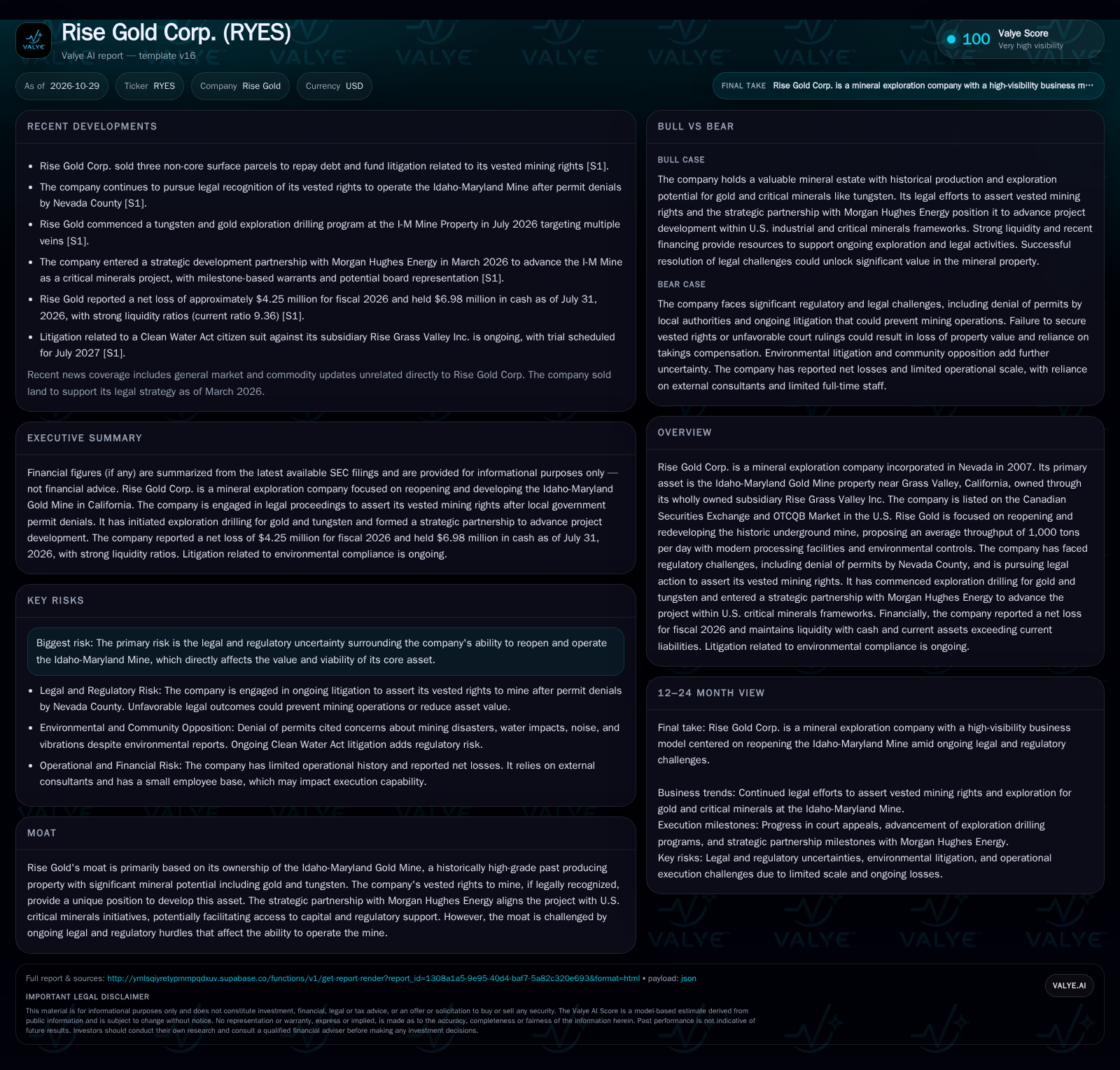
Rise Gold Corp. controls the Idaho-Maryland Gold Mine property and is pursuing both legal recognition of its mining rights and new exploration for gold and tungsten. After local authorities denied permits, Rise Gold lost its initial court bid and is appealing; failure could lead to a compensation lawsuit. The company has cash reserves and a strategic partnership, but litigation and regulatory uncertainty fundamentally shape its outlook. [S1]
Rise Gold Corp. stands at a pivotal juncture where the legal status of its Idaho-Maryland Mine property will likely determine the company’s future. Despite controlling a historically productive gold asset and initiating new gold/tungsten exploration, local permit denials and a recent court loss have blocked operational restart. With a strategic partner in Morgan Hughes Energy and sufficient cash to pursue legal and exploration strategies in the near term, Rise Gold’s outlook is ultimately shaped by the unpredictable intersection of litigation outcomes, regulatory dynamics, and the evolving U.S. critical minerals narrative.
Legal Setbacks and Asset Pursuits Define the Present
Rise Gold Corp.’s primary asset is the Idaho-Maryland Gold Mine near Grass Valley, California, a property with a legacy of high-grade gold production and exploration potential for both gold and tungsten. In fiscal 2026, the company commenced a new drilling program targeting multiple veins and entered a strategic partnership with Morgan Hughes Energy to advance the project as a U.S. critical minerals asset. [S1]
However, the company’s operational ambitions have been stymied by regulatory action: in late 2023 and early 2024, Nevada County denied both vested rights and use permits for mine reopening, citing environmental and safety concerns. Despite a Final Environmental Impact Report finding no significant impacts, legal proceedings have so far favored regulators. In May 2026, a court denied Rise Gold’s Writ of Mandamus to compel recognition of its mining rights; the company appealed in September 2026. If unsuccessful, Rise Gold plans to pursue a takings lawsuit seeking compensation for its mineral estate, conservatively valued at $400 million based on comparable mines and historic yield. [S1]
Financially, Rise Gold reported a net loss of $4.25 million for the fiscal year ended July 31, 2026, but held $6.98 million in cash and a current ratio of 9.36, providing resources for ongoing legal and exploration efforts. [S1]
Economic Model Hinges on Regulatory Unlock or Litigation Outcome
Rise Gold’s ability to generate revenue depends almost entirely on gaining the legal right to operate the Idaho-Maryland Mine. If mining operations are permitted, the company could monetize high-grade gold and potentially tungsten through underground extraction, using gravity and flotation processing to produce concentrates. The proposed throughput of 1,000 tons per day suggests potential scale, but capital requirements for mine development, processing facilities, environmental controls, and water treatment would be substantial and likely require further financing or partnership capital.
The economics of underground gold mining are characterized by high fixed costs (development, permitting, equipment) and high operating leverage: once operational, incremental production can drive significant margin expansion if gold prices are favorable and ore grades are maintained. However, the fixed cost base also creates risk if throughput or grades disappoint. The possibility of developing industrial-zoned land from barren rock and tailings could add a secondary revenue stream, but its value is contingent on project approval.
If the legal route fails, Rise Gold’s economic model pivots from mining to the pursuit of compensation for a regulatory takings claim. This would shift value realization from operational cash flows to the uncertain and potentially protracted process of litigation against the government, with outcomes dependent on legal precedent and valuation of mineral assets.
Strategic Asset, but Regulatory Hurdles Erode Competitive Edge
Rise Gold’s principal competitive advantage is its control of a historically productive and largely intact underground gold mine in California, a jurisdiction with attractive geology but increasingly complex permitting. The Idaho-Maryland property’s history and exploration data suggest above-average grades and multi-metal (gold and tungsten) potential—attributes that could command a premium if mining rights are secured.
The strategic partnership with Morgan Hughes Energy may help position the project within U.S. critical minerals frameworks, potentially improving access to capital, government support, or offtake agreements—especially as tungsten is on the U.S. list of critical minerals. However, these advantages are theoretical until legal and regulatory barriers are overcome.
Compared to peer junior miners and project developers, Rise Gold faces an unusually high regulatory hurdle: while many juniors struggle with permitting, few encounter outright permit denials and adverse court rulings at this stage. This regulatory overhang not only delays operations but may also deter potential investors or partners who would otherwise value the asset’s mineral potential.
Unlocking Mining Rights Could Catalyze Asset Value and Development
The most favorable scenario for Rise Gold involves a successful appeal or ultimate legal recognition of its vested mining rights, allowing the company to proceed with reopening the Idaho-Maryland Mine. In this case, Rise Gold could rapidly transition from litigation to mine development, leveraging its strategic partnership and recent exploration results to attract further investment and technical expertise.
Confirmation of this scenario would come from a court ruling in Rise Gold’s favor or a negotiated settlement with local authorities. Additional signals would include new project financing, accelerated hiring and procurement, and progress toward construction milestones. Gold price strength and U.S. policy support for critical minerals could further enhance project economics.
Falsification would be clear if courts definitively reject Rise Gold’s claims and no alternative permitting path emerges, or if community/political opposition remains intractable despite legal wins.
Protracted Legal Process with Uncertain Resolution and Delayed Value Realization
The most plausible path forward sees Rise Gold engaged in a lengthy legal process, with the timing and outcome of appeals and potential takings litigation uncertain. During this period, the company continues limited exploration and maintains its partnership with Morgan Hughes Energy, but major development is on hold pending legal clarity.
In this scenario, cash burn from legal, administrative, and exploration expenses continues, with periodic financing required if the legal process drags on. The market may continue to discount the asset, given the binary nature of the regulatory risk. Partial value realization could occur if Rise Gold secures partial rights, compensation, or an out-of-court settlement, but these outcomes are difficult to predict and would depend on legal precedent and political context.
Evidence supporting this scenario would be continued legal filings, absence of project development announcements, and stability in cash reserves with ongoing but limited operational activity.
Unfavorable Legal Outcomes and Asset Write-Downs
In the adverse scenario, Rise Gold exhausts its legal options without securing mining rights or meaningful compensation. Courts could reject both the appeal and any takings claim, or award compensation far below the company’s stated mineral estate valuation. Prolonged litigation could drain cash reserves, forcing asset sales, further dilution, or even insolvency if additional capital cannot be raised.
Operationally, this would leave the Idaho-Maryland Mine as a stranded asset, with sunk costs and no clear path to monetization. Environmental litigation, such as the ongoing Clean Water Act suit, could add further costs or restrictions.
Confirmation of this scenario would be final adverse court rulings, asset impairments or write-downs, and a shift in company communication from project development to asset recovery or wind-down strategies.
Milestones and Developments That Will Shape Rise Gold’s Trajectory
Outcome of the pending appeal regarding the Writ of Mandamus for vested mining rights recognition. A favorable court decision would be a clear positive inflection point. [S1]
Progress or resolution in the Clean Water Act citizen suit against Rise Grass Valley Inc., with trial scheduled for July 2027. The impact of this litigation on future permitting and operational risk is material. [S1]
Evidence of new exploration results or resource estimates from the ongoing gold and tungsten drilling program. If disclosed, these could affect asset value and partnership interest.
Milestones in the strategic partnership with Morgan Hughes Energy, such as exercise of milestone-based warrants, joint development announcements, or new regulatory/policy support.
Announcements regarding asset sales or changes in property ownership structure, which could indicate shifting strategy or liquidity needs.
Any new community or regulatory developments, such as changes in local political leadership, public referenda, or shifts in state/federal policy on critical minerals and permitting.
Disclaimer: This is research-only, informational analysis and not investment advice. It may include AI-generated interpretation and general industry context. Always verify important details using primary sources.

Comments