
Rivian’s Next Phase: Capital, Execution, and the High-Stakes Transition to Mainstream EV Markets
Rivian’s narrowed Q3 loss and 38% revenue growth highlight operational progress, but the company’s ability to access a $4.5 billion DOE loan and scale its R2 platform will determine whether it can transition from a niche player to a mass-market contender in electric vehicles.
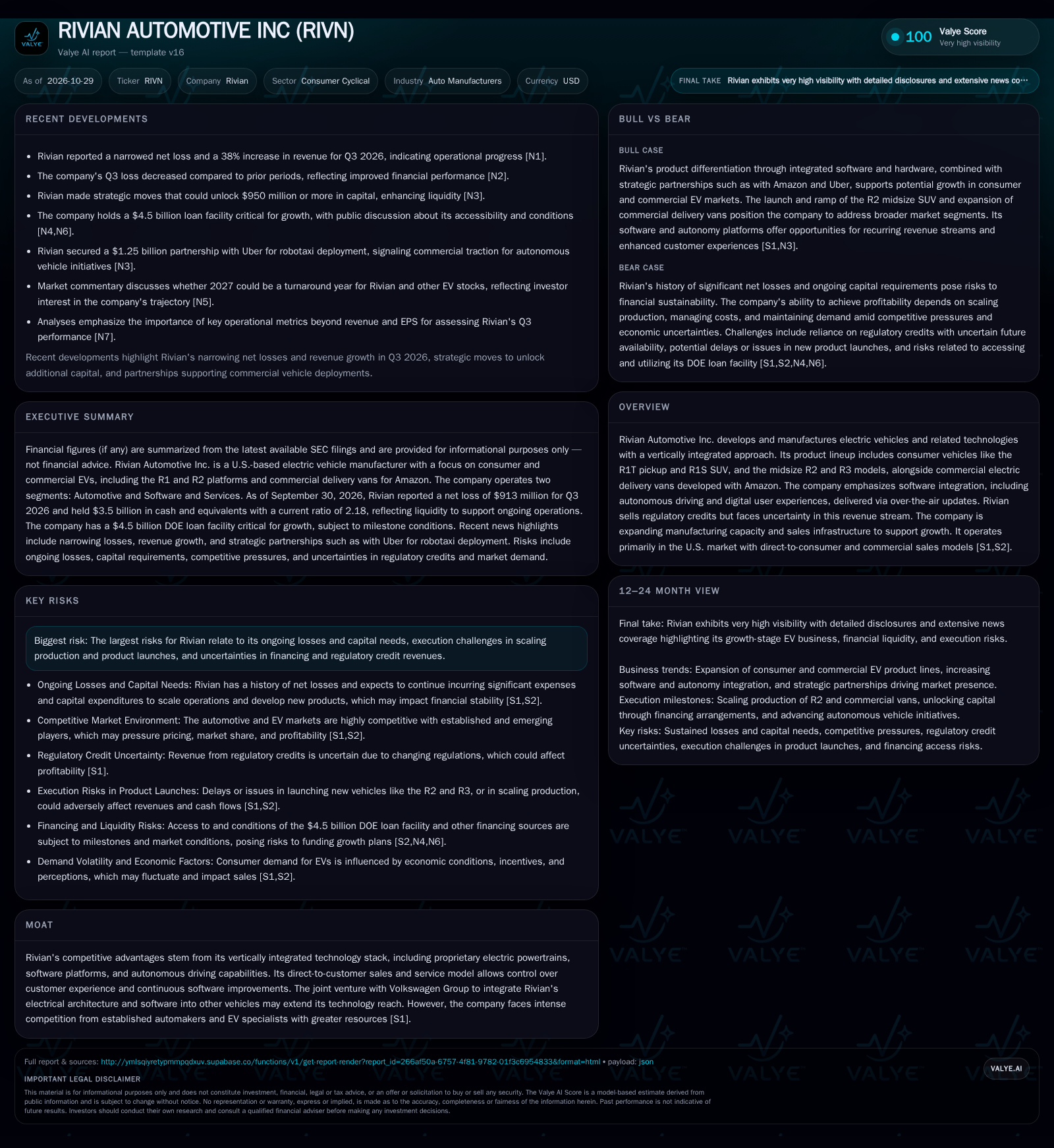
Rivian reported a Q3 2026 net loss of $913 million, improved from prior periods, and delivered 38% revenue growth, signaling progress in operational efficiency. The company’s cash and investments total over $5.5 billion, but sustained losses and the conditional nature of a $4.5 billion DOE loan make ongoing capital access a pivotal issue. The ramp-up of the R2 midsize platform and expansion in commercial vehicles—especially its Amazon partnership—offer growth, but execution risk remains high amid intensifying EV competition and uncertain regulatory credit revenues. The next 12-24 months hinge on Rivian’s ability to deliver new models at scale, control costs, and secure growth capital.
Rivian Automotive’s Q3 2026 results signal progress in its quest to become a mainstream electric vehicle manufacturer, with a sharply reduced net loss and robust revenue growth. Yet, these financial improvements are only a prelude to the company’s true test: delivering the R2 platform at scale, managing persistent losses, and securing essential growth capital. As the EV market becomes more crowded and consumers more discerning, Rivian’s ability to execute—particularly in accessing its $4.5 billion DOE loan and accelerating production—will decide whether it can move beyond its early adopter base to achieve durable, profitable growth.
Financial Progress Collides with Capital Reality in Q3 2026
Rivian reported a net loss of $913 million for Q3 2026—a clear improvement over previous quarters—while revenue surged by 38% year-over-year, indicating that scaling efforts and operational improvements are beginning to bear fruit [N1] [N2]. This narrowing loss is significant for a company with a history of heavy investment and persistent deficits, suggesting early signs of operating leverage as production ramps. However, Rivian remains unprofitable and continues to burn cash as it invests in new products and capacity.
The company reported cash and liquidity metrics for the period; these figures do not by themselves establish operating runway, investment capacity, financial flexibility, or financing capacity. [S2]
A $4.5 billion loan facility from the U.S. Department of Energy stands out as a potential lifeline for Rivian’s next growth phase, but its availability is tied to milestones and remains under scrutiny [S2] [N4] [N6]. The ability to access and deploy this capital will determine whether Rivian can continue scaling without disruptive capital raises or strategic pivots.
Decoding Rivian’s Cost Structure and Revenue Levers
Rivian’s business model is anchored in the development and sale of electric vehicles—including the R1T pickup, R1S SUV, and the new R2 platform—alongside commercial vehicles like the Amazon Electric Delivery Van (EDV) [S1]. The company also pursues software-driven revenue via autonomy features and connected services, though these are still emerging as material contributors.
Economically, the EV space demands high upfront capital outlays for manufacturing, R&D, and sales infrastructure, with gross margins initially pressured by underutilized factories and high per-unit costs. As production volumes increase, fixed costs are spread across more units, enabling operating leverage and, potentially, margin expansion. Rivian’s 38% revenue growth and narrowing losses suggest some early success in this direction, but the company has yet to demonstrate positive gross or operating margins at scale [N1] [N2].
Rivian’s commercial contracts, especially the Amazon EDV order (up to 100,000 vehicles globally, subject to modification), provide some volume visibility—but the commercial segment’s profitability depends on execution, contract terms, and the ability to avoid price concessions. Regulatory credits currently supplement revenue but are inherently unstable and exposed to policy changes [S1].
The company’s capital needs remain large, with the DOE loan facility pivotal for funding plant expansions, new model launches, and possibly software R&D. If Rivian can achieve higher utilization on new platforms (notably R2/R3), it may achieve the cost efficiencies needed to approach break-even.
Where Rivian Fits in the Intensifying EV Race
Rivian competes in a rapidly evolving market against traditional automakers pivoting to EVs, established EV specialists, and emerging startups [S1] [S2]. Its vertically integrated approach—combining proprietary electric powertrains, software, and direct-to-consumer sales—offers potential differentiation, particularly in customer experience and over-the-air update capabilities.
The company’s relationship with Amazon provides a commercial beachhead and a source of recurring orders, while partnerships such as the joint venture with Volkswagen Group could extend Rivian’s software and platform reach. However, these advantages are counteracted by rivals with greater scale, broader product portfolios, and deeper balance sheets.
Pricing pressure is intensifying as mainstream automakers and Chinese entrants push aggressively into the U.S. market with lower-cost EVs. Supply chain reliability, battery cost control, and the ability to ramp new models quickly will define long-term winners. Rivian’s success may hinge on its ability to execute flawlessly on R2 and maintain a technological lead in autonomy and digital experience—both areas where switching costs and customer lock-in could eventually emerge, but are not yet proven.
R2 Platform Success Unlocks Operating Leverage and Strategic Optionality
If Rivian executes a smooth R2 ramp—with strong delivery growth, high utilization rates at new facilities, and robust demand in the midsize SUV/crossover segment—the company could transition from high-burn to sustainable growth. This scenario would see the R2 platform achieve cost reductions through scale, with positive gross margins and accelerating cash flow improvement.
Commercial volume from Amazon and new partners could provide additional production stability, while maturing software and autonomy offerings may unlock higher-margin, recurring revenue streams. Regulatory credit volatility would become less material as core vehicle economics strengthen.
Evidence for this scenario would include sustained sequential delivery growth, improving gross margin per vehicle, positive free cash flow trends, and successful draws on the DOE loan tied to visible milestones. A major commercial contract win beyond Amazon or rapid consumer adoption of R2/R3 would further validate the upside.
Gradual Scale-Up and Persistent Losses as Market Pressures Mount
The most plausible outcome is that Rivian continues to grow deliveries and revenue, but at a pace that reflects the realities of a maturing, highly competitive EV market. The R2 ramp proceeds, but margin improvement is slow due to price competition, supply chain costs, and the need for promotional activity to drive adoption.
Regulatory credit revenue remains a modest tailwind, but not a core driver. The Amazon EDV contract continues to provide a commercial volume base, but further expansion is incremental rather than transformative. Software and autonomy revenues grow, but not enough to offset hardware cost pressures in the near term.
Rivian periodically taps its DOE loan and potentially raises additional capital as needed, but ongoing net losses persist through at least 2027. Confirmation would come from delivery and revenue growth in line with recent trends, gradual margin improvement, and continued capital raises or facility draws. Falsification would be a sharp reversal in demand, significant cost overruns, or failure to access planned funding.
Capital Constraints and Execution Stumbles Derail the Growth Story
In the adverse case, Rivian faces setbacks in R2 production—such as supply chain disruptions, quality issues, or tepid consumer demand—that prevent the company from achieving the necessary scale.
Commercial customers may delay or reduce orders, while regulatory credit revenues decline due to policy changes or increased competition from other zero-emission vehicle producers. The company may be forced to raise capital under unfavorable terms, scale back growth plans, or restructure operations.
This scenario would be confirmed by missed delivery targets, widening losses, negative cash flow trends, inability to access the DOE loan, or public announcements of retrenchment, layoffs, or program delays.
Milestones and Metrics That Will Shape Rivian’s EV Trajectory
Quarterly R2 platform delivery volume and production ramp versus guidance—evidence of scale and demand.
Gross margin per vehicle, especially for R2 and commercial lines, if disclosed—critical for break-even analysis.
Cash burn rate and free cash flow trends—will show whether improved operating leverage is materializing.
Progress toward and draws from the $4.5 billion DOE loan facility—confirmation of capital access and milestone achievement.
Updates on Amazon EDV order fulfillment and any new commercial contract wins or renewals.
Adoption and monetization rates for Rivian’s autonomy platform and connected services—if disclosed, evidence of software economics.
Disclosure of any new capital raises, credit facilities, or changes to investment plans indicating altered runway or strategic pivot.
Regulatory credit revenue trends and commentary on policy changes affecting credit markets.
Disclaimer: This is research-only, informational analysis and not investment advice. It may include AI-generated interpretation and general industry context. Always verify important details using primary sources.

Comments