
DaVita’s Dialysis Model: Navigating Volume Recovery, Reimbursement Sensitivity, and Sector Pressures
DaVita Inc. posts profit gains and treatment volume recovery, but its core economics remain highly exposed to reimbursement trends and operational leverage. With sector-wide regulatory and competitive uncertainties unresolved, the company’s ability to sustain earnings hinges on both execution and the evolving healthcare funding landscape.
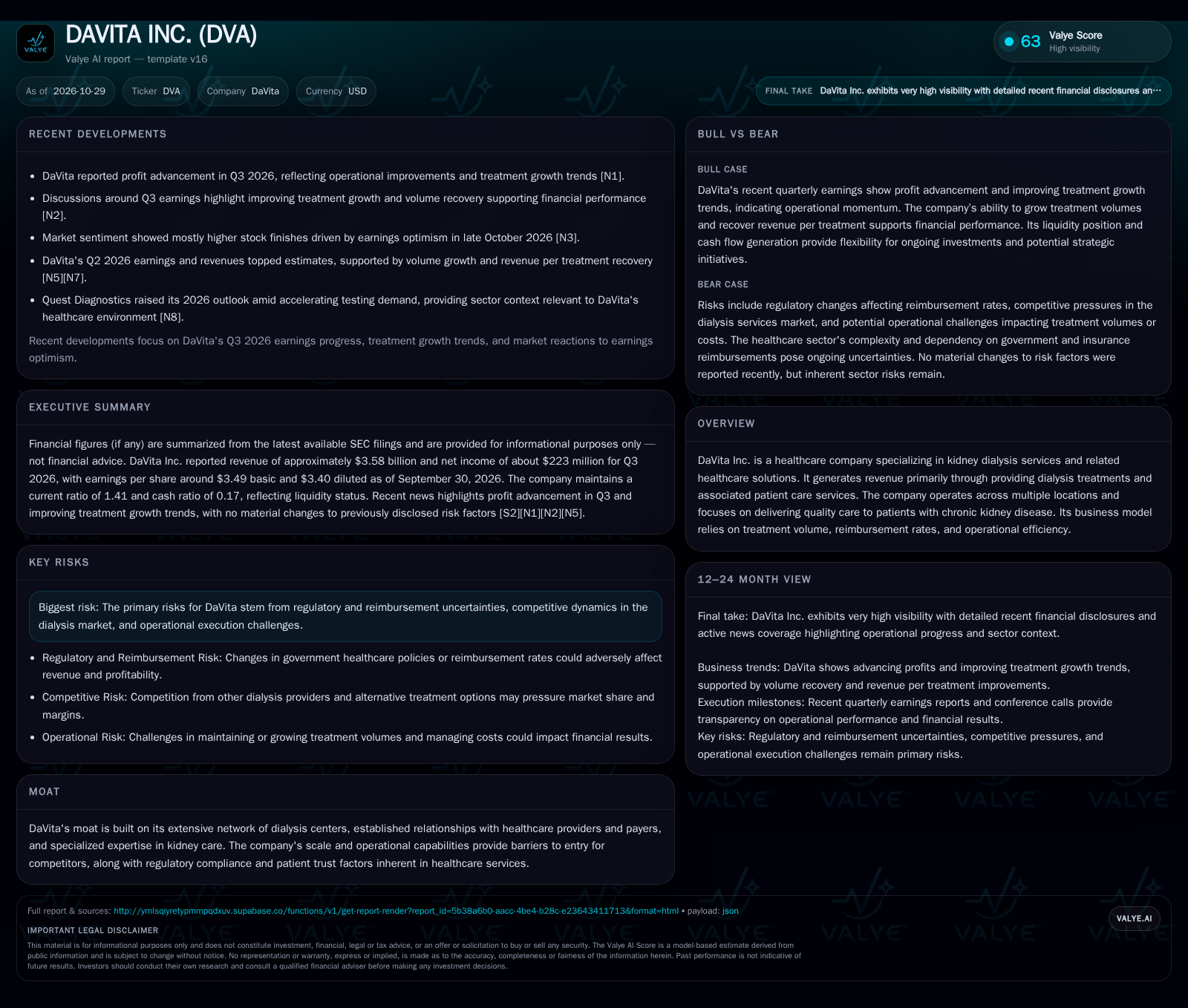
DaVita reported Q3 2026 revenue of $3.58 billion and net income of $223 million, supported by improving treatment volumes and recovery in revenue per treatment. While the company’s operational momentum is evident, its business remains deeply sensitive to reimbursement rates and sector competition. The path forward will depend on DaVita’s ability to control costs, grow volumes, and adapt to potential shifts in healthcare policy and payer dynamics. [S2] [N1] [N2] [N5] [N7]
DaVita Inc., a major U.S. provider of kidney dialysis services, has demonstrated profit growth and operational progress in 2026, with improving treatment volumes and revenue per treatment supporting its Q3 results. Yet, the company’s core economics remain deeply tethered to government and private payer reimbursement levels—a structural reality that shapes both upside and downside scenarios. As sector competition and regulatory headwinds persist, DaVita’s ability to manage costs, sustain volume growth, and navigate policy shifts will be central to its medium-term trajectory. Investors must weigh the operational momentum against persistent uncertainties in healthcare funding and competitive dynamics.
Profitability Returns as Treatment Volumes Rebound
DaVita reported Q3 2026 revenue of approximately $3.58 billion and net income of $223 million, translating to basic earnings per share of $3.49 and diluted EPS of $3.40 [S2]. These results reflect a period of profit advancement, with recent quarters showing improving treatment growth trends and a recovery in revenue per treatment [N1] [N2] [N5] [N7]. The company’s balance sheet as of September 30, 2026, includes $496 million in cash and cash equivalents, and a current ratio of 1.41 [S2]. There have been no material changes to DaVita’s disclosed risk factors since its 2025 annual report [S2]. This operational and financial context establishes DaVita’s current momentum while underscoring the ongoing relevance of regulatory and competitive risks.
Dialysis Economics: Volume, Reimbursement, and Operational Leverage
DaVita’s revenue model is fundamentally volume-driven: each dialysis treatment generates revenue, with aggregate financial performance determined by treatment counts, average revenue per treatment (RPT), and negotiated reimbursement rates. Fixed costs—staffing, facility leases, regulatory compliance—are high, making incremental volume growth disproportionately accretive to margins due to operating leverage. Conversely, any sustained volume decline or reimbursement cut can rapidly erode profits.
Reimbursement is a linchpin: A substantial portion of DaVita’s revenue is derived from government programs such as Medicare and Medicaid, where rates are set administratively and are subject to periodic adjustment. Commercial payers typically reimburse at higher rates, but shifts in payer mix, policy, or contract renegotiations could impact blended margins. The capital intensity of opening and maintaining dialysis centers requires ongoing investment, though mature centers can throw off substantial cash if volumes are stable or rising. The company reported cash and liquidity metrics for the period; these figures do not by themselves establish operating runway, investment capacity, financial flexibility, or financing capacity. [S2]
The interplay between fixed and variable costs in DaVita’s dialysis operations creates a pronounced sensitivity to fluctuations in treatment volume. Because a significant portion of expenses—such as facility overhead, equipment depreciation, and salaried staff—are fixed, incremental increases in patient treatments can disproportionately enhance profitability by spreading these costs over a larger revenue base. However, this operational leverage also means that volume declines can quickly erode earnings, as fixed costs remain largely unchanged while revenue contracts. Therefore, maintaining or growing treatment volumes is not just beneficial but essential to sustaining margin health.
Reimbursement dynamics extend beyond headline rates to encompass the complexity of payer mix and contract structures. For example, shifts toward a higher proportion of government-insured patients can compress average revenue per treatment due to typically lower Medicare and Medicaid rates compared to commercial payers. Additionally, periodic renegotiations may introduce tiered pricing, volume discounts, or quality-based adjustments that influence effective reimbursement. DaVita’s ability to manage these contractual nuances and optimize payer relationships is critical, as even marginal changes in blended reimbursement rates can materially impact overall profitability given the scale of treatment volumes.
Scale and Network Depth Versus Sector Headwinds
DaVita’s competitive position is anchored in its expansive national network of dialysis clinics, established relationships with nephrologists, and experience navigating complex regulatory requirements. This scale provides some barrier to entry for new providers and enables cost efficiencies in procurement and compliance. However, the dialysis services sector remains highly competitive, with other large chains and regional providers vying for contracts, patients, and payer deals.
Alternative treatment modalities—such as home dialysis and kidney transplantation—represent both a competitive threat and an opportunity, depending on DaVita’s ability to adapt its offerings and capture share in these segments. The company’s dependence on government reimbursement also means that policy shifts or new entrants able to deliver lower-cost care could erode its moat. While DaVita’s operational expertise and established infrastructure are strengths, the risk of reimbursement pressure and evolving care models remains persistent.
The competitive landscape also includes emerging care delivery models that could reshape patient preferences and payer incentives. Telehealth-enabled monitoring, integrated care pathways, and value-based reimbursement models may incentivize providers to shift away from traditional in-center dialysis toward more cost-effective or patient-centric alternatives. DaVita’s strategic response to these trends—whether through investment in home dialysis infrastructure, partnerships with nephrology networks, or adoption of innovative care management technologies—will influence its competitive resilience. Failure to adapt could accelerate patient attrition and revenue pressure, while proactive evolution may unlock new growth avenues and margin expansion.
What Could Drive Sustained Earnings Upside for DaVita?
A favorable scenario centers on continued recovery in treatment volumes, stable or improving reimbursement rates, and incremental margin expansion through cost control and operational efficiency. If DaVita can sustain or accelerate treatment growth—potentially by expanding its presence in home dialysis or specialty care—and maintain a favorable payer mix, operating leverage could drive outsized profit gains.
Evidence for this scenario would include multiple quarters of sequential volume growth, rising or stable revenue per treatment, and margin improvement outpacing sector peers. Confirmation would also come from new contract wins, successful expansion into higher-margin care settings, or favorable regulatory updates that protect or enhance reimbursement. Conversely, evidence of volume stagnation or reimbursement headwinds would challenge this upside.
The Likely Course: Margins Hold as Volume and Reimbursement Stabilize
The most plausible scenario is that DaVita maintains modest volume growth and stable reimbursement rates, resulting in steady but unspectacular earnings progression. Ongoing cost pressures—such as labor, supplies, and compliance—are likely to be offset by operational efficiencies and incremental pricing gains where possible.
Support for this base case would be found in continued quarterly profit stability, limited volatility in treatment volumes, and absence of major regulatory or competitive shocks. Falsification would come from either a material reimbursement reduction, a shift in payer mix toward lower-margin government programs, or a sustained decline in treatment counts.
How Reimbursement Cuts or Volume Slippage Could Pressure Results
A negative scenario would unfold if government or commercial payers reduce reimbursement rates, or if treatment volumes stagnate or decline—whether due to increased competition, patient migration to alternative modalities, or macroeconomic pressures limiting patient access. Given DaVita’s high fixed-cost base, even modest negative shifts could disproportionately impact earnings.
Confirmation of this scenario would include reported declines in revenue per treatment, negative volume trends, margin compression, or explicit management guidance about reimbursement pressures. Early warning signs could also include regulatory proposals to cut dialysis reimbursement, increasing patient churn, or higher-than-expected center closures.
Factors That Will Shape DaVita’s Earnings Power and Strategic Leeway
Quarterly trends in treatment volumes—a direct driver of revenue and margin leverage.
Revenue per treatment (RPT) trajectory, especially any change in underlying payer mix or contract terms.
Operating margin progression and cost-per-treatment trends, if disclosed.
Regulatory developments or policy proposals affecting Medicare/Medicaid reimbursement rates.
Evidence of success (or failure) in expanding home dialysis or other alternative care models.
New center openings, closures, or capacity utilization metrics—would help test growth and efficiency.
Payer contract renewals, renegotiations, or shifts in commercial versus government reimbursement share.
Material changes in labor costs, supply chain expenses, or regulatory compliance outlays.
Disclaimer: This is research-only, informational analysis and not investment advice. It may include AI-generated interpretation and general industry context. Always verify important details using primary sources.

Comments