
LKQ’s Strategic Crossroads: ERP Disruption, Segment Strain, and the Search for Operating Resilience
LKQ Corporation faces a pivotal period marked by ERP-driven disruptions in Europe, underperformance and goodwill impairment in its Specialty segment, and a leadership change with the suspension of strategic guidance. The company’s ability to restore operational momentum and redefine its path in the fragmented global vehicle parts aftermarket will shape its next phase.
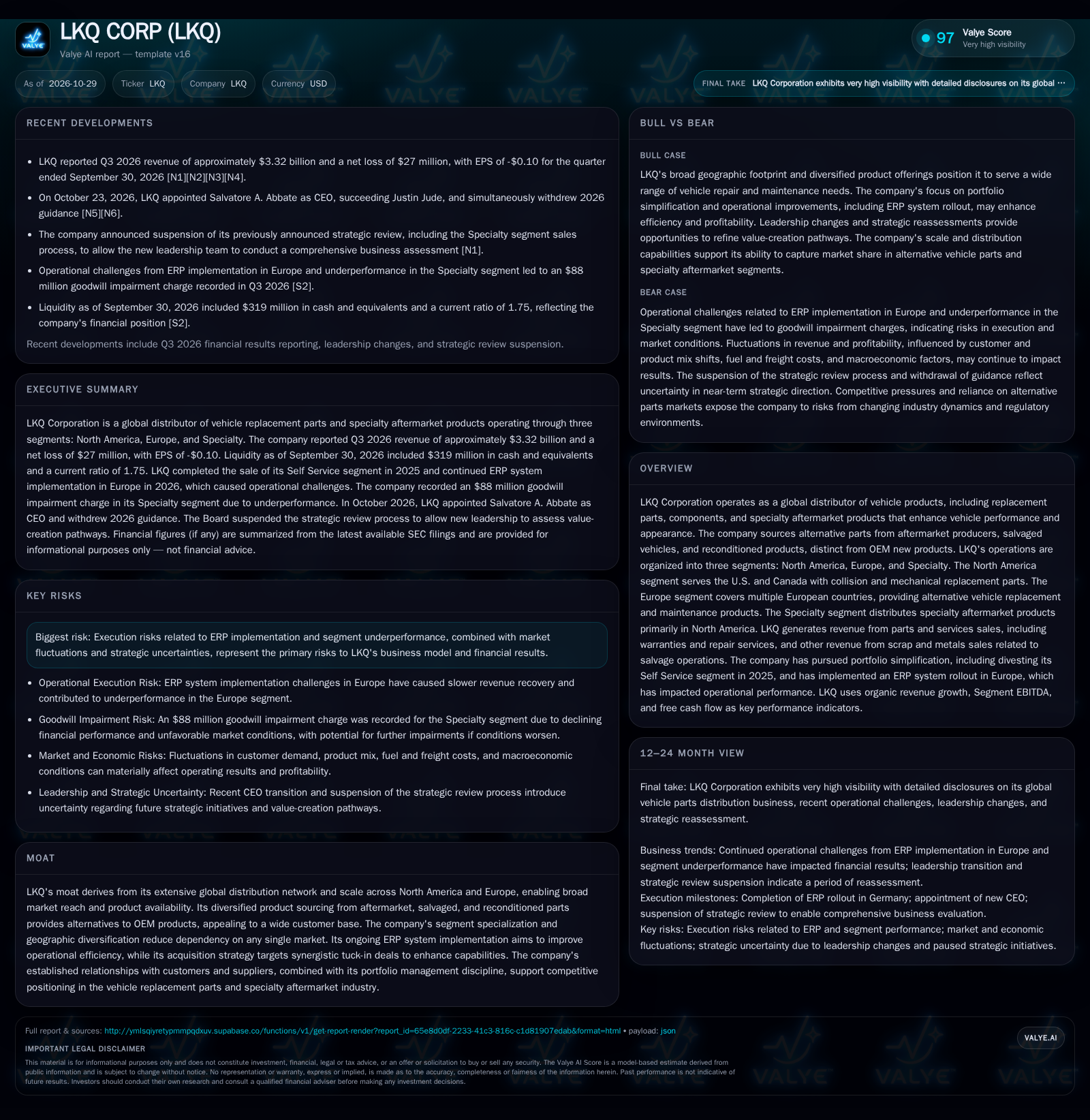
LKQ has entered a period of operational and strategic uncertainty after ERP implementation challenges in Europe, segment underperformance leading to an $88M goodwill impairment, and a CEO transition accompanied by the suspension of strategic guidance. The company’s cash position and current ratio remain neutral, but near-term visibility is reduced. LKQ’s recovery will hinge on the stabilization of its European operations, renewed Specialty segment performance, and the clarity brought by new leadership’s strategic assessment. [S2] [N5] [N6]
LKQ Corporation, a global distributor of alternative and specialty vehicle parts, is at a strategic inflection point. Operational turbulence from a major ERP rollout in Europe, underperformance in its Specialty segment leading to a significant goodwill impairment, and a sudden leadership change have converged to produce a period of financial and strategic uncertainty. With guidance withdrawn and a strategic review on hold, LKQ’s next moves—particularly under new CEO Salvatore Abbate—will determine whether the company can capitalize on its scale and diversified sourcing model or remain mired in execution and market challenges. The coming quarters will test LKQ’s ability to stabilize operations, extract value from its portfolio, and define a credible growth trajectory in a fragmented, cost-sensitive aftermarket landscape.
Leadership Transition and Operational Disruption Redefine LKQ’s Outlook
Three developments now shape LKQ’s near-term trajectory: 1) the company’s Q3 2026 revenue of $3.32 billion and net loss of $27 million, reflecting both operational challenges and a non-cash $88 million goodwill impairment in its Specialty segment; 2) persistent disruption from an ERP system rollout in Europe, which has slowed revenue recovery in that region; and 3) a CEO transition in October 2026, with Salvatore Abbate appointed and the company simultaneously withdrawing 2026 financial guidance and suspending its strategic review. These facts collectively signal a reset of both operational baselines and strategic direction, with near-term visibility now heavily dependent on new leadership’s assessment and stabilization of core segments. [S2] [N5] [N6] [N1]
How LKQ’s Multi-Sourced Aftermarket Model Generates—and Risks—Cash Flows
LKQ’s economics hinge on being a global distributor of non-OEM vehicle parts: alternative components sourced from aftermarket manufacturers, salvaged vehicles, and reconditioned/refurbished parts. This model, in theory, allows LKQ to offer lower-cost options for collision and mechanical repairs, targeting insurance-paid claims, repair shops, and value-oriented consumers. Revenue is primarily driven by parts volume and mix, with services (warranties, diagnostics) and scrap sales adding ancillary streams.
Gross margins in this business depend on effective sourcing (especially for salvage and reconditioned parts), logistics efficiency, and the ability to maintain a price/value gap relative to OEM parts. Fixed costs are significant in distribution, warehousing, and IT—recently amplified by the cost and disruption of ERP rollouts. Variable costs track volume but can spike with fuel, freight, and labor volatility. The operating leverage in this model is meaningful: incremental revenue, especially in mature North American markets, can drive substantial EBITDA improvement if fixed cost absorption is high and mix skews toward higher-margin specialty or reconditioned lines.
However, the recent impairment and segment underperformance highlight the risk that not all segments are equally resilient. Specialty aftermarket products, in particular, may be more exposed to discretionary demand and channel-specific volatility, reducing predictability. The ERP rollout, while intended to drive long-run efficiency, has imposed near-term costs and complexity, especially in Europe—undercutting the typical distribution scale advantages.
Distribution Scale and Sourcing Breadth: LKQ’s Edge—But Not an Unassailable Moat
LKQ’s core advantage lies in its broad distribution network across North America and Europe, supported by diverse sourcing from aftermarket, salvage, and reconditioned channels. This breadth enables wide product availability, rapid fulfillment, and the ability to serve both insurance-driven and retail repair segments. In North America, LKQ is a leading alternative to OEM channels, while in Europe, it competes in a more fragmented landscape with regional distributors and local independents.
However, these advantages are being tested. The ERP-driven operational challenges in Europe have exposed the complexity of integrating acquired businesses and harmonizing systems across geographies. Specialty segment underperformance suggests that product differentiation and channel strength are not universal across the portfolio. Competition from OEMs (increasingly offering competitively priced "genuine" parts), large regional distributors, and e-commerce entrants (including direct-from-manufacturer platforms) is intensifying, particularly as digitization lowers barriers for smaller players to reach repair shops and consumers directly.
Switching frictions for customers—repair shops, insurers, and DIY consumers—can be moderate, as price, availability, and logistical reliability matter more than brand loyalty. LKQ’s moat is thus functional and scale-based, rather than deeply entrenched by proprietary technology or exclusive distribution rights.
Restoring Operational Discipline and Segment Momentum Could Re-Establish Margin Expansion
A favorable scenario for LKQ would see the new CEO quickly diagnosing ERP-related disruptions in Europe, stabilizing operations, and restoring revenue growth in that region. If the Specialty segment rebounds—either through targeted restructuring, renewed product innovation, or improved channel execution—the $88 million impairment could prove a one-off reset rather than a harbinger of deeper structural decline.
Evidence confirming this upside would include: sequential improvement in European organic revenue growth; rising Segment EBITDA margins in both Europe and Specialty; renewed guidance or strategic clarity from management; and tangible signs of ERP-driven efficiency (such as lower SG&A as a percentage of sales or improved working capital turns). Additionally, successful tuck-in acquisitions or portfolio actions that enhance core capabilities without major integration risk would support the case for margin recovery and renewed cash flow generation.
Conversely, if operational execution lags or specialty demand remains weak, the upside scenario would be quickly falsified by continued margin compression or further impairments.
LKQ’s Most Probable Course: Prolonged Stabilization and Incremental Portfolio Adjustments
The most plausible near-term outlook is one of stabilization rather than rapid recovery. The ERP rollout in Europe is likely to continue causing operational friction, with incremental improvements as the system matures and local teams adapt. Revenue growth in Europe may remain below potential until these issues are fully resolved. Specialty segment performance may gradually improve if market conditions stabilize and targeted operational fixes are effective, but sustained outperformance appears unlikely given recent underperformance and the impairment charge.
Management, under new leadership, will likely prioritize internal assessment and operational discipline over bold strategic moves until greater clarity is achieved. Portfolio simplification—such as the completed Self Service divestiture—could continue if underperforming assets are identified, but large-scale M&A or divestitures seem unlikely until integration risk is better controlled.
Evidence supporting this scenario would include flat-to-moderate organic revenue growth, stable (but not expanding) margins, and cautious commentary from management regarding strategic direction. Falsification would require either a dramatic operational turnaround or a further deterioration in segment economics.
Persistent Execution Missteps and Segment Drag Could Trigger Further Value Erosion
A negative scenario would involve continued operational disruption in Europe—prolonged ERP issues, customer attrition, and sustained margin pressure. If the Specialty segment fails to recover, further goodwill impairments and potential asset write-downs could follow, eroding book value and investor confidence. In this scenario, LKQ could be forced into defensive cost-cutting, lose share to more nimble competitors, or face pressure to divest additional segments at unfavorable terms.
Confirmation of this downside would come from sequential revenue declines, additional impairment charges, negative free cash flow, or management resorting to restructuring announcements. If disclosed, rising customer churn, declining organic revenue, or persistent negative segment EBITDA would all signal a deepening of challenges. Conversely, stabilization in these metrics would help disprove the most bearish case.
Milestones and Metrics That Will Reveal LKQ’s Strategic Trajectory
Organic revenue growth by segment—especially Europe and Specialty—will be critical to assess whether operational recovery is underway. If disclosed, quarterly segment breakdowns would help test for stabilization.
Segment EBITDA margins, reported by geography and product line, will reveal whether ERP frictions and Specialty underperformance are being contained or worsening.
Progress reports on ERP rollout—particularly system stabilization, process efficiency, and any quantifiable cost savings—would show if the technology investment is yielding the expected benefits.
Any renewed strategic guidance, portfolio action (acquisition or divestiture), or explicit management commentary on value-creation priorities under the new CEO will clarify the medium-term direction.
Free cash flow trends—especially in the context of working capital swings and potential restructuring costs—will indicate whether LKQ is managing through disruption without burning cash.
If disclosed, customer retention/churn rates among repair shops and insurers in Europe would provide an early signal of market share risk or resilience.
Additional impairment charges or asset write-downs, particularly in Specialty or Europe, would signal ongoing structural challenges.
Disclaimer: This is research-only, informational analysis and not investment advice. It may include AI-generated interpretation and general industry context. Always verify important details using primary sources.

Comments