
BridgeBio Pharma: Commercial Traction, Pipeline Optionality, and the Realities of Genetic Disease Drug Markets
BridgeBio Pharma’s commercial launch of Attruby in the U.S. and Beyonttra in Europe has delivered rapid revenue growth and prescriber adoption, while a late-stage pipeline offers further upside—but the company’s reliance on rare disease markets, regulatory milestones, and evolving payer dynamics sets up a thesis defined by both high visibility and high leverage to execution.
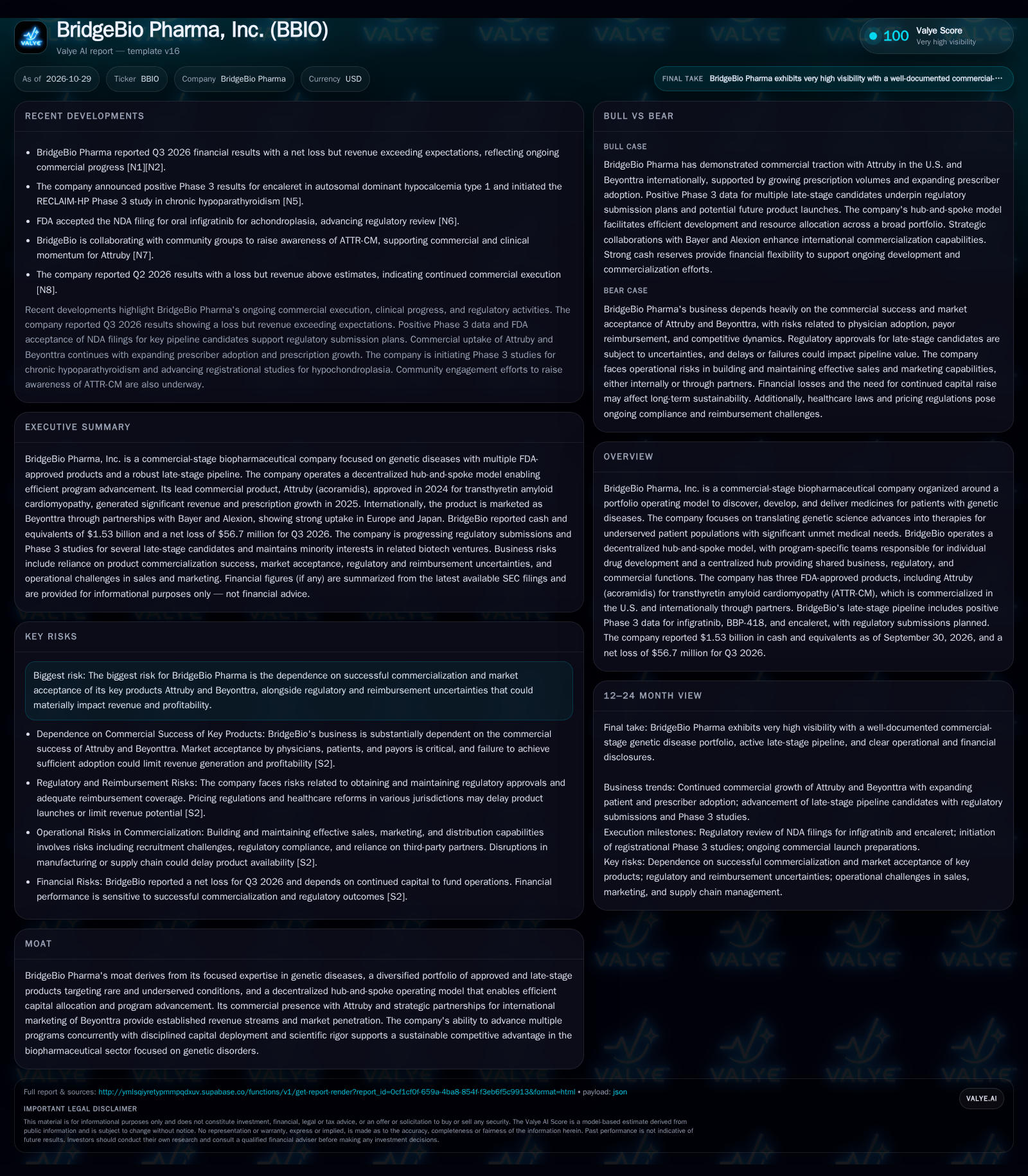
BridgeBio Pharma’s 2025–2026 trajectory is defined by robust U.S. and European uptake of its lead genetic disease drug (acoramidis/Attruby/Beyonttra), a strong late-stage pipeline with multiple regulatory submissions pending, and a sizable cash balance. However, the business remains highly dependent on continued commercial momentum, successful pipeline transitions, and favorable market access, with significant regulatory and reimbursement risks still in play. [S1] [S2] [N1] [N2] [N5] [N6] [N7]
BridgeBio Pharma has moved decisively from a portfolio-driven R&D organization into a commercial-stage rare disease company, anchored by the U.S. and international launches of its transthyretin amyloid cardiomyopathy therapy (acoramidis, branded as Attruby/Beyonttra). Strong early commercial uptake, robust prescription growth, and partnerships underpin a tangible revenue base, while a late-stage pipeline offers credible near-term expansion opportunities. Yet, the company’s thesis is tightly bound to its ability to sustain specialist adoption, navigate payer and regulatory hurdles, and translate pipeline wins into durable commercial franchises—a high-visibility but high-leverage proposition in the genetic disease drug sector. [S1] [S2] [N1] [N2] [N5] [N6] [N7]
Commercialization of Acoramidis Drives Revenue and Sets the Stage for Pipeline Pivots
BridgeBio’s financial and operational profile in late 2025 and 2026 is dominated by the U.S. launch of Attruby (acoramidis) for transthyretin amyloid cardiomyopathy (ATTR-CM), which generated $362.4 million in U.S. net product revenue in 2025, with over 7,800 unique patient prescriptions and nearly 1,900 prescribing physicians as of early 2026. Internationally, the product—marketed as Beyonttra through Bayer and Alexion—achieved rapid uptake, including over 50% new-to-brand prescription share in Germany within its first year, contributing $105 million in license and services revenue and $11.4 million in royalties in 2025. [S1]
The company reported cash and liquidity metrics for the period; these figures do not by themselves establish operating runway, investment capacity, financial flexibility, or financing capacity. [S2] [N1] [N2] [N5] [N6]
The material facts shaping the thesis are (1) clear commercial traction for acoramidis across both U.S. and European rare disease markets, (2) a pipeline with multiple late-stage catalysts on the horizon, and (3) a capital base that supports near-term execution, but with ongoing losses underscoring the need for continued revenue ramp and pipeline success.
How BridgeBio’s Hub-and-Spoke Model Translates Science into Revenue in Rare Diseases
BridgeBio’s business model is built on the economics of rare disease drug development: high unmet medical need, concentrated prescriber bases, and the potential for premium pricing. The company’s decentralized hub-and-spoke structure aims to maximize capital efficiency—small, focused teams drive each asset, while centralized functions support regulatory, commercial, and corporate needs. This structure can limit fixed overhead and enable rapid pipeline progression, but it also means that each program’s commercial outcome is disproportionately important.
Revenue generation is currently anchored by acoramidis/Attruby and its ex-U.S. analog Beyonttra. In rare disease markets, pricing is often high and volume is relatively low, with payer acceptance and diagnostic rates heavily influencing uptake. The reported 7,800+ unique U.S. prescriptions and >1,850 prescribers suggest that BridgeBio has penetrated a meaningful share of the specialist market, but future growth will depend on expanding diagnosis, payer coverage, and potentially moving earlier in the treatment paradigm.
The company’s economics for ex-U.S. markets rely on upfront licensing, milestone, and royalty structures—these can deliver high-margin revenue, but are dependent on partner execution and local reimbursement environments. As the pipeline matures, each new launch will test the scalability of BridgeBio’s model: success could drive significant operating leverage, while failure to convert late-stage assets would result in stranded R&D spend and ongoing fixed costs.
Navigating Specialist Markets, Entrenched Competitors, and the Realities of Rare Disease Commercialization
BridgeBio operates in a competitive landscape defined by entrenched rare disease incumbents, established specialty pharma players, and a steady influx of biotech innovators. In ATTR-CM, acoramidis faces competition from other TTR stabilizers and silencers, many of which are already established in both the U.S. and Europe. The >50% new-to-brand share in Germany for Beyonttra suggests early success in displacing or supplementing existing therapies, but maintaining and growing share will depend on demonstrating differentiated clinical benefit, ease of use, and payer value.
Beyond ATTR-CM, the company’s late-stage pipeline targets indications like achondroplasia, LGMD2I/R9, and ADH1—each with its own competitive dynamics. In these settings, barriers to entry include clinical data strength, physician education, diagnostics infrastructure, and patient advocacy engagement. BridgeBio’s hub-and-spoke model provides agility, but competitors with deeper commercial infrastructure or broader portfolios may be better positioned to drive uptake and negotiate with payers.
Switching costs in rare disease drugs are typically high due to treatment inertia, patient support programs, and the complexity of transitioning stable patients. However, new entrants with superior efficacy or safety can rapidly shift prescribing patterns—making the durability of BridgeBio’s lead franchises contingent on continued clinical and commercial differentiation.
Pipeline Conversions and Expanding Market Access Could Unlock Disproportionate Value
If BridgeBio successfully navigates regulatory reviews and launches for its late-stage pipeline—particularly infigratinib for achondroplasia and encaleret for ADH1—the company could see a step-change in both revenue and operating leverage. The rare disease model means that even modest patient penetration in validated indications can yield substantial top-line growth, especially if premium pricing and rapid payer coverage are achieved.
Upside would also be driven by further gains in market share for acoramidis/Attruby/Beyonttra, especially if new clinical data support broader use (e.g., earlier-stage patients or off-label indications). International expansion via partners could accelerate royalty and milestone flows, while the decentralized model may allow BridgeBio to rapidly redeploy capital to new programs.
Evidence confirming this scenario would include regulatory approvals for the pipeline assets within anticipated timelines, strong initial prescription and payer uptake post-launch, continued growth in Attruby’s U.S. patient base, and expansion of ex-U.S. royalties and milestones. If disclosed, metrics like new patient starts, duration of therapy, and payer coverage rates would further validate the thesis.
Sustained Commercial Execution with Selective Pipeline Wins Defines the Most Likely Outcome
The most plausible trajectory for BridgeBio involves steady commercial growth for acoramidis/Attruby/Beyonttra, driven by incremental gains in specialist adoption, continued physician education, and gradual payer expansion. The rare disease market’s long adoption curves mean that growth may be measured but durable, with revenue compounding as diagnosis rates improve and treatment duration increases.
On the pipeline side, it is likely that at least one late-stage asset will achieve regulatory approval and commercial launch in the next 12–24 months, but not all programs will succeed or achieve blockbuster status.
Confirmation of this scenario would come from sequential growth in prescription volumes, expansion of the prescriber base, successful regulatory submissions and approvals for select assets, and maintenance of a reported cash position. Signs of slower-than-expected uptake, regulatory delays, or higher-than-anticipated cash burn would challenge this base case.
Commercial Plateau or Pipeline Setbacks Could Expose Structural Risk
The principal risk is that Attruby/Beyonttra’s commercial trajectory plateaus below expectations, whether due to slower diagnosis growth, payer pushback, or competitive displacement. In this scenario, revenue would stagnate, the company’s cash burn would accelerate, and the thesis of expanding operating leverage would break down. As BridgeBio remains loss-making, it would eventually need to consider cost reductions, asset sales, or external capital raises.
Pipeline risk is equally significant: regulatory setbacks, negative clinical data, or delays in launch timing could strand R&D investment and leave BridgeBio overly reliant on its existing portfolio. In rare disease markets, commercial infrastructure is often indication-specific, so failed launches can result in underutilized sales forces and impaired fixed cost absorption.
Evidence confirming a downside scenario would include flattening or declining prescription trends for Attruby/Beyonttra, regulatory rejections or major delays for late-stage assets, worsening operating losses, and a declining cash balance without clear offsetting revenue growth. Increased reliance on external financing or partner-driven milestones would also signal stress.
Milestones That Will Determine BridgeBio’s Portfolio Value Realization
Quarterly new patient starts and cumulative unique patient counts for Attruby/Beyonttra in both the U.S. and ex-U.S. markets—if disclosed, these would test the sustainability of commercial momentum.
Prescription growth rate and prescriber base expansion for acoramidis, especially in specialist centers and new geographies.
Payer coverage rates, formulary wins, and actual reimbursement levels for Attruby/Beyonttra—crucial for long-term revenue durability in rare diseases.
Regulatory review timelines and outcomes for infigratinib (achondroplasia), BBP-418 (LGMD2I/R9), and encaleret (ADH1), including any FDA or EMA feedback.
Initial launch metrics for new indications: speed of uptake, breadth of prescriber adoption, and early payer acceptance.
Cash burn rate relative to pipeline progress and commercial ramp, as a measure of capital efficiency and financial runway.
Any disclosure on partner performance in ex-U.S. markets (e.g., Bayer, Alexion) that would affect royalty and milestone flows.
Updates on competitive dynamics—new entrants, label expansions by rivals, or changes in treatment guidelines impacting BridgeBio’s addressable market.
Disclaimer: This is research-only, informational analysis and not investment advice. It may include AI-generated interpretation and general industry context. Always verify important details using primary sources.

Comments