
Sonic Automotive: Segment Divergence, Margin Pressures, and the Search for Durable Advantage in U.S. Auto Retail
Sonic Automotive’s record Q3 revenues mask underlying weakness in new vehicle sales, margin compression in key segments, and intensifying market cyclicality. The company’s multi-pronged strategy—balancing luxury new car sales, EchoPark’s used vehicle push, and the Powersports segment—faces operational and competitive stress, with future performance hinging on inventory discipline, service expansion, and resilience to industry shocks.
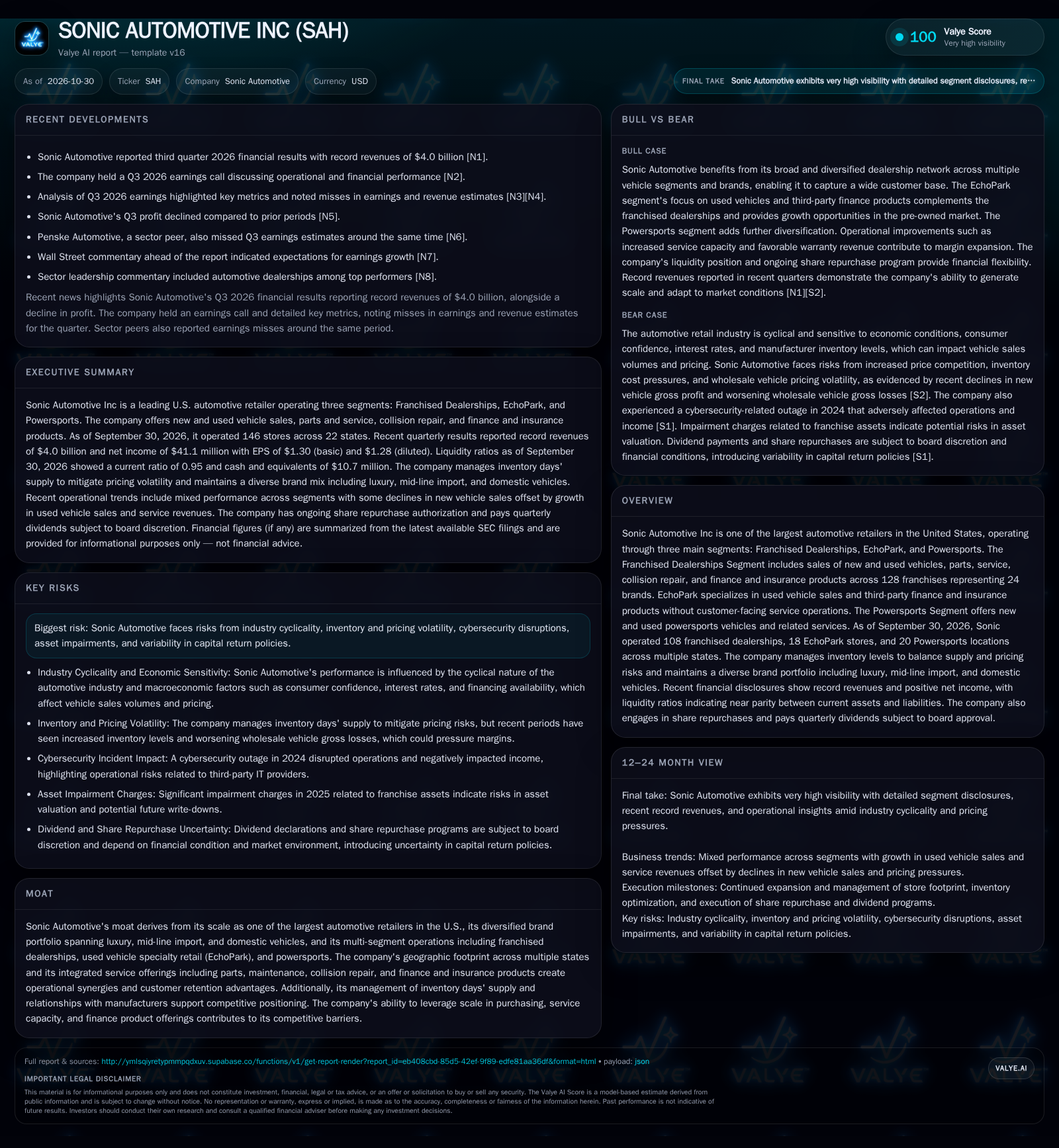
Sonic Automotive reported record Q3 2026 revenue of $4.0 billion, but profit declined as new vehicle sales and gross margins softened. EchoPark’s used vehicle volume expanded, yet average selling prices and per-unit F&I profits fell. Inventory days’ supply increased, amplifying exposure to pricing volatility. The company’s multi-segment model provides diversification, but margin and asset impairment risks persist amid industry cyclicality and capital allocation uncertainty. [N1] [S2]
Sonic Automotive stands at a crossroads after posting record Q3 2026 revenues, revealing a business that is both diversified and exposed. The company’s strategy of leveraging its scale across franchised dealerships, a growing EchoPark used vehicle footprint, and powersports diversification has delivered headline revenue gains. However, profitability headwinds—driven by declining new vehicle sales, intensified margin pressure from inventory dynamics, and asset impairments—underscore the fragility of traditional auto retail models in a shifting landscape. As economic cyclicality, pricing volatility, and capital allocation decisions converge, the next phase for Sonic will be defined by its ability to manage inventory risk, expand higher-margin service lines, and adapt to evolving consumer and competitive pressures. [N1] [S2]
Q3 2026 Results: Record Revenue, But Profit Under Strain
Sonic Automotive posted record Q3 2026 revenues of $4.0 billion, yet net income declined to $41.1 million (basic EPS $1.30, diluted EPS $1.28) as of September 30, 2026. The company’s liquidity, as measured by a current ratio of 0.95 and cash/equivalents of $10.7 million, remains tight, with liabilities nearly matching current assets. Notably, new vehicle sales and gross profit both declined on a same-store basis, while used vehicle retail revenue increased but was offset by worsening wholesale vehicle losses. EchoPark drove higher used vehicle unit sales and gross profit, but average selling prices and F&I profit per unit fell. Fixed Operations (service, parts, repair) delivered modest gains in both revenue and gross profit, partially cushioning the impact of vehicle margin pressure. [N1] [S2]
Inventory days’ supply ticked upward across segments, signaling greater exposure to price volatility and market softening. The company also continues to absorb the aftereffects of a 2024 cyber outage and significant 2025 impairment charges tied to franchise assets. These developments highlight a business facing both operational and structural pressures despite its top-line strength. [S1] [S2]
How Sonic Makes Money: Segment Mix and Margin Mechanics
Sonic Automotive’s revenue model is anchored by three distinct segments: Franchised Dealerships (new and used vehicles, F&I, service/parts), EchoPark (used vehicles, F&I), and Powersports (powersports vehicles and service). The Franchised Dealerships segment, which includes 128 new vehicle franchises across 24 brands, generates revenue from vehicle sales but increasingly relies on Fixed Operations—service, parts, collision repair—for margin stability. This segment’s mix is heavily skewed toward luxury brands (62% of new vehicle sales), which generally offer higher gross profit per unit but are more sensitive to economic cycles.
EchoPark, a used vehicle specialty retailer, is designed to capture share in the growing pre-owned market. Its economics depend on vehicle sourcing efficiency, inventory turnover, and F&I product attachment. However, the absence of customer-facing service operations limits recurring revenue and customer stickiness compared to traditional dealerships.
The Powersports segment adds diversification but remains smaller, with economics driven by new and used vehicle sales and service. Across all segments, F&I remains a critical profit lever, with modest increases in gross profit per retail unit in 2026 despite flat total F&I revenue. Inventory financing costs, property leases, and the need to manage days’ supply are core to the capital structure. Fixed costs are substantial—especially for property and personnel—while variable costs are dominated by inventory and sales commissions. Operating leverage is high: incremental revenue growth can drive outsized profit gains if gross margins hold, but margin compression (as seen in 2026) can quickly erode earnings.
Assessing Sonic’s Defenses: Scale, Brand Mix, and Vulnerabilities
Sonic Automotive’s competitive position is built on scale (as one of the largest U.S. auto retailers), brand diversity, and a multi-segment footprint across franchised dealerships, EchoPark, and powersports. The company’s luxury brand concentration may confer some pricing power and affluent customer resilience, but it also amplifies sensitivity to macroeconomic downturns or luxury demand shocks.
Its geographic reach and integrated service offerings (parts, service, collision repair) create switching frictions and recurring customer touchpoints, which can buffer against pure-play used car competitors or digital upstarts. EchoPark’s used vehicle focus targets a secularly expanding market, but the lack of in-house service limits cross-sell and customer retention versus traditional full-service dealerships.
Major competitive threats include large public dealer groups, digital-first used vehicle platforms, and direct-to-consumer models from automakers. The capital intensity of physical dealerships and inventory management limits the ability to rapidly pivot to asset-light or online-only models. Sonic’s ability to manage inventory risk, maintain F&I attachment rates, and expand higher-margin service lines will determine whether its scale translates into durable economic advantage or simply amplifies exposure to industry cyclicality.
Unlocking Value: Mix Shift, Service Expansion, and EchoPark Growth
A favorable scenario for Sonic Automotive would see stabilization or recovery in new vehicle gross margins, continued growth in used vehicle unit sales (particularly through EchoPark), and further expansion of Fixed Operations revenue as service capacity increases. If inventory days’ supply can be efficiently managed—limiting exposure to wholesale price swings—margin recovery is plausible even amid modest volume growth.
EchoPark could drive outsized growth if it leverages digital retailing, expands sourcing channels, and improves F&I product attachment. Powersports, while a smaller contributor, could add incremental margin through premium product offerings and service expansion. Confirmation of this scenario would require evidence of improving per-unit gross profit (especially in new vehicles and EchoPark), stable or declining inventory days’ supply, and sustained gains in service/parts revenue. Falsification would come from persistent margin erosion, stagnant service growth, or an inability to manage inventory risk through market cycles.
Segment Divergence and Margin Tension Define the Near-Term Outlook
The most plausible trajectory is one of mixed operating results: gradual expansion of EchoPark’s used vehicle footprint and incremental growth in service/parts revenue, offset by continued softness in new vehicle margins and the risk of further price volatility. Inventory management will remain a balancing act, with the threat of wholesale losses and working capital strain if market conditions deteriorate.
Franchised Dealerships are likely to remain the earnings anchor, but with limited growth as luxury demand plateaus and mid-line/domestic brands face competitive pricing. Powersports may provide some diversification but is unlikely to move the overall profit needle. Confirmation of this scenario would be a continuation of current trends: modest service growth, volatile but stable used vehicle gross margins, and low-single-digit overall revenue growth. The scenario would be challenged by either a significant recovery in new vehicle demand/margins or an acute downturn in consumer spending and wholesale pricing.
Margin Compression and Asset Impairments Amid Cyclical Pressures
A negative scenario would involve a combination of sustained new vehicle margin compression, further increases in inventory days’ supply, and deepening wholesale vehicle losses. If used vehicle pricing continues to soften, EchoPark could see its recent volume gains wiped out by falling per-unit profitability and rising inventory holding costs. Powersports segment growth could stall if discretionary spending weakens.
Additional asset impairments—such as those seen in 2025—could signal overcapacity or underperforming stores, leading to further write-downs and restructuring costs. Cybersecurity or operational disruptions, as experienced in 2024, could exacerbate the earnings decline. Evidence supporting this scenario would include another round of significant asset impairments, a spike in inventory days’ supply, worsening gross losses in wholesale vehicles, and negative operating cash flow. The scenario would be less likely if Sonic demonstrates improved inventory discipline and a rebound in service/parts profitability.
Signals That Will Define Sonic Automotive’s Next Phase
Trends in inventory days’ supply by segment—declining or stable levels would indicate improved risk management, while further increases heighten margin and cash flow risk.
Gross profit per retail unit in new and used vehicles—recovery or stability would support margin resilience; further declines would confirm ongoing pricing pressure.
Growth rate and profitability of Fixed Operations (service/parts)—continued expansion would signal success in building high-margin recurring revenue.
EchoPark unit sales growth and per-unit F&I gross profit—if disclosed, improvements would validate the used vehicle strategy; ongoing declines would challenge the thesis.
Occurrence and magnitude of future asset impairments—additional write-downs would signal persistent overcapacity or asset productivity issues.
Impact and remediation of any future cybersecurity or operational disruptions—evidence of robust recovery and minimal earnings drag would mitigate downside risk.
Disclaimer: This is research-only, informational analysis and not investment advice. It may include AI-generated interpretation and general industry context. Always verify important details using primary sources.

Comments