
SuperX AI Technology: Growth Ambitions, Institutional Endorsements, and Scaling AI Economics
SuperX AI Technology Ltd has drawn institutional investment and initiated a buyback, signaling management and investor confidence, yet its substantial net losses and limited model transparency raise questions about the sustainability and scalability of its AI-driven business.
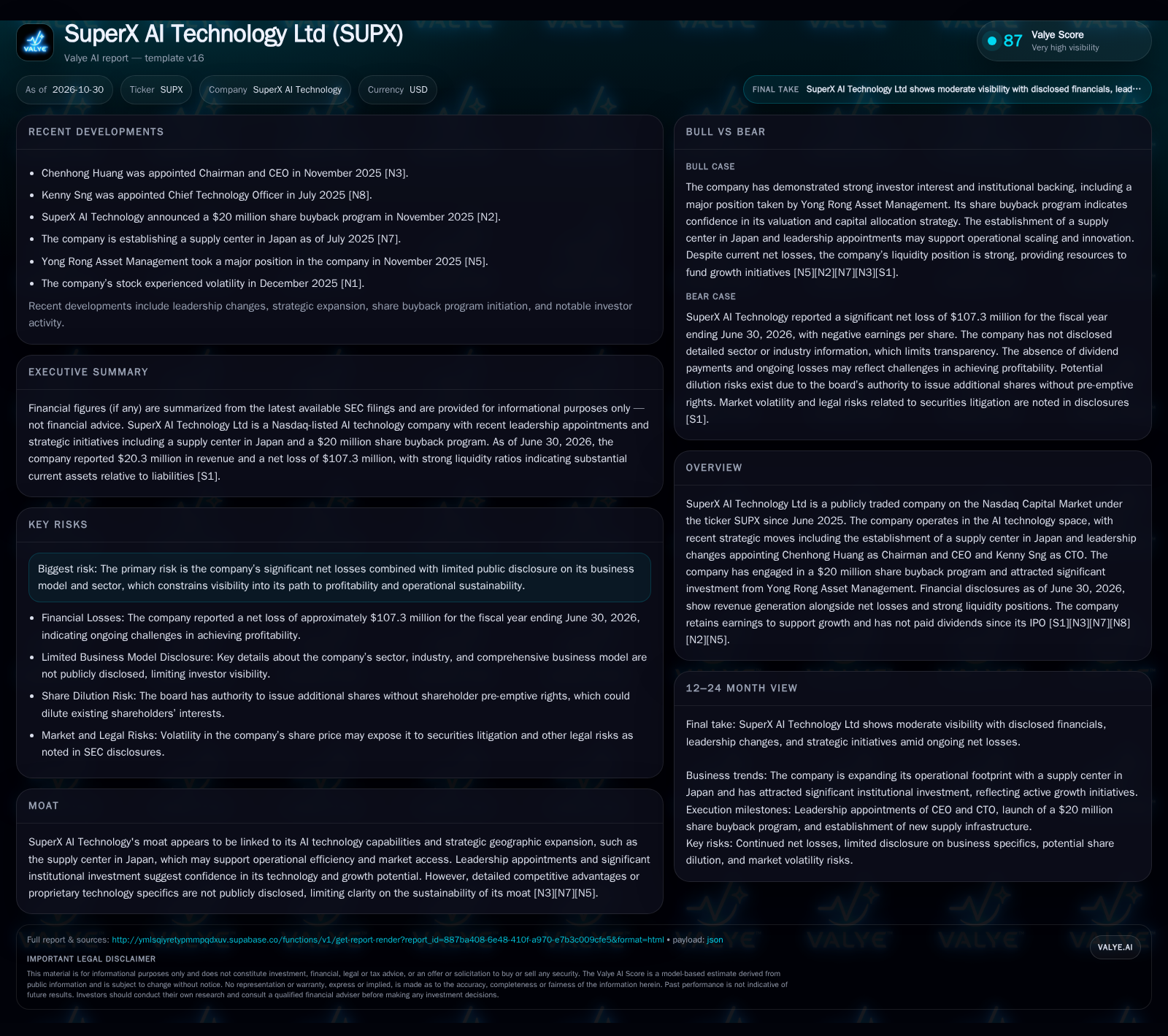
SuperX AI Technology Ltd is pursuing geographic expansion and operational growth, marked by a new supply center in Japan, major institutional investment, and a $20 million buyback. However, significant net losses, scant disclosure on its business model, and potential dilution risks present material challenges to realizing durable shareholder value. [S1] [N2] [N5]
SuperX AI Technology Ltd stands at a pivotal juncture: the company is executing on visible growth initiatives—such as launching a supply center in Japan and attracting major institutional investment—while simultaneously facing deep net losses and a lack of business model transparency. The next phase will test whether SuperX’s operational expansion and capital base can translate into durable economic value.
Recent Developments Position SuperX at a Strategic Juncture
SuperX AI Technology Ltd reported $20.3 million in revenue and a net loss of $107.3 million for the fiscal year ending June 30, 2026. The company’s cash and equivalents stood at $98.9 million, with short-term investments of $7.97 million and a current ratio of 19.73. Notably, SuperX announced a $20 million share buyback program and attracted a major position from Yong Rong Asset Management in late 2025. The company is also establishing a supply center in Japan, indicating a push toward operational scaling and international reach. The company reported cash and liquidity metrics for the period; these figures do not by themselves establish operating runway, investment capacity, financial flexibility, or financing capacity. [S1] [N2] [N5]
AI Business Models Characterized by High Fixed Costs and Scaling Challenges
SuperX AI Technology’s revenue base—$20.3 million against a $107.3 million net loss—suggests a business model currently dominated by high fixed costs, likely related to research and development, infrastructure, and talent acquisition typical of AI technology companies. The sparse disclosure on commercial mechanics leaves open whether revenues are generated from software licensing, AI services, hardware integration, or a mix thereof. In the AI sector, scalable software and platform economics can, in theory, yield high incremental margins once the initial investment in data, models, and infrastructure is absorbed. However, the current scale of revenue relative to losses implies that SuperX has not yet reached the threshold where operating leverage turns positive.
The company’s reported liquidity position and absence of dividends indicate a capital allocation strategy focused on reinvestment and growth. The buyback, however, introduces a tension: it returns capital to shareholders but may also signal a lack of near-term organic growth opportunities. If SuperX can shift its revenue mix toward higher-margin, recurring software or service streams, and leverage its geographic expansion for volume growth, the economics could improve dramatically. Conversely, if fixed costs remain structurally high without a commensurate rise in revenue, persistent losses could force strategic retrenchment or further dilution.
A critical factor influencing the scalability of AI business models like SuperX’s is the balance between upfront fixed costs and the marginal cost of serving additional customers. In many AI enterprises, once the core models and infrastructure are developed, incremental costs for adding users or transactions can be relatively low, enabling high operating leverage. However, this assumes that the company can achieve sufficient market penetration and customer retention to amortize fixed investments effectively. If SuperX’s revenue growth remains modest or customer acquisition costs escalate, the fixed-cost burden may persistently overwhelm incremental margins, impeding the transition to profitability.
Moreover, the nature of SuperX’s revenue streams—whether predominantly transactional, subscription-based, or license fees—will critically affect the predictability and stability of cash flows. Recurring revenue models typically provide better visibility and facilitate scaling by smoothing demand fluctuations and enabling long-term planning. In contrast, reliance on one-off sales or project-based contracts can introduce volatility and complicate resource allocation. Without detailed disclosure, it is challenging to ascertain how SuperX’s revenue composition aligns with sustainable growth dynamics or whether it faces significant customer concentration risks that could amplify revenue variability.
Institutional Support and Strategic Moves: Assessing Longevity of Competitive Edge
SuperX’s efforts to establish a supply center in Japan may provide logistical advantages, improved customer access in Asia, and a hedge against supply chain disruption—potentially differentiating it from AI peers focused solely on digital delivery. The appointment of new leadership and the participation of Yong Rong Asset Management suggest market confidence in the company’s growth prospects or technology platform. Nevertheless, the lack of public detail on SuperX’s core technologies, customer segments, or IP portfolio makes it difficult to assess the sustainability of any competitive moat.
In the AI technology landscape, barriers to entry can be high if a company possesses proprietary models, unique datasets, or deep integration with customer workflows. However, switching costs and pricing power are not guaranteed; many AI solutions face rapid commoditization, and new entrants can disrupt established positions if technology evolves or if customers prioritize interoperability and open standards. SuperX’s ability to capitalize on its operational expansion and convert investor interest into durable market share will depend on whether it can demonstrate unique, defensible value to end-users or partners.
The competitive landscape for AI companies is also shaped by the pace of technological innovation and evolving customer expectations. Firms that can rapidly iterate their models, incorporate diverse data sources, and integrate seamlessly into existing workflows tend to build stronger competitive moats. For SuperX, the strategic establishment of a supply center in Japan may enhance operational resilience, but it must be complemented by continuous innovation and differentiated offerings to maintain relevance. If competitors develop superior models or more cost-effective solutions, SuperX may face pressure on pricing and margins, underscoring the importance of sustained investment in R&D and customer engagement.
Additionally, regulatory and ethical considerations in AI deployment increasingly influence competitive positioning. Companies that proactively address data privacy, algorithmic transparency, and bias mitigation may gain trust advantages with customers and regulators. While the current article does not elaborate on SuperX’s approach to these issues, their effective management could become a strategic asset or liability. Failure to anticipate or comply with emerging standards could result in operational disruptions or reputational damage, further complicating the company’s path to durable market differentiation.
Scaling and Productization as Potential Catalysts for Transformation at SuperX
If SuperX successfully leverages its liquidity to accelerate product development, deepen market penetration, and scale its Japan supply center, it could unlock operating leverage and shift toward profitability. A plausible upside pathway would see the company converting R&D investment into high-margin, recurring revenue streams—such as AI-driven SaaS platforms or enterprise solutions—while benefiting from operational efficiencies and expanded distribution in Asia. Confirmation of this scenario would include sequential revenue acceleration, improved gross and operating margins, and evidence of sticky, growing customer relationships.
Additional upside indicators could include public disclosure of major customer wins, long-term contracts, or proprietary technology breakthroughs that establish switching costs or network effects. If the buyback is followed by earnings inflection and reduced cash burn, it may validate management's confidence in intrinsic value and the effectiveness of capital allocation.
Long-Term Outlook Marked by Execution Risks and an Unclear Inflection Point
The most plausible near-term trajectory is one of continued operational execution with gradual revenue growth, underpinned by a substantial reported cash balance but persistent net losses. The board’s authority to issue additional shares, coupled with ongoing losses, raises the risk of future dilution if organic growth fails to materialize.
Confirmation of this scenario would be a pattern of modest revenue gains, continued high operating expenses, and periodic capital raises or buybacks without a decisive transition to profitability. Lack of detailed disclosure on business segments, customer concentration, or contract structure would further reinforce this status quo, leaving investors reliant on headline liquidity and strategic initiatives rather than demonstrated economic momentum.
Capital Constraints and Persistent Losses Threaten Model Viability
The principal risk is that SuperX’s high fixed costs and limited revenue scale prove structurally mismatched, leading to persistent cash burn and eventual need for dilutive equity issuance.
Falsifying evidence for the downside would include accelerating net losses, shrinking cash balances without corresponding revenue gains, or management resorting to frequent share issuance. Additional red flags would be the absence of customer traction disclosures, setbacks in operational expansion, or legal/market events that trigger further volatility or litigation costs.
Milestones That Will Determine the Viability of SuperX’s AI Economic Model
Quarterly and annual revenue growth rates, especially segmented by product or geography if disclosed, would help clarify whether operational expansion is translating into commercial traction.
Gross margin and operating margin trends, particularly if management discloses cost structure or unit economics, would indicate progress toward positive operating leverage.
Disclosure of major customer wins, contract values, or multi-year agreements would help test the thesis of durable demand and market validation.
Updates on the operational status and output of the Japan supply center would provide evidence of supply chain improvements and geographic scaling.
Announcements of new product launches, platform upgrades, or proprietary technology milestones would clarify the company’s competitive positioning.
Any share issuance, buyback activity, or changes in institutional ownership could signal management’s and investors’ evolving confidence in the business model.
Legal or regulatory developments, including any new litigation or compliance disclosures, may impact risk and capital allocation decisions.
Disclaimer: This is research-only, informational analysis and not investment advice. It may include AI-generated interpretation and general industry context. Always verify important details using primary sources.

Comments