
Carlisle Companies: Revenue Growth, Margin Uncertainty, and the Levers Behind Long-Term Value Creation
Carlisle Companies delivered 9% revenue growth and solid profitability in Q3 2026, but earnings lagged some expectations, spotlighting the tension between top-line momentum and cost management.
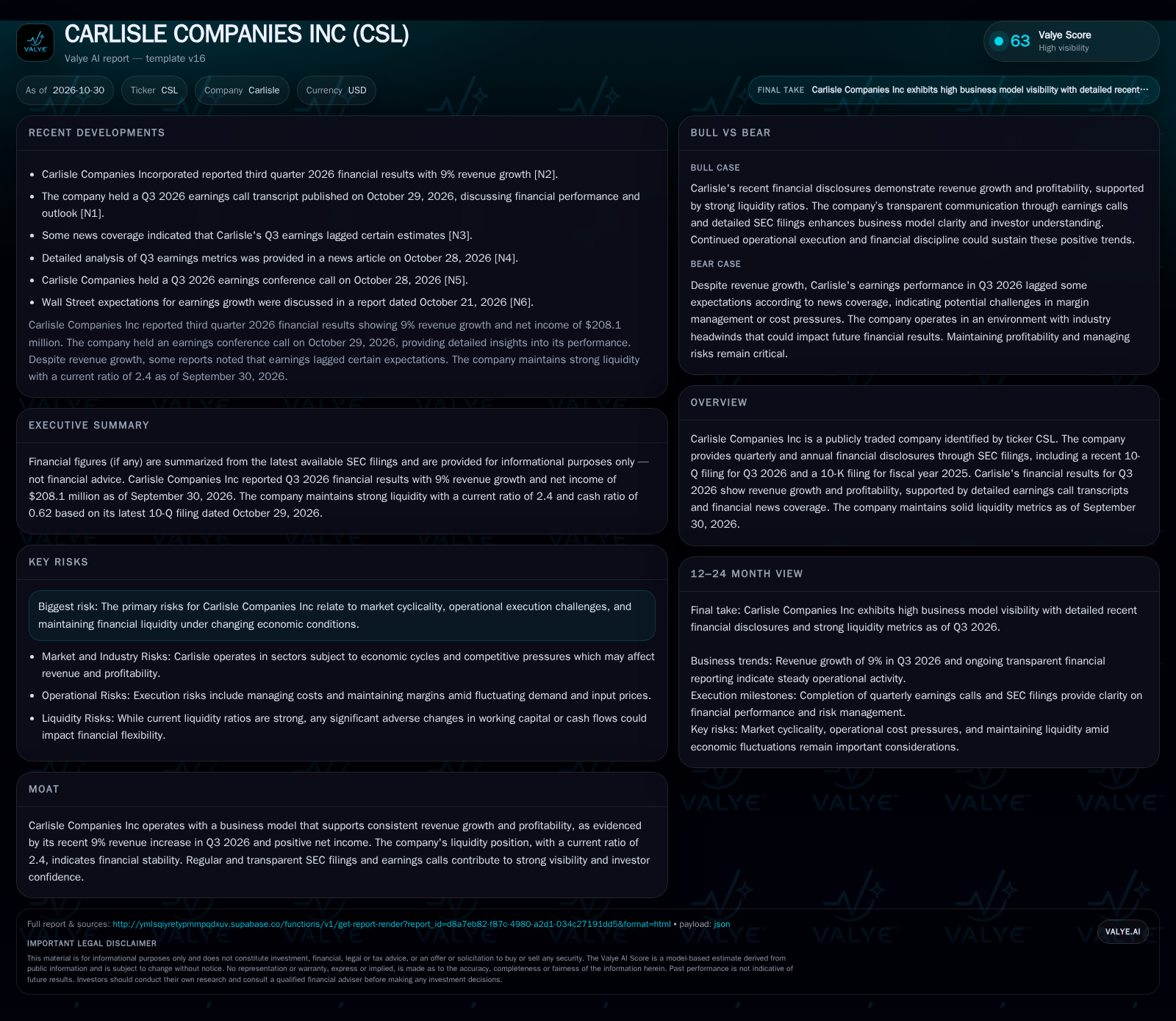
Carlisle Companies reported 9% revenue growth in Q3 2026 and a net income of $208.1 million, maintaining a reported liquidity position. However, earnings underperformed some estimates, raising questions about margin resilience. The company’s future trajectory will hinge on its ability to manage costs and sustain demand in cyclical end markets. [S2] [N2] [N3]
Yet, despite these positives, the company’s earnings missed some analyst expectations, highlighting the importance of cost control and margin defense in a competitive, cyclical landscape. As Carlisle moves forward, its ability to convert revenue gains into sustainable profit—and to weather potential industry headwinds—remains central to the long-term investment case.
Recent Results Highlight Growth but Reveal Margin Tensions
Carlisle Companies reported 9% revenue growth for Q3 2026, alongside net income of $208.1 million and diluted earnings per share of $5.24. The company’s liquidity remains notable, with $546.7 million in cash and a current ratio of 2.4 as of September 30, 2026. However, despite these positive headline figures, news coverage noted that earnings lagged certain analyst estimates, suggesting that underlying margin or cost pressures may have weighed on profitability. This gap between top-line growth and bottom-line delivery is now a central focus for investors and management alike. [S2] [N2] [N3]
How Carlisle’s Revenue Model and Cost Structure Shape Profit Potential
Carlisle’s business model centers on manufacturing and selling engineered products, historically with significant exposure to construction, building envelope, and industrial segments. Revenue growth can arise from both volume (end-market demand) and pricing (ability to pass through input cost increases or capture value from differentiated products). Operating leverage is typically present in such industrial models: incremental revenue above fixed cost bases can deliver outsized profit gains, but the reverse is also true in downturns.
The company’s recent 9% revenue growth suggests healthy end-market demand or pricing power, but the failure to meet earnings expectations implies either cost inflation, temporary operational inefficiencies, or mix shifts toward lower-margin products. In this context, the sustainability of margin expansion will depend on Carlisle’s ability to manage raw material costs, labor, and supply chain disruptions—factors that can swing profitability sharply in cyclical markets. Capital needs are generally moderate, with working capital swings and selective capex for plant upgrades or product innovation, but cash discipline remains vital to buffer against volatility.
Another important consideration is the impact of fixed versus variable costs on Carlisle’s margin dynamics. Given the industrial manufacturing nature of the business, a significant portion of costs—such as plant overhead, depreciation, and salaried personnel—are fixed or semi-fixed, which can amplify operating leverage during periods of volume growth. However, this also means that during demand downturns or volume softness, the inability to flex these fixed costs quickly can lead to disproportionate margin contraction. Therefore, Carlisle’s cost structure flexibility, including the ability to adjust labor costs or optimize production scheduling, is a critical lever that will influence profitability resilience across cycles.
Additionally, the company’s pricing strategy in response to raw material cost volatility is a key determinant of margin sustainability. In industries with commodity-linked inputs, the timing and effectiveness of price pass-through to customers are often imperfect and lagged, creating margin pressure in the interim. Carlisle’s ability to negotiate contracts with escalation clauses or to differentiate its products sufficiently to justify price increases will condition how well it can preserve margins amid inflationary pressures. Moreover, the competitive environment’s tolerance for price hikes will influence the extent to which Carlisle can maintain pricing power without sacrificing volume.
Competitive Dynamics and the Challenge of Defending Share
Carlisle operates in mature, often fragmented markets with exposure to construction cycles and industrial demand. Its key competitors are other diversified industrial manufacturers and specialized building products firms. Competitive advantages may stem from product differentiation, scale-driven cost efficiencies, customer relationships, and the ability to innovate with new materials or solutions. However, these advantages are not always durable: price competition can intensify during slowdowns, and new entrants or substitutes may erode share, especially if switching costs are low.
The company’s regular financial transparency and operational discipline provide some investor confidence, but the true test lies in Carlisle’s ability to defend margins when input costs rise or demand softens. If competitors are able to undercut on price or innovate faster, Carlisle’s pricing power and volume growth could come under pressure. The company’s ability to maintain customer loyalty—potentially through service, product breadth, or integration—will be critical to its long-term moat.
Carlisle’s competitive positioning also depends on the balance between scale economies and niche specialization. While scale can provide cost advantages in procurement, manufacturing efficiency, and distribution, niche specialization can support higher margins through tailored solutions and reduced price sensitivity. The company’s challenge lies in optimizing this balance to defend against commoditization and aggressive pricing by competitors. Furthermore, the pace of innovation—whether in materials science, product design, or process improvements—can create transient advantages, but sustaining these requires continuous investment and market responsiveness, which may be constrained during periods of cost pressure or capital discipline.
Margin Recovery and Volume Strength Drive Outperformance
A favorable scenario for Carlisle involves successfully passing through cost inflation to customers, restoring or expanding margins even as input costs fluctuate. If the company leverages its scale, operational efficiency, and product innovation to differentiate from competitors, volume growth could be sustained or even accelerated, particularly if end-markets such as commercial construction or industrial manufacturing rebound.
Confirmation of this scenario would come from future earnings reports showing both revenue growth and margin expansion, with management commentary highlighting successful cost controls, pricing actions, or market share gains. Evidence could also include new product launches, customer wins, or positive revisions to guidance. If Carlisle delivers several quarters of above-peer margin performance and surprises to the upside on earnings, it would indicate that the business model is delivering operating leverage in a favorable demand environment.
Sustained Growth with Ongoing Margin Volatility
The most plausible path for Carlisle is continued revenue growth at mid-to-high single-digit rates, reflecting steady demand in core end markets and disciplined sales execution. However, margin performance may remain choppy, as cost pressures from labor, materials, or logistics offset some of the revenue gains.
Evidence for this scenario would include consistent revenue growth, but with operating margins moving within a relatively narrow band, and management commentary acknowledging both wins and ongoing cost challenges. If disclosed, sequential or year-over-year gross/operating margin trends would help confirm this view. Failure to materially expand margins despite top-line growth, or persistent earnings misses relative to consensus, would support the base-case thesis of a solid but not breakout performer.
Cost Pressures and Demand Softness Undermine Profitability
In a downside scenario, Carlisle could face a combination of rising input costs and softening demand in its core markets. If the company struggles to pass on cost increases or is forced to discount to maintain volume, margins could compress further, eroding profitability and possibly leading to negative earnings surprises. This could be exacerbated if competitors become more aggressive on pricing or if macroeconomic conditions deteriorate, reducing industrial or construction activity.
Confirmation would come from future earnings reports showing declining margins or flat-to-negative net income despite revenue stability or growth. Sequential deterioration in gross or operating margins, increased inventory levels, or negative free cash flow (if disclosed) would be red flags. Management commentary citing challenges in passing through costs or losing share in key segments would further validate the downside mechanism.
Milestones and Metrics to Assess Carlisle’s Margin Resilience and Growth Durability
Quarterly gross and operating margin trends, if disclosed, to assess the company’s ability to defend or expand profitability.
Volume versus price contribution to revenue growth—clarification on whether growth is driven by higher demand or price increases would help test demand elasticity and competitive strength.
Cost inflation disclosures, especially around raw materials, labor, and logistics, to gauge pressure on margins.
Earnings guidance revisions or management commentary on margin outlook in upcoming SEC filings or earnings calls.
Evidence of major customer wins, contract extensions, or market share gains that could support above-market growth.
New product introductions or innovation milestones that could create differentiation and pricing power.
Cash flow from operations and capital expenditure trends—would help test the company’s ability to fund growth and maintain liquidity through cycles.
Any significant changes in competitive behavior (such as price wars or new entrants) reported in industry or company updates.
Disclaimer: This is research-only, informational analysis and not investment advice. It may include AI-generated interpretation and general industry context. Always verify important details using primary sources.

Comments