
Leonardo DRS: Defense Tech Execution, Backlog Strength, and the Tension Between Visibility and Volatility
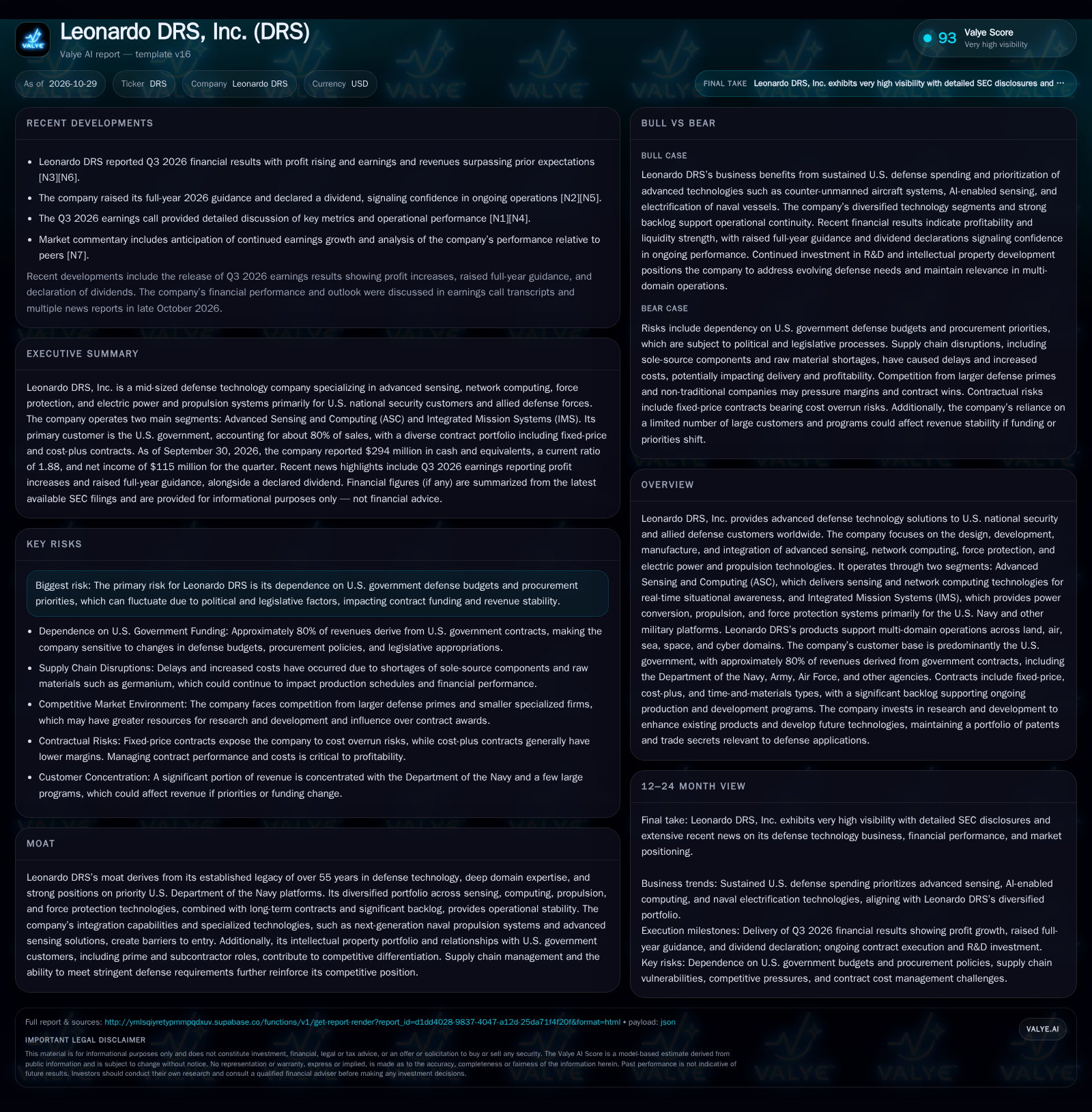
Leonardo DRS, Inc. enters late 2026 with rising profits, a substantial backlog, and raised full-year guidance, benefiting from U.S. defense priorities around sensing, electronic warfare, and naval electrification. However, heavy reliance on government funding, exposure to fixed-price contract risks, and supply chain headwinds introduce volatility alongside high operational visibility.
The cited source reports dividend-related activity; that disclosure alone does not establish dividend-policy continuity, management confidence, or a material constraint on capital flexibility. Navy and allied defense contracts. While the company’s advanced sensing and naval propulsion technologies align well with evolving defense needs, significant exposure to government budgets, fixed-price contracts, and supply chain risks create a complex risk/reward profile for investors. Ongoing R&D, contract execution, and defense spending trends will be critical for sustaining momentum and managing volatility [S1] [S2] [N1] [N2] [N5] [N6].
Leonardo DRS, Inc. stands at a pivotal moment in late 2026, reporting rising profits and a record backlog amid robust demand for advanced defense technologies from the U.S. government and allied forces. The company’s focus on next-generation sensing, electronic warfare, and naval electrification positions it well for evolving national security priorities, as reflected in recent financial outperformance and a raised full-year outlook. However, with 80% of revenues tied to government contracts and persistent supply chain challenges, the company faces a delicate balance between operational visibility and the volatility inherent in defense procurement cycles and contract execution risk.
Profit Upside and Backlog Support: What the Latest Numbers Reveal
Leonardo DRS reported net income of $115 million for Q3 2026, with both earnings and revenues surpassing prior expectations and prompting an upward revision of full-year 2026 guidance [S2] [N2] [N6]. The cited source reports dividend-related activity; that disclosure alone does not establish dividend-policy continuity, management confidence, or a material constraint on capital flexibility. [N5] As of December 31, 2025, Leonardo DRS held a funded backlog of $4.643 billion, providing substantial revenue visibility into future quarters [S1]. U.S. government contracts accounted for roughly 80% of 2025 sales, with the Department of the Navy representing a core customer [S1]. These facts highlight a business with strong near-term demand visibility, but also underscore a pronounced reliance on public sector funding cycles.
How Leonardo DRS Monetizes Advanced Defense Tech: Contract Structures and Margin Dynamics
Leonardo DRS’s revenue model is anchored in long-term defense contracts, split between firm-fixed price and flexibly priced (cost-plus and time-and-materials) arrangements. In 2025, $3.205 billion was derived from firm-fixed price contracts—typical for mature production programs—while $443 million came from flexibly priced contracts, often used for development and integration work [S1]. Fixed-price contracts offer margin leverage if costs are well controlled but transfer cost overrun risks to the company, whereas cost-plus contracts provide lower but more predictable margins.
The company’s operations exhibit a mix of high fixed costs (R&D, advanced manufacturing, compliance) and variable costs tied to program volume and supply chain inputs. The company reported cash and liquidity metrics for the period; these figures do not by themselves establish operating runway, investment capacity, financial flexibility, or financing capacity. [S1] [S2]
Operating leverage is present, as higher production volume on existing platforms can drive incremental profitability, but this is offset by the risk of margin compression if contract costs are underestimated or if supply chain disruptions persist.
Defending the Edge: Where Leonardo DRS Stands in the Defense Tech Value Chain
Leonardo DRS competes in a defense technology landscape dominated by large primes and specialized mid-tier firms. Its position is differentiated by deep domain expertise in advanced sensing (electro-optic/infrared, electronic warfare), ruggedized network computing, and next-generation naval propulsion—especially for the U.S. Navy’s Columbia Class ballistic missile submarine [S1]. The company’s integration capabilities and portfolio of intellectual property create moderate barriers to entry, especially in programs with high regulatory and technical requirements.
However, the company faces competitive pressure from both larger primes with broader resources (potentially able to cross-subsidize bids or invest more aggressively in R&D) and smaller, agile disruptors with niche tech offerings. Substitution risk is relatively low in the near term due to strict defense procurement standards, but emerging technologies from commercial and dual-use sectors could shift the competitive landscape over time.
Customer stickiness is driven by long qualification cycles, platform integration, and mission-critical performance, but contract renewal is not guaranteed, and program funding can be subject to shifting political priorities.
When Advanced Defense Priorities Accelerate: What Sustained Momentum Could Look Like
A favorable scenario for Leonardo DRS is one in which U.S. and allied defense spending continues to prioritize advanced sensing, electronic warfare, and naval electrification—areas where the company holds strong technical and programmatic positions. Continued contract wins, on-time delivery, and effective cost management would allow the company to convert its $4.6 billion backlog into profitable revenues, potentially expanding margins if fixed-cost absorption increases with higher volume.
Further upside could come from successful commercialization of new R&D-driven offerings, such as AI-enabled sensing or next-generation electric propulsion systems, especially if these technologies become standard in future defense procurement cycles. Confirmation of this scenario would include new major contract announcements, backlog growth, sustained R&D investment, and margin expansion on reported results. A falsification would be a material slowdown in order flow or evidence of cost overruns eroding profitability.
Earning Visibility Amid Procurement Cycles and Execution Risks
The most plausible trajectory for Leonardo DRS is continued growth in line with its funded backlog, supported by persistent demand from the U.S. government for advanced defense technology. Revenue recognition will likely track the conversion of existing contracts, with some volatility driven by the timing of program milestones and deliveries. Ongoing investment in R&D and execution on high-priority Navy and multi-domain platforms should sustain relevance and renewal opportunities.
However, the company will likely face periodic supply chain disruptions, incremental cost pressures, and the need to balance fixed-price contract risk with cost-plus opportunities. Margins may remain stable but are unlikely to expand dramatically barring a step-change in operational efficiency or a major new platform win. Evidence supporting this scenario would include steady contract execution, modest backlog growth, and margin stability. Signs of deviation would be a sharp contraction in defense budgets, major delivery delays, or significant contract losses.
What If Defense Budgets Tighten or Supply Chains Disrupt? Downside Mechanisms
The principal downside scenario involves a material reduction in U.S. defense appropriations or a shift in procurement focus away from the company’s core technology domains. Such a shift could result from political gridlock, budget sequestration, or a reorientation of military priorities. Given that 80% of revenues are tied to government contracts, even modest cuts or delays could disrupt revenue and profit trajectories [S1].
Additionally, continued or worsening supply chain disruptions—especially involving sole-source components or critical raw materials—could drive up costs and delay deliveries, eroding margins on fixed-price contracts. If the company fails to control costs or faces penalties for late delivery, profitability could deteriorate rapidly. Evidence confirming this scenario would include declining backlog, rising contract costs, increased program delays, or negative guidance revisions. A mitigating factor would be the company’s ability to secure new commercial or international contracts to diversify its revenue base.
Milestones and Metrics That Will Shape the Leonardo DRS Thesis
Quarterly backlog updates—growth or contraction in funded backlog will be a leading indicator of future revenue visibility and program health.
Contract win announcements, especially for next-generation sensing, naval propulsion, or electronic warfare programs, would validate the company’s competitive positioning.
Gross and operating margin trends—stability or expansion would suggest cost control and effective fixed-price contract execution; compression could indicate overruns or supply chain stress.
R&D expense trajectory—continued investment (if disclosed) would support future product relevance but could pressure near-term margins.
Supply chain commentary and disclosed disruptions—any escalation in delays, shortages, or cost increases could directly impact delivery and profitability.
Revenue mix by contract type—shifts between fixed-price and cost-plus contracts (if disclosed) would help gauge risk and margin outlook.
Customer concentration metrics—greater diversification beyond the U.S. government, if achieved, would reduce budgetary risk exposure.
Disclaimer: This is research-only, informational analysis and not investment advice. It may include AI-generated interpretation and general industry context. Always verify important details using primary sources.

Comments