
Credit Acceptance Corp: Subprime Auto Lending at a Regulatory and Economic Crossroads
A net loss and regulatory settlements define Credit Acceptance Corp’s current landscape, as it contends with the dual pressures of credit performance and compliance in the subprime auto loan market. The company’s specialized risk-management capabilities and dealer network are tested by shifting economics, heightened oversight, and the cyclical nature of its borrower base.
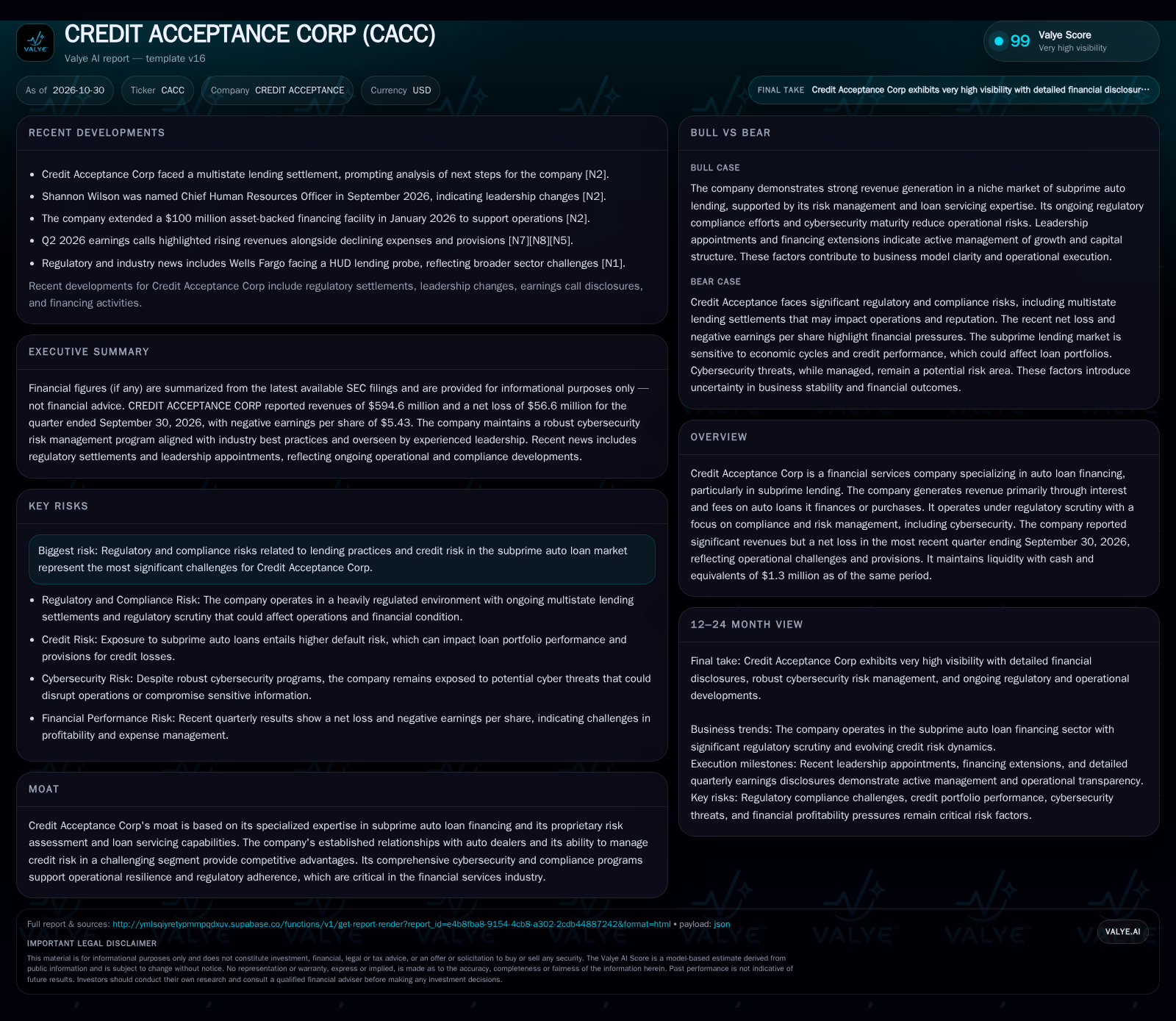
Credit Acceptance Corp reported a net loss of $56.6 million on $594.6 million in revenue for Q3 2026, while navigating a multistate lending settlement and ongoing regulatory scrutiny. Despite its established expertise in subprime auto lending and robust cybersecurity practices, the company faces material risks from credit performance, compliance costs, and economic headwinds. The future will hinge on its ability to balance loan growth, credit quality, and regulatory adaptation in a volatile environment. [S2] [N2]
Credit Acceptance Corp stands at a critical juncture as it navigates substantial regulatory scrutiny and economic headwinds in the subprime auto lending market. Reporting a significant net loss for Q3 2026, the company’s results highlight the fragility of profitability in an environment marked by heightened compliance demands, evolving credit risk, and macroeconomic uncertainty. While its specialized risk-management infrastructure and dealer relationships remain core strengths, the company must now demonstrate that it can adapt to increased oversight and shifting credit dynamics to sustain its business model.
Recent Losses and Regulatory Settlements Shape Strategic Priorities
Credit Acceptance Corp reported revenues of $594.6 million for the quarter ended September 30, 2026, but also posted a net loss of $56.6 million, with negative earnings per share of $5.43. This marks a period of financial pressure following a multistate lending settlement that has intensified regulatory scrutiny and may impose additional operational or compliance costs. The company ended the quarter with cash and equivalents of $1.3 million—a modest figure for a lender of its scale, underscoring the importance of access to external funding and prudent liquidity management. These developments frame a landscape where profitability, cost containment, and compliance adaptation are immediate priorities. [S2] [N2]
How Subprime Auto Lending Economics Drive Volatility and Margin Risk
Credit Acceptance’s revenue generation is rooted in originating and servicing auto loans for subprime borrowers, earning interest income and fee-based revenue streams. The economics of this model are particularly sensitive to default rates, recovery values on repossessed vehicles, and the effectiveness of risk-based pricing. Fixed costs include infrastructure for loan servicing, compliance, and dealer relations, while variable costs are tied to credit losses, loan acquisition, and funding expenses.
Operating leverage can be significant: in periods of stable or improving credit performance, incremental loan volume can drop through to the bottom line. However, adverse shifts in credit quality or regulatory costs quickly erode margins, as evidenced by the recent net loss despite strong topline revenue. Capital needs are ongoing, as the company must fund both new originations and absorb credit provisions. The company reported cash and liquidity metrics for the period; these figures do not by themselves establish operating runway, investment capacity, financial flexibility, or financing capacity. The cyclical nature of subprime credit—where borrower performance deteriorates rapidly in downturns—means that the company’s economics are highly exposed to both macroeconomic conditions and regulatory cost escalation.
Specialized Risk Management and Dealer Networks as Double-Edged Swords
Credit Acceptance’s competitive positioning is grounded in its proprietary risk assessment models, deep experience in subprime lending, and established relationships with a national network of auto dealers. These factors have historically enabled the company to underwrite riskier loans more effectively than less specialized players, supporting volume and market share in a segment with high barriers for new entrants.
However, these advantages are increasingly offset by rising regulatory scrutiny, as evidenced by the recent settlement, and by the growing sophistication of alternative lenders and fintech entrants leveraging new data sources and automated underwriting. Traditional banks, captive auto finance arms, and digital-first lenders all compete in adjacent credit tiers, and could encroach further if regulatory costs or reputational risks mount for specialized subprime lenders. Switching costs for dealers may be moderate, but could rise if Credit Acceptance’s compliance infrastructure is perceived as a safer partner amid ongoing industry scrutiny.
If Regulatory Headwinds Abate, Margin Recovery and Loan Growth Could Resume
A favorable scenario emerges if Credit Acceptance successfully absorbs the costs and operational changes required by the multistate lending settlement and restores regulatory confidence without further major penalties. In such a case, the company could refocus on disciplined loan growth, leveraging its risk analytics and dealer network to originate new loans at attractive spreads.
Evidence of this trajectory would include a return to net profitability, stabilization or reduction in credit loss provisions, and renewed growth in loan originations without a corresponding spike in compliance costs. Additional confirmation would come from expanded access to funding—such as successful securitizations or renewed warehouse capacity—and positive commentary from management regarding regulatory relationships. If the company can demonstrate that its compliance investments translate into a sustainable, lower-risk business model, the market may reward it with a higher valuation multiple.
Managing Through Volatility: Expense Discipline and Incremental Remediation
The most plausible scenario is one of ongoing volatility: Credit Acceptance continues to operate under persistent regulatory oversight, with periodic expenses for compliance, legal defense, and operational remediation. Loan origination and servicing remain core strengths, but growth is constrained by tighter underwriting, higher provisions, and increased funding costs.
This scenario would be confirmed by continued fluctuation in quarterly profitability, with some quarters of modest profit interspersed with losses as credit costs and compliance expenses ebb and flow. Loan volume may grow only incrementally, with management focusing on risk-adjusted returns rather than aggressive expansion. Evidence against this base case would be either a sharp deterioration in credit metrics or a major regulatory event that forces a structural shift in the business model.
Escalating Credit Losses and Regulatory Costs Lead to Structural Profitability Challenges
In a negative scenario, Credit Acceptance faces a confluence of rising credit losses—potentially triggered by macroeconomic weakness or adverse employment trends among subprime borrowers—and spiraling compliance costs stemming from further regulatory actions. If default rates spike and recovery values on repossessed vehicles fall, provisions could overwhelm revenue growth, leading to sustained or deepening net losses.
This downside would be evidenced by a persistent negative net income, ongoing or increased regulatory settlements, difficulty in accessing affordable external funding, and possible downgrades from ratings agencies. If dealer partners begin to defect due to reputational or compliance concerns, origination volumes could contract, further amplifying fixed-cost deleverage. A critical signal would be management warning of going concern uncertainties or seeking emergency capital infusions.
Concrete Progress Markers for Credit Acceptance’s Regulatory and Credit-Risk Thesis
Quarterly net income or loss trends, with a focus on whether the company can return to and sustain profitability after recent losses. [S2]
Loan origination volumes and portfolio growth rates, particularly shifts in mix or credit quality if disclosed.
Quarterly provision for credit losses, as an indicator of underlying loan performance and economic conditions.
Total operating expenses and specifically compliance/legal costs, to assess the financial impact of regulatory settlements and ongoing oversight.
Cash and equivalents plus available borrowing capacity, as a signal of liquidity health and ability to fund new originations. [S2]
Dealer network retention or churn, if disclosed, to gauge the ongoing strength of distribution relationships.
Any new regulatory actions, settlements, or investigations, which could materially alter operational or financial assumptions. [N2]
Management disclosures on funding strategy—such as new securitizations or warehouse lines—which would affect the company’s capital flexibility.
Disclaimer: This is research-only, informational analysis and not investment advice. It may include AI-generated interpretation and general industry context. Always verify important details using primary sources.

Comments