
Norwegian Cruise Line: Profitability Rebounds, But Structural Liquidity and Operational Risks Loom Large
Norwegian Cruise Line Holdings reported Q3 2026 net income of $491.5 million and raised its full-year guidance on improved operational performance, even as fares trended lower.
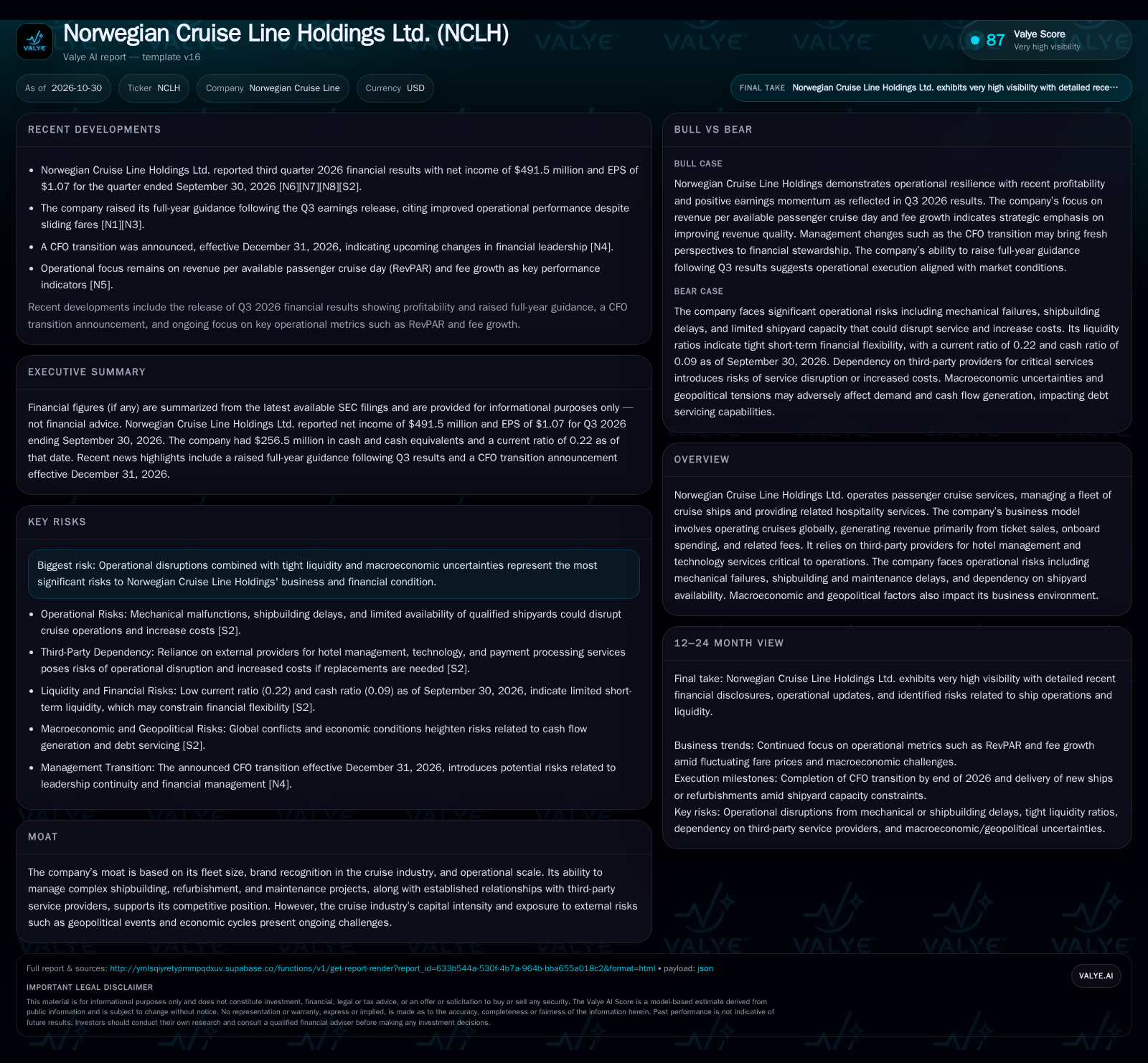
Norwegian Cruise Line Holdings reported Q3 2026 net income of $491.5 million and raised its full-year guidance on improved operational performance, even as fares trended lower. Operational risks such as ship mechanical issues, shipyard capacity, and reliance on third-party service providers remain material. A CFO transition is set for year-end, adding uncertainty to the company’s financial management outlook. The core question is whether recent execution can offset structural vulnerabilities as the cruise industry navigates ongoing macroeconomic and operational headwinds. [S2] [N1] [N3] [N4]
Norwegian Cruise Line Holdings’ third quarter 2026 results mark a return to profitability, with the company reporting $491.5 million in net income and raising its full-year outlook despite fare pressure. This operational rebound, however, is juxtaposed against a balance sheet that remains structurally tight, with a current ratio of just 0.22 and significant dependency on external providers for core services. As the company prepares for a CFO transition at year-end, the durability of its recovery will depend on its ability to manage operational volatility, maintain cash generation, and navigate persistent macroeconomic headwinds.
Profit Recovery Meets Financial Constraints in Q3 2026
Norwegian Cruise Line Holdings reported a robust net income of $491.5 million and earnings per share of $1.07 for the third quarter of 2026, marking a notable return to quarterly profitability [S2]. This performance prompted management to raise full-year guidance, reflecting improved operational execution even as fares have declined [N1] [N3]. However, the company’s liquidity metrics remain sharply constrained: as of September 30, 2026, it reported cash and cash equivalents of $256.5 million, current assets of $1.29 billion, and current liabilities of $5.75 billion, resulting in a current ratio of just 0.22 and a cash ratio of 0.09 [S2]. Additionally, a CFO transition is slated for December 31, 2026, introducing a new variable into financial oversight during a period of heightened operational and financial complexity [N4].
Cruise Economics: Pricing Leverage, Fixed Cost Burden, and Capital Intensity
Norwegian’s revenue model is anchored in ticket sales and onboard spending, with ancillary fees contributing incremental margin. The cruise industry’s economic engine is highly sensitive to occupancy and pricing—small shifts in either can drive pronounced swings in profitability due to the sector’s high fixed cost structure. Variable costs (fuel, food, labor) are meaningful on a voyage basis, but the dominant expense base is fixed: ship depreciation, interest, crew overhead, and maintenance. This creates substantial operating leverage, which can amplify both upturns (as seen in Q3 2026) and downturns.
The capital requirements are formidable. Each new ship or major refurbishment demands significant upfront investment and long lead times. Shipbuilding delays or mechanical issues can sideline revenue-generating assets and trigger expensive workaround costs. Additionally, Norwegian’s reliance on third-party providers for hotel, technology, and payment services introduces both cost variability and operational dependency: disruption or price increases from these partners could quickly erode margin. The low current and cash ratios underscore that Norwegian’s ability to absorb shocks or invest opportunistically is limited absent external financing or sustained cash flow generation [S2].
The interplay between fixed and variable costs also influences Norwegian’s strategic pricing flexibility. In periods of demand softness, the high fixed cost base limits the company’s ability to reduce prices without eroding profitability, as fixed costs must be absorbed regardless of occupancy. Conversely, during demand surges, incremental revenue contributes disproportionately to profits, underscoring the importance of demand forecasting and yield management. Additionally, the capital intensity and long asset lifecycles necessitate careful fleet capacity planning to avoid overcapacity, which can depress yields, or undercapacity, which limits revenue growth potential. Effective asset utilization and timing of capital expenditures are therefore critical to sustaining long-term profitability.
Operational dependencies extend beyond third-party service providers to include regulatory compliance and environmental standards, which impose additional cost layers and operational constraints. Compliance with evolving maritime safety, emissions, and labor regulations can increase capital and operational expenditures, impacting margins. These regulatory factors also introduce uncertainty into maintenance scheduling and capital planning, as retrofits or upgrades may be mandated unexpectedly. Norwegian’s ability to anticipate and integrate regulatory changes into its operational and financial planning will be pivotal in managing cost pressures and avoiding disruption-related penalties or reputational damage.
Competitive Dynamics: Scale, Substitution, and Risk of Disruption
Norwegian operates in a triopoly—alongside other major cruise lines—where scale, brand equity, and fleet breadth confer some advantages in marketing, procurement, and itinerary flexibility. However, the cruise sector faces a broad substitution threat from land-based vacations, all-inclusive resorts, and increasingly, adventure and experiential travel segments.
Operational reliability is a key differentiator: mechanical failures or delayed ship deliveries can undermine brand trust and cede share to competitors. The dependency on third-party service providers for critical onboard and shoreside functions is a double-edged sword—while it allows for operational specialization, it can also create switching frictions and bottlenecks if providers falter or renegotiate terms. Furthermore, the capital intensity and regulatory scrutiny in the cruise industry create high entry barriers, but also make incumbents vulnerable to macro shocks, geopolitical disruptions, and shifts in consumer sentiment.
Operational Execution Offsets Liquidity Constraints
If Norwegian can continue to deliver strong operational performance—maintaining high occupancy, driving onboard revenue, and tightly managing costs—it could generate sufficient cash to gradually relieve liquidity pressures and fund fleet upgrades. A successful CFO transition, combined with disciplined capital allocation and effective risk management around ship operations and third-party dependencies, could further bolster investor confidence.
Confirmation of this scenario would include sustained positive net income, sequential improvement in liquidity ratios, successful new ship launches or refurbishments without major delays, and evidence of customer retention despite fare volatility. Additionally, the ability to renegotiate or extend debt maturities, or secure favorable financing, would signal increased financial resilience.
Navigating Thin Margins Amid Persistent Volatility
The most plausible outcome is that Norwegian remains profitable on a quarterly basis but continues to operate with limited potential financial flexibility. Fare pressure, elevated fixed costs, and periodic operational disruptions (mechanical issues, shipyard bottlenecks) constrain margin expansion, while the company’s dependency on third-party providers and macroeconomic sensitivity keep volatility high.
In this scenario, the company manages to roll over or refinance near-term debt as needed, executes a smooth CFO transition, and maintains stable fleet operations, but does not achieve a step-change in its liquidity or risk profile. Evidence would include stable but low current and cash ratios, moderate profit growth, and ongoing news of operational challenges or competitive responses.
Operational Disruption or Macro Shock Triggers Financial Strain
Under this scenario, the company could be forced into emergency financing, asset sales, or aggressive cost-cutting that undermines service quality and future demand.
Confirmation would come from a sudden deterioration in liquidity ratios, negative cash flow, significant voyage cancellations, or adverse debt covenant developments. News of customer dissatisfaction, regulatory intervention, or difficulties in refinancing would further validate this downside trajectory.
Milestones That Will Define Norwegian’s Resilience in 2027
Quarterly trends in net income and EPS, which will reveal whether Q3 profitability is sustainable or a one-off driven by transient factors [S2].
Sequential changes in current and cash ratios—improvement would indicate greater financial headroom, while deterioration would suggest rising vulnerability [S2].
Operational reliability metrics: number and severity of mechanical incidents, shipbuilding delays, or voyage cancellations (if disclosed), as these directly impact both costs and customer perception.
Progress on new ship deliveries or major refurbishments—on-time and on-budget execution would support the bull case; delays or overruns would be a red flag (if disclosed).
Third-party provider stability: renewals, renegotiations, or disruptions in hotel management, technology, or payment processing partnerships (if disclosed).
CFO transition outcomes: retention of key finance personnel, clear communication of strategy, and evidence of continuity or improvement in financial management [N4].
Trends in booking volume, average fare, and onboard spend per passenger (if disclosed), as these are leading indicators of demand and margin potential.
Disclaimer: This is research-only, informational analysis and not investment advice. It may include AI-generated interpretation and general industry context. Always verify important details using primary sources.

Comments