
Erie Indemnity’s Insurance Platform: Earnings Resilience, Structural Economics, and the Real Levers of Moat and Risk
Erie Indemnity’s recent earnings outperformance underscores a pattern of operational consistency—but the company’s true long-term economics hinge on underwriting discipline, expense management, and its ability to navigate regulatory and insurance market volatility. The durability of its competitive position will depend on structural cost advantages, network effects in agent relationships, and the evolving landscape of risk pricing.
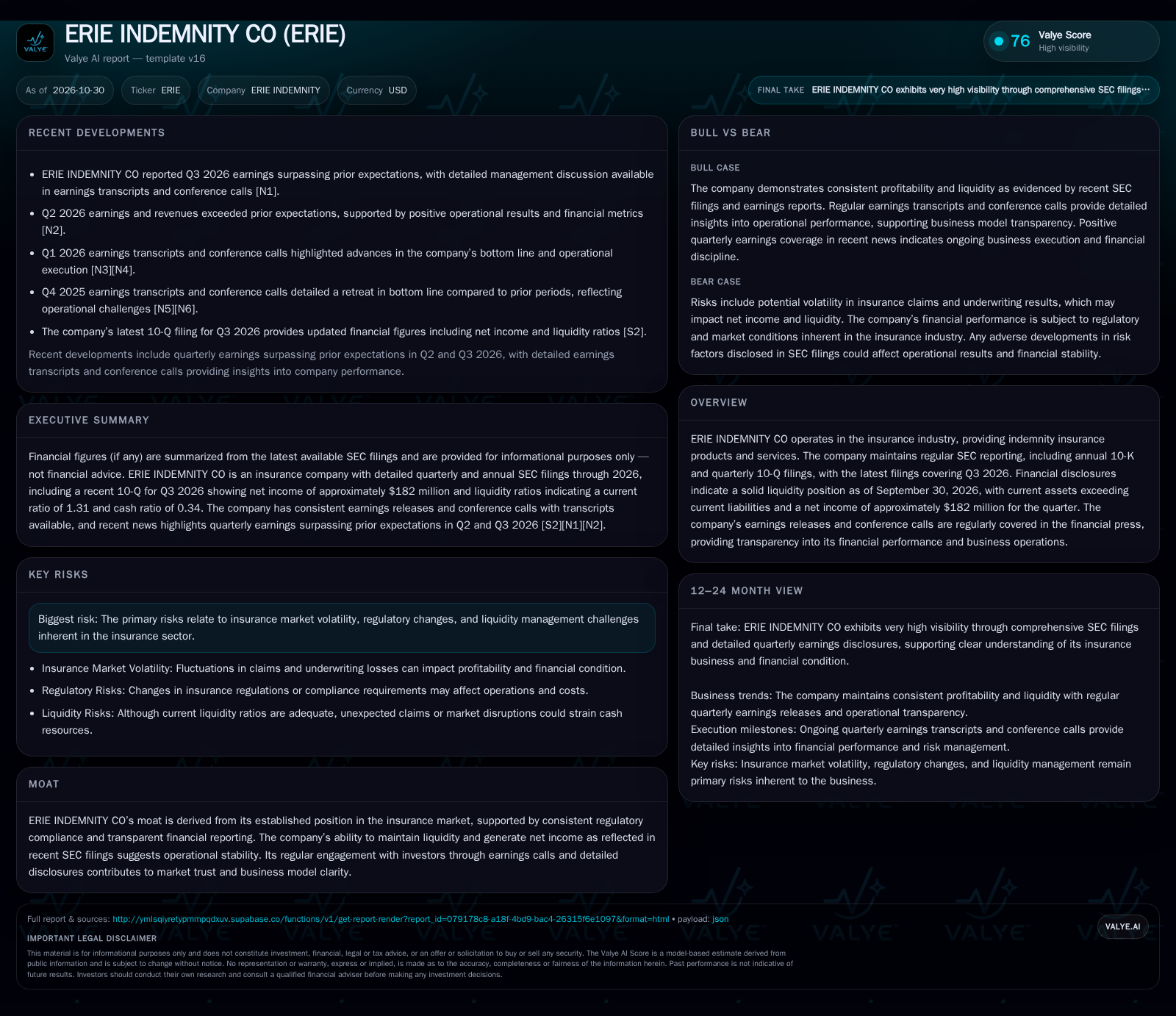
Erie Indemnity reported Q3 2026 net income of $182 million, exceeding expectations and extending a multi-quarter streak of earnings outperformance. The company’s competitive moat is based on established distribution, regulatory compliance, and operational transparency, but long-term differentiation will require continuous adaptation to market and cost pressures. [S2] [N1] [N2]
Erie Indemnity Company’s strong Q3 2026 earnings headline a period of operational momentum, marked by consecutive quarters of beating expectations and maintaining a reported liquidity position. Yet, while current financials reflect stability, the insurance sector’s structural realities—volatile claims, regulatory risk, and the need for ongoing cost control—mean that Erie’s longer-term performance will depend on more than just quarterly outperformance. Understanding the company’s underlying business mechanics, competitive position, and the scenarios that could change its trajectory is essential for gauging the true durability of its economics.
Recent Earnings Strength and Liquidity Shifts at Erie Indemnity
Erie Indemnity Company reported net income of approximately $182 million for Q3 2026, continuing a trend of quarterly earnings that have surpassed analyst expectations in both Q2 and Q3 2026. This recent outperformance comes after a more challenging Q4 2025, when bottom-line pressures were noted in earnings transcripts and calls. The company’s current assets of $1.31 billion and current liabilities of $1.01 billion produce a current ratio of 1.31 and a cash ratio of 0.34 as of September 30, 2026. These figures indicate that, at present, Erie maintains a neutral-to-reported liquidity position, though the cash ratio suggests a significant portion of current assets are non-cash or less liquid. The company’s consistency in releasing detailed earnings and maintaining transparency through conference calls is also notable, providing the market with high visibility into its operations and financial health. [S2] [N1] [N2] [N5]
The Mechanics Behind Erie’s Conversion of Premiums and Fees to Profits
Erie Indemnity primarily earns revenue through the management of insurance policies and the administration of services for Erie Insurance Exchange and affiliated entities. Its income stream is driven by a mix of policyholder premiums (from which it earns management fees), investment income on float, and potentially other service fees. In the standard insurance model, profitability is determined by underwriting margins (the spread between premiums and claims/expenses), expense discipline, and the ability to deploy float for incremental returns.
Fixed costs—such as personnel, technology, and regulatory compliance—are relatively high, but can be leveraged over a growing book of business. Variable costs scale with claims activity and the volume of policies administered. Operating leverage is a key feature: when premium volume rises faster than fixed costs, margins can expand, but adverse claims cycles or regulatory-driven cost spikes can quickly erode profitability.
The company’s capital needs are shaped by regulatory requirements, the need to pay claims, and the necessity to maintain liquidity buffers. While the reported current and cash ratios indicate reported liquidity position, insurance companies must also manage capital adequacy for potential catastrophic losses, which can create sudden capital requirements not visible in quarterly liquidity snapshots.
A critical aspect of Erie’s profitability lies in the management of its investment portfolio, which generates income on the float—the premiums collected but not yet paid out in claims. This investment income can significantly enhance overall returns, but it is inherently linked to prevailing interest rates and market conditions. In a low-rate environment, investment returns may compress, putting additional pressure on underwriting margins to compensate. Conversely, rising rates could provide a tailwind, but only if underwriting discipline remains intact to avoid losses that outweigh investment gains. Therefore, Erie’s financial performance is conditional on both underwriting outcomes and macroeconomic factors influencing investment yields.
Erie’s Competitive Edge: Distribution Reach Coupled with Regulatory Confidence
Erie’s competitive position is rooted in its established distribution network—primarily independent agents—and its reputation for regulatory compliance and transparency. This network effect can increase switching friction for policyholders, as agent relationships often drive renewal and retention rates. However, these advantages are not unassailable: digital-native insurers, insurtech entrants, and large national carriers are investing heavily in direct-to-consumer platforms and cost-reducing technologies, which could compress margins or erode agent loyalty over time.
The company’s moat is further reinforced by regulatory trust and brand recognition, but these are also subject to ongoing investment in compliance, customer experience, and technology. Erie’s ability to maintain its edge will depend on adapting to competitive pricing pressures, evolving consumer preferences, and the rising table stakes of data analytics and automation in underwriting and claims.
The interplay between Erie’s agent network and emerging digital distribution channels presents both opportunities and challenges. While agent relationships foster customer loyalty and personalized service, they also entail higher fixed costs relative to direct-to-consumer models. If consumer preferences shift markedly toward digital engagement and self-service platforms, Erie may face pressure to invest substantially in technology to retain relevance and cost competitiveness. The company’s ability to integrate digital tools without alienating its agent base will be pivotal. Moreover, regulatory frameworks that govern agent compensation and licensing can either reinforce or undermine these distribution advantages, depending on their evolution.
Margin Growth Potential Through Continued Underwriting Discipline
If Erie can continue to outperform on underwriting—keeping claims ratios and operating expenses below industry averages—while leveraging its agent network to grow premium volume, the business could see sustained margin expansion and compounding earnings growth. This scenario would require disciplined risk selection, effective pricing strategies, and successful containment of both technology and regulatory costs.
Confirmation of this upside would be visible in continued multi-quarter trends of earnings outperformance relative to peers, declining combined ratios (if disclosed), stable or improving retention rates, and evidence of premium growth outpacing industry averages. Falsification would come from a spike in claims ratios, rising expense ratios, or a breakdown in agent or customer retention despite top-line growth.
Earnings Settle as Claims and Expense Levels Return to Historical Norms
The most plausible near-term trajectory is that Erie returns to industry-average profitability as claims frequency and severity normalize, and expense pressures from technology, compliance, and distribution costs persist. In this scenario, Erie’s earnings would track with the broader insurance cycle: solid in stable periods, pressured during adverse claim cycles or regulatory shifts.
Evidence supporting this scenario would include stable but unremarkable earnings growth, reported liquidity-ratio trends, and management commentary focused on efficiency initiatives rather than aggressive expansion. Falsification would occur if the company either breaks out to industry-leading margins through distinctive cost or risk management, or faces a marked deterioration from a negative claims shock or regulatory event.
Potential Earnings Pressure from Claims Fluctuations or Regulatory Changes
The primary risk is a material increase in claims—due to natural catastrophes, adverse selection, or systemic risk factors—that drives up loss ratios and erodes profitability. Alternatively, regulatory changes (such as mandated coverage expansions or new capital requirements) could increase operating costs or constrain pricing flexibility. Under these conditions, Erie’s current liquidity buffer could be quickly depleted, forcing asset sales, capital raises, or retrenchment.
Confirmation of this downside would be seen in a dramatic quarter-over-quarter spike in claims expenses, negative surprises in earnings releases, or management guidance forecasting margin compression or liquidity stress. Early warning signs could include rising current liabilities without a commensurate increase in current assets, or a sudden shift in regulatory or market sentiment reflected in management commentary.
Factors Shaping the Future Economic Performance of Erie Indemnity
Trends in combined ratio and loss ratio, if disclosed, to gauge underwriting discipline and claims volatility.
Premium volume growth relative to industry benchmarks, indicating success in expanding the policyholder base.
Retention and renewal rates among policyholders and agents—a useful metric would be disclosed trends here.
Expense ratio trends and management commentary on technology, compliance, and distribution cost initiatives.
Regulatory developments that could impact required capital, permissible pricing, or product offerings.
Evidence of competitive encroachment: market share losses, agent defections, or pricing pressure from digital insurers.
Management guidance on risk appetite, claims trends, and strategic investments in technology or distribution.
Disclaimer: This is research-only, informational analysis and not investment advice. It may include AI-generated interpretation and general industry context. Always verify important details using primary sources.

Comments