
Community Health Systems: Network Scale, Demand Headwinds, and the Stakes of potential Financial Flexibility
Community Health Systems faces a pivotal period as it contends with operational losses, a softening in elective procedures, and balance-sheet constraints. The company’s large hospital and outpatient network provides strategic breadth, but sustaining growth and margin improvement will depend on execution in physician recruitment, outpatient expansion, and cost control amid industry-wide reimbursement and regulatory pressures.
Community Health Systems reported a Q3 2026 net loss and lowered its full-year outlook, reflecting operational and demand challenges. The next phase depends on success in expanding outpatient services, improving cost structure, and navigating shifts in healthcare demand and reimbursement.
Community Health Systems, one of the nation’s largest hospital operators, is at a strategic crossroads. The company’s Q3 2026 net loss and reduced outlook underscore the immediate pressures from softening elective procedures and persistent cost challenges. The next 12-24 months will test whether scale and operational standardization can offset reimbursement pressures and demand volatility, or whether the company’s financial constraints will limit its ability to reposition for a more outpatient and value-based future.
Recent Losses, Lowered Guidance, and Asset Sales Define the Current Juncture
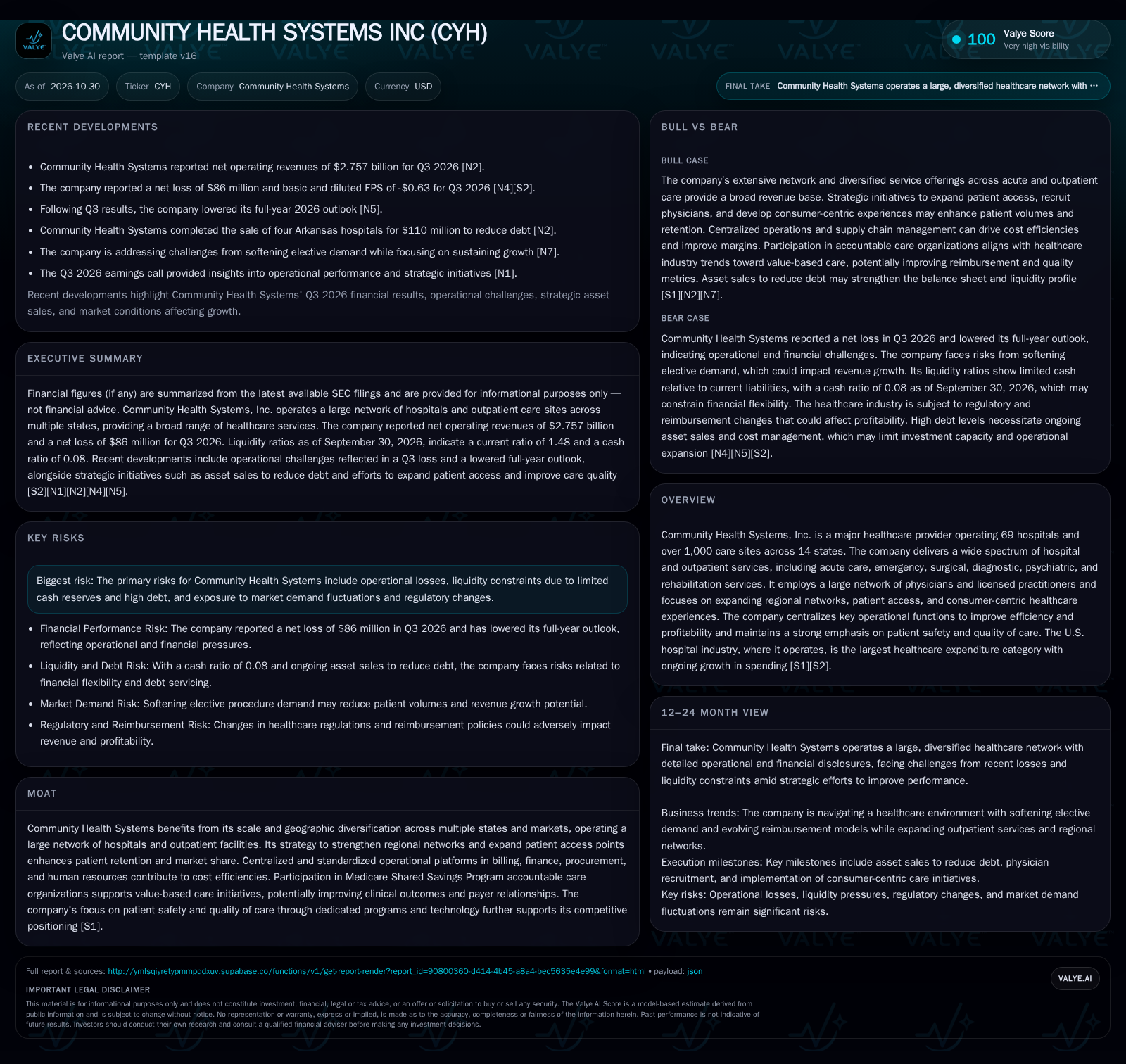
Community Health Systems reported a net loss of $86 million for Q3 2026, with basic and diluted EPS of -$0.63, and subsequently lowered its full-year 2026 outlook [N4] [N5] [S2]. This negative surprise reflects both operational and demand-side headwinds, particularly a decline in elective procedure volumes. The company’s liquidity remains tight: as of September 30, 2026, it held $155 million in cash and equivalents against $2.021 billion in current liabilities, resulting in a cash ratio of 0.08 [S2]. In response, management has pursued asset sales, including the divestiture of four Arkansas hospitals for $110 million, to reduce debt and shore up the balance sheet [N2] [N7]. These facts highlight a period of heightened financial discipline and operational scrutiny, with the company balancing near-term losses against long-term repositioning.
Hospital Revenue Model: Fixed-Cost Leverage, Payer Mix, and Capital Intensity
Community Health Systems generates revenue by providing a broad portfolio of acute and outpatient services, paid for by governmental agencies, private insurers, and patients [S1]. The economics of hospital operations are characterized by high fixed costs—salaries, facility maintenance, regulatory compliance, and equipment—relative to variable costs. This structure creates substantial operating leverage: small changes in patient volumes or payer mix can drive outsized swings in profitability. Elective procedures, typically higher-margin and often paid by commercial insurers, are particularly important for incremental profitability. When elective demand softens, as in the current environment, the company’s ability to absorb fixed costs is undermined, compressing margins.
Centralized and standardized operations in billing, procurement, and support functions may help mitigate some cost pressures and improve efficiency [S1]. However, the need for ongoing capital investment in facilities, technology, and physician recruitment is high. The company reported cash and liquidity metrics for the period; these figures do not by themselves establish operating runway, investment capacity, financial flexibility, or financing capacity.
The fixed-cost intensity of hospital operations also implies that the timing and scale of volume fluctuations have disproportionate impacts on financial performance. For example, short-term dips in elective procedures can create cash flow stress that complicates capital planning and liquidity management. Conversely, sustained volume growth can generate operating leverage benefits, but only if capacity constraints and staffing challenges are managed effectively. Additionally, payer mix shifts—such as an increasing share of government payers with lower reimbursement rates—can compress average revenue per case, necessitating even greater efficiency gains or service diversification to maintain margins. Capital intensity further complicates this dynamic, as investment cycles in technology and infrastructure often lag demand shifts, creating periods of underutilization or deferred modernization that may affect competitive positioning.
Scale, Regional Networks, and the Push Toward Value-Based Care
Community Health Systems’ competitive positioning rests on its scale—69 hospitals and over 1,000 care sites in 36 markets across 14 states [S1]. Geographic diversification and the ability to centralize back-office operations can yield procurement advantages and administrative cost reductions compared to smaller peers. The company’s strategy of strengthening regional networks and expanding patient access points is intended to capture a larger share of local healthcare spending, improve patient retention, and build referral pipelines.
However, the hospital industry is intensely competitive, with rivals ranging from large for-profit systems and nonprofit health networks to ambulatory surgery centers and telehealth providers. The shift toward outpatient and ambulatory care, as well as the rise of value-based reimbursement models, is eroding the historical advantage of inpatient hospital beds and requiring investment in new care delivery models. Participation in 11 Medicare Shared Savings Program accountable care organizations (ACOs) aligns with this trend and could improve payer relationships, but success depends on execution and the ability to manage population health cost-effectively [S1].
The company’s scale advantage also creates both opportunities and risks in the evolving healthcare market. While centralized procurement and administrative functions can lower unit costs, the complexity of managing a large, geographically dispersed network requires robust information systems and coordination capabilities. Integration of outpatient services and alignment with physician groups must be seamless to avoid fragmentation that could erode patient experience and referral loyalty. Moreover, as value-based payment models gain traction, the ability to aggregate and analyze population health data across the network becomes critical. Failure to effectively implement these capabilities may limit the company’s ability to share in savings or receive performance incentives under accountable care organizations. Competitive pressure from non-traditional entrants—such as retail clinics and telemedicine providers—further challenges the company to innovate care delivery models while maintaining cost discipline.
If Outpatient Expansion and Physician Recruitment Drive Volume Recovery
A favorable outcome for Community Health Systems would depend on stabilizing and then growing patient volumes, particularly in elective and outpatient services. Success in recruiting physicians and expanding access points—urgent care, ambulatory surgery, imaging—could recapture lost elective procedures and drive higher-margin case mix. If centralized operations deliver on promised efficiencies and value-based care initiatives (such as participation in ACOs) yield improved reimbursement and quality metrics, the company could leverage its fixed cost base for margin recovery.
Evidence supporting this scenario would include a reversal in elective demand declines, improved volumes in outpatient settings, and a return to operating profitability. Additional asset sales that reduce debt without materially shrinking core market presence would also be supportive. Conversely, continued volume stagnation or persistent margin pressure would falsify this upside thesis.
If outpatient expansion and physician recruitment efforts succeed, the company could also benefit from enhanced care coordination and higher patient retention rates. By broadening service offerings in community settings, the company may capture a greater share of chronic disease management and preventive care, which tend to be more stable revenue sources. Additionally, effective physician recruitment not only increases volume but can improve negotiating leverage with payers due to broader clinical capabilities. However, these benefits depend on the company’s ability to integrate new providers culturally and operationally, avoiding turnover or productivity lags. Furthermore, value-based care participation requires investments in analytics and care management infrastructure; if these are well executed, they can reduce avoidable hospitalizations and improve quality metrics, thereby enhancing reimbursement and reputation.
Managing Through Margin Compression and Slow Repositioning
The most plausible near-term scenario is one in which Community Health Systems operates under continued financial constraint, with only modest improvement in elective volumes and ongoing margin pressure. The company may be able to stabilize through incremental cost reductions, targeted asset sales, and selective investment in outpatient and physician recruitment, but structural headwinds—high debt service, competition from non-hospital providers, and reimbursement pressure—limit the scope for rapid turnaround.
Confirmation of this scenario would be continued but slowing asset divestitures, stable or slightly improving current ratios, and muted revenue growth. If disclosed, trends in same-hospital admissions, outpatient procedure counts, and payer mix would provide real-time signals. A further deterioration in liquidity or inability to execute on operational improvement plans would indicate downside risk.
Liquidity Erosion, Persistent Losses, and Forced Asset Shrinkage
In a negative scenario, Community Health Systems could see continued softening of elective demand and limited success in cost control, resulting in ongoing operating losses and further erosion of liquidity.
Evidence for this scenario would include a falling current ratio, further reductions in cash balance, asset sales from key markets, and an inability to stem net losses despite cost initiatives. Regulatory or reimbursement shocks could further exacerbate the situation, leading to covenant breaches or restructuring.
Milestones and Outcomes That Will Shape the Next Phase for Community Health Systems
Trends in same-hospital admissions and elective procedure volumes, if disclosed, would provide early signals of demand recovery or continued weakness.
Outpatient visit growth and expansion of ambulatory care sites: Increases would support the company’s repositioning toward higher-growth, lower-cost care settings.
Payer mix evolution: Shifts toward commercial or value-based reimbursement, if disclosed, would impact margin prospects.
Progress on physician recruitment and retention: Physician headcount and clinical productivity metrics would help assess the ability to drive volume and referrals.
Operating margin trends: Movement toward positive operating margins would validate efficiency and volume improvement strategies.
Pace and terms of asset sales: Disposals of non-core versus core assets, and their impact on debt reduction and regional scale, will be important to monitor.
Participation and performance in Medicare Shared Savings Program ACOs: Evidence of improved quality and cost outcomes would indicate traction in value-based care initiatives.
Disclaimer: This is research-only, informational analysis and not investment advice. It may include AI-generated interpretation and general industry context. Always verify important details using primary sources.

Comments