
WESCO’s Distribution Engine: Scale, Supply Chain Integration, and the Stakes of Cyclical Exposure
WESCO International’s strong Q3 results and raised 2026 guidance showcase the power of its scale-driven, integrated distribution model. Yet, the company’s fortunes remain tightly linked to the health of industrial and construction end markets, raising important questions about margin durability, working capital demands, and the sustainability of recent momentum.
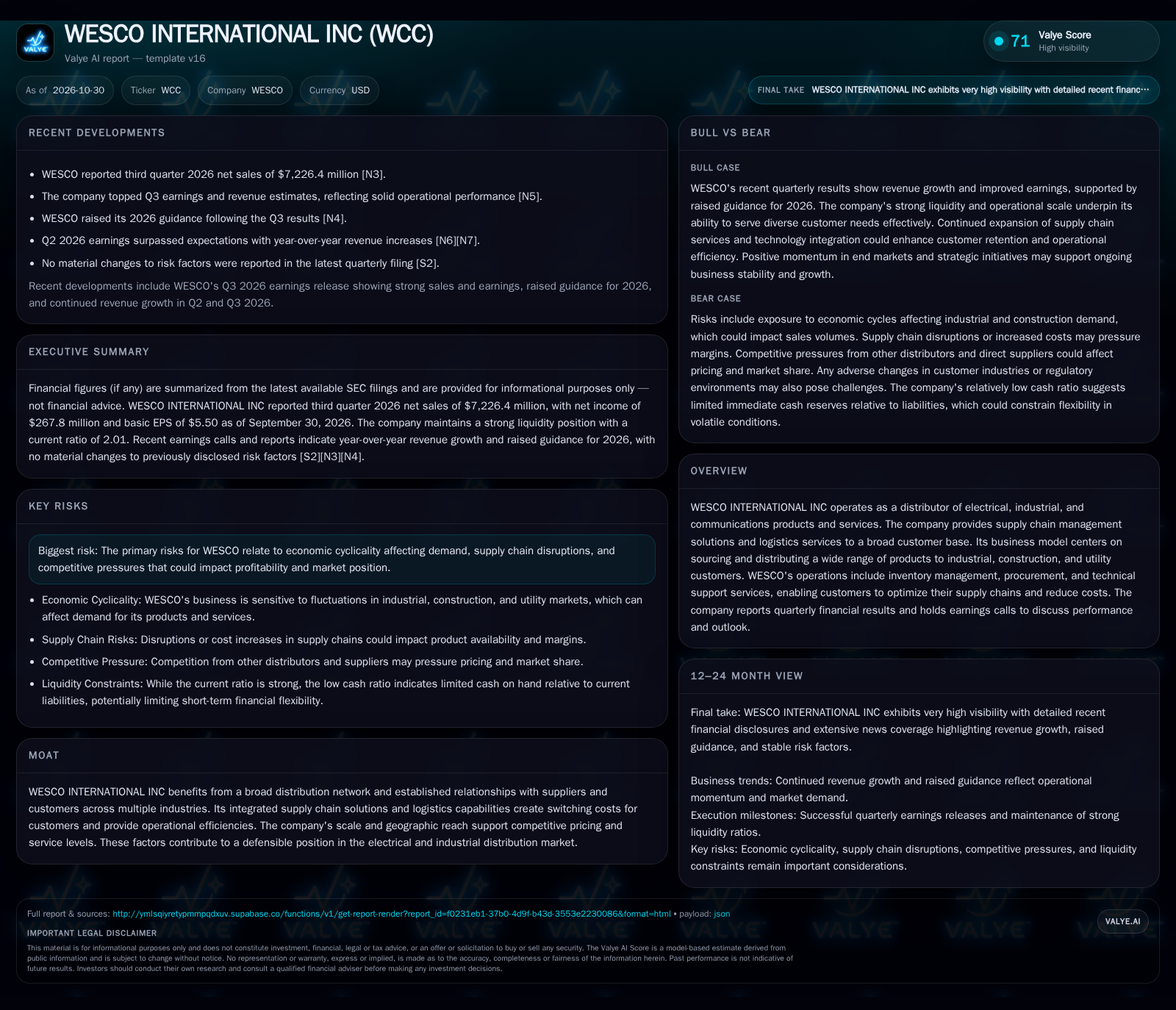
WESCO posted robust Q3 2026 results with $7.2B in net sales, exceeded estimates, and raised full-year guidance. The core question: Can WESCO’s scale and integration offset the inherent risks of its end-market exposure? [N3] [S2] [N4]
As WESCO leans into integrated solutions and scale advantages, the central question is whether these strengths can consistently outpace the structural risks of its end markets.
Recent Results Spotlight Scale and Momentum, But Liquidity Structure Draws Scrutiny
WESCO delivered net sales of $7,226.4 million in Q3 2026, with net income of $267.8 million and basic EPS of $5.50—results that exceeded analyst expectations and prompted management to raise full-year guidance [N3] [S2] [N4]. [S2] Year-over-year revenue growth in both Q2 and Q3 highlights strong demand across WESCO’s customer base [N6] [N7], while the absence of new risk-factor disclosures signals operational stability for now [S2]. These facts set the stage for a business with significant scale and momentum—yet one where liquidity composition and cyclicality remain essential watchpoints.
How the Distribution Model Drives Margin Potential—and Its Limits
WESCO’s core economics hinge on high-volume, low-margin distribution of electrical, industrial, and communications products, augmented by value-added supply chain and logistics services. Gross margins are typically slim in this sector, but operational efficiency, procurement scale, and value-added services can support incremental margin expansion. The company’s fixed-cost base—distribution centers, logistics infrastructure, technology investments—creates operating leverage when volumes rise, as seen in recent quarters.
Pricing power is typically limited by competition and customer sophistication, though WESCO may extract premium pricing on integrated solutions or in niche categories where technical support and supply chain integration could increase switching costs. The risk is that in downturns, volumes can fall faster than costs adjust, compressing margins and straining cash flows. The company’s raised guidance and recent outperformance suggest that, for now, scale and service breadth are winning—but the fundamental economics remain sensitive to both end-market demand and the cost of working capital.
An additional factor influencing WESCO’s margin potential is the interplay between inventory management and supplier terms. Efficient inventory turnover reduces holding costs and obsolescence risk, but maintaining service levels often requires safety stock buffers, which tie up working capital. The company’s ability to negotiate favorable payment terms with suppliers can mitigate this capital intensity, but such terms may vary with market conditions and supplier concentration. Furthermore, fluctuations in commodity prices and transportation costs can squeeze gross margins unpredictably, necessitating agile pricing strategies and cost controls. If WESCO can leverage data analytics to optimize inventory and procurement, it may enhance margin resilience despite external cost pressures.
Integrated Supply Chain Capabilities Form a Defensive Moat—But Substitution and Price Pressure Persist
WESCO’s competitive position is rooted in its national distribution footprint, supplier relationships, and ability to bundle logistics, inventory management, and technical services for large industrial, utility, and construction clients. These integrated offerings create customer stickiness by embedding WESCO deeper into the procurement and operations processes of its customers, raising switching costs and reducing the appeal of transactional competitors.
However, the distribution sector remains highly competitive and fragmented, with large peers and regional specialists vying for share. Digital procurement platforms and direct sales by manufacturers represent substitution risks, especially for less differentiated SKUs. WESCO’s scale enables competitive pricing and broad product access, but margin pressure is a constant reality. The company’s ability to defend its moat depends on continuing to invest in technology, maintaining service reliability, and deepening integration with customers’ supply chains—while also managing cost pressures from suppliers and the risk of technological disintermediation.
The competitive landscape also demands continuous innovation in digital capabilities. As customers increasingly adopt e-procurement platforms, WESCO’s investment in seamless digital interfaces and real-time inventory visibility could become critical differentiators. However, digital transformation requires upfront capital and organizational change, which could pressure near-term margins. Moreover, the rise of direct-to-customer sales by manufacturers challenges traditional distributor roles, especially for commoditized products. WESCO’s success in defending its moat will depend on its ability to evolve beyond transactional distribution towards consultative partnerships that embed its services into customers’ operational workflows, thereby creating higher switching costs and reducing vulnerability to commoditization.
If Cycle Resilience and Service Integration Outweigh Macro Volatility
The bull case for WESCO is that its scale, supply chain integration, and value-added services enable it to capture outsized share as customers consolidate vendors and seek efficiency in procurement. If end-market demand remains resilient—helped by ongoing infrastructure investment or reshoring trends—WESCO could see sustained volume growth, improved operating leverage, and incremental margin expansion as fixed costs are absorbed over a higher revenue base.
Falsification would be signaled by a sharp drop in volumes or margins despite stable macro conditions, or by customer churn indicating that WESCO’s integrated model is losing its stickiness.
If WESCO successfully deepens its integration with customers’ supply chains, it could unlock cross-selling opportunities and expand its service portfolio, further enhancing revenue visibility and margin stability. For example, offering predictive analytics or just-in-time delivery services tailored to specific industries could differentiate WESCO from competitors. Additionally, if infrastructure spending or reshoring trends accelerate, the company might benefit from expanded project pipelines and longer-term contracts, which typically carry better margins. However, realizing this upside requires sustained investment in technology and talent, and the ability to scale these solutions without diluting service quality. Failure to execute on these fronts could limit the potential benefits of scale and integration.
Operational Momentum Persists, but Cyclical Sensitivity Remains
The most plausible scenario is that WESCO continues to execute well, matching or modestly exceeding its updated 2026 guidance, with revenue growth decelerating but remaining positive as end markets normalize.
Confirmation would come from quarterly results that track guidance, stable or improving days sales outstanding and inventory turns, and no material adverse changes in risk disclosures. Evidence against this scenario would include a sudden deterioration in one or more end markets, a spike in bad debts or inventory write-downs, or any sign that liquidity constraints are forcing asset sales or curtailing investment.
A Demand Shock or Supply Chain Disruption Tests the Model’s Flexibility
In a negative scenario, an economic downturn or sector-specific slowdown leads to a sharp drop in industrial and construction demand. Supply chain disruptions—whether from geopolitical events, transportation bottlenecks, or supplier bankruptcies—could further erode reliability and customer satisfaction.
Confirmation would include missed guidance, negative revenue or earnings surprises, or a material increase in short-term borrowing. A downgrade in risk factors or a change in auditor language around going concern would strongly indicate that the downside is materializing. Signs of customer attrition or loss of major supplier relationships would further amplify downside risks.
Milestones and Metrics That Will Define WESCO’s Resilience and Growth Trajectory
Quarterly revenue growth versus guidance and consensus estimates, as a direct measure of end-market demand and execution.
Gross margin trends by product and service line—if disclosed—to assess the contribution of value-added services versus core distribution.
Operating cash flow and free cash flow conversion, especially relative to net income, to test the sustainability of working capital management.
Days sales outstanding and inventory turnover metrics, which would reveal shifts in customer payment behavior or inventory risk if disclosed.
Short-term debt levels and revolver utilization, as indicators of liquidity management and potential stress points.
Customer retention rates and contract renewal activity—if disclosed—to gauge the durability of WESCO’s integrated supply chain relationships.
Any updates to risk factor disclosures or auditor language in SEC filings, which could signal emerging pressures or vulnerabilities.
Major wins in new verticals or large account expansions, which would validate the upside scenario of share gains through integration and scale.
Disclaimer: This is research-only, informational analysis and not investment advice. It may include AI-generated interpretation and general industry context. Always verify important details using primary sources.

Comments