
Alcoa’s Strategic Expansion: South32 Deal, Financing Stakes, and the Future of Integrated Aluminum
Alcoa is navigating a pivotal juncture—leveraging reported liquidity position and profitability to pursue the acquisition of South32's bauxite, alumina, and aluminum assets. This bold move, financed with a $2.6 billion debt issuance, could reshape Alcoa’s competitive standing, but also raises questions about integration risk, cost pressures, and the sustainability of its operating model as global aluminum markets remain volatile.
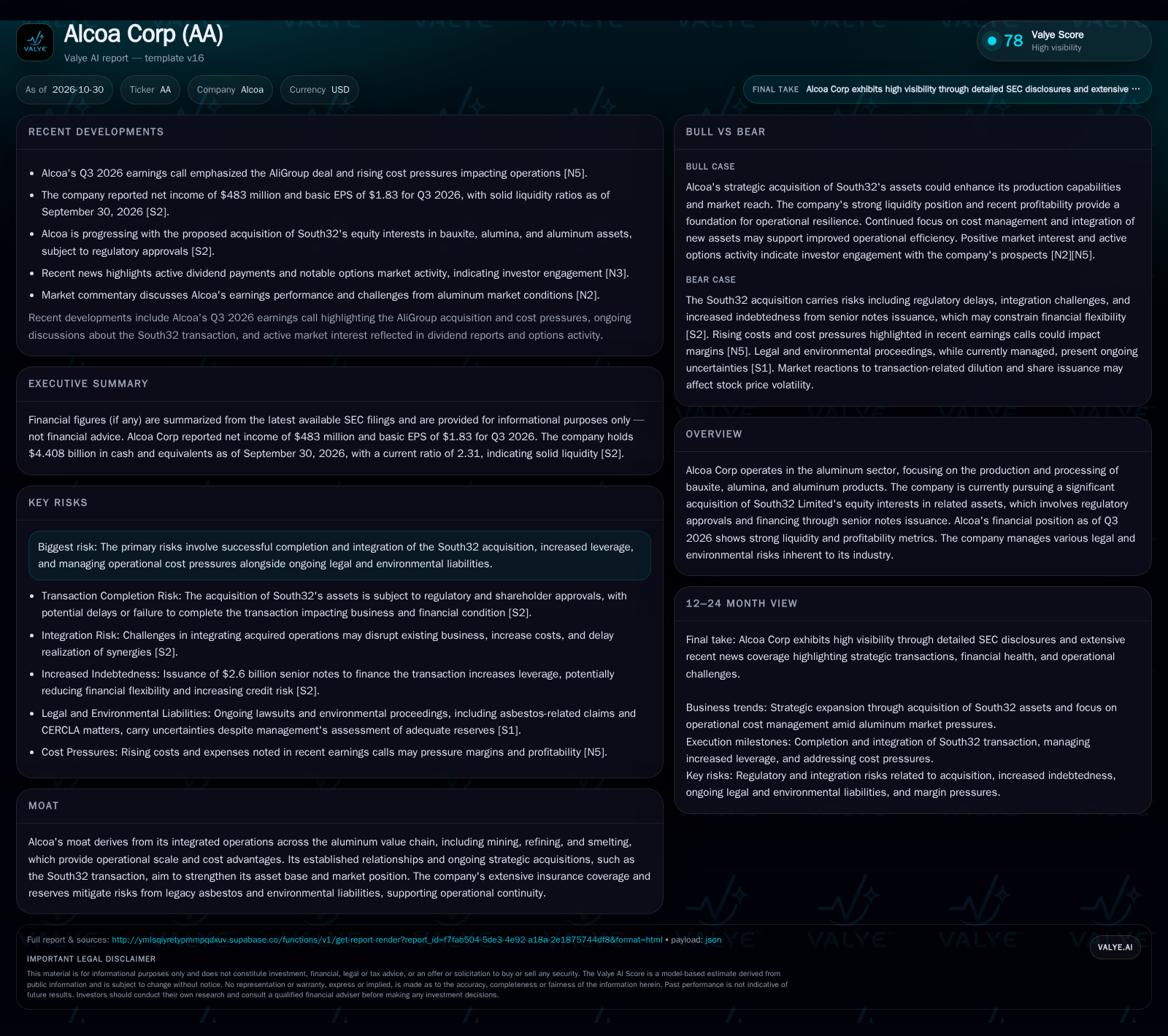
Alcoa’s Q3 2026 results show robust profitability and liquidity, but the company is making a major bet on expanding its integrated aluminum platform via the South32 asset acquisition. The deal, financed in part by $2.6 billion in new senior notes, could strengthen Alcoa’s cost position and market reach, but brings leverage and execution risk. The outcome will hinge on successful integration, cost discipline, and navigating a challenging aluminum price environment. [S2]
Alcoa Corp stands at a strategic crossroads, balancing financial strength with bold expansion ambitions. The company’s Q3 2026 results reflect both operational resilience and a willingness to undertake considerable risk in pursuit of scale. By seeking to acquire South32’s bauxite, alumina, and aluminum assets, Alcoa aims to reinforce its position as an integrated aluminum powerhouse. However, this move—financed by a substantial $2.6 billion debt issuance—brings the dual challenges of heightened leverage and complex integration. With aluminum markets showing persistent volatility and input costs rising, the stakes for Alcoa’s next phase are high: success could mean durable competitive advantages, while missteps could expose the company to financial and operational headwinds.
Alcoa’s Present Defined by Strategic Acquisition and Capital Structure Shift
Alcoa’s Q3 2026 financials show a company in robust health: $483 million in net income, basic EPS of $1.83, and $4.408 billion in cash with a current ratio of 2.31. The company reported cash and liquidity metrics for the period; these figures do not by themselves establish operating runway, investment capacity, financial flexibility, or financing capacity. To support this acquisition, Alcoa issued $2.6 billion in senior notes, a move that materially increases leverage and signals a bet on future returns from enlarged scale. The acquisition remains subject to regulatory and shareholder approvals, and its outcome will directly affect Alcoa’s ownership structure and potentially its stock price. [S2]
These moves occur amid persistent legal and environmental liabilities—chiefly CERCLA and asbestos matters—with management maintaining that reserves are adequate and do not expect a material adverse impact. While these risks are managed, they remain a recurring feature of Alcoa’s operating environment. [S1]
Recent earnings calls and news coverage have highlighted both the potential of the South32 transaction and the headwinds from rising costs and aluminum market volatility, underscoring the importance of successful integration and disciplined capital management. [N2] [N5]
Financial Leverage and Integrated Value Chain Form Alcoa’s Economic Foundation
Alcoa’s business model relies on vertical integration across bauxite mining, alumina refining, and aluminum smelting. This structure is designed to capture margin at each stage of the value chain, shield the company from third-party supply shocks, and optimize cost through asset proximity and operational scale. Revenue is driven by the global pricing of aluminum and alumina, both highly cyclical and subject to commodity market swings. Alcoa’s cost structure is a mix of fixed costs (plant and equipment, labor, environmental compliance) and variable costs (energy, raw materials such as caustic soda, petroleum coke, and bauxite).
The acquisition of South32’s assets, if completed, could enhance Alcoa’s access to low-cost bauxite and alumina, potentially improving its cost curve positioning and increasing bargaining power with customers and suppliers. However, the $2.6 billion in new senior notes used to finance the deal increases interest expense and reduces potential financial flexibility, making cost discipline and synergy realization critical to maintaining profitability. If integration is successful, operating leverage could magnify earnings in a rising price environment; conversely, increased debt service could exacerbate downside risk if commodity prices weaken.
Capital intensity remains high in the aluminum sector, with ongoing needs for mine development, plant maintenance, and regulatory compliance.
Alcoa’s Competitive Edge Built on Scale and Sustainability Efforts
Alcoa is positioned as one of the world’s largest alumina producers outside China and a major bauxite miner, benefitting from integrated operations and strategically located refineries. The company’s cost position—recently in the first quartile of global alumina producers—has been challenged by lower bauxite grades in Australia, though the South32 acquisition could help restore or reinforce cost advantages. Alcoa’s competitors include global mining and metals firms (such as Rio Tinto, Glencore, and South32 prior to the deal), commodity traders, and producers of substitute materials (steel, copper, composites, etc.).
Alcoa’s sustainability-branded products (EcoDura, EcoLum, EcoSource) target growing demand for low-carbon and recycled aluminum, potentially creating differentiation in markets sensitive to environmental performance. However, the competitive landscape remains intense, with Chinese and Indonesian producers expanding capacity and often benefiting from different cost structures and regulatory regimes. The degree to which Alcoa can monetize sustainability advantages will depend on customer willingness to pay premiums, regulatory shifts, and the company’s ability to scale production of these products.
Switching costs for customers are typically low in commodity markets, though long-term supply agreements and reliability may create some stickiness. The risk of substitution by alternative materials (especially in automotive and construction) is ever-present, but the lightness and recyclability of aluminum continue to support demand in key sectors.
Potential for Step-Change Value from Integration Synergies and Market Recovery
If Alcoa successfully completes the South32 acquisition, rapidly integrates the new assets, and realizes targeted synergies, it could materially improve its cost position and expand its global market share in bauxite and alumina. The enlarged asset base would give Alcoa greater supply chain control, potentially enabling more consistent margins even amid volatile aluminum prices. Should global aluminum demand recover—driven by infrastructure investment, automotive electrification, and packaging—Alcoa could achieve outsized earnings leverage due to its increased scale and integrated operations.
Confirmation of this scenario would require evidence of smooth regulatory approval and deal closing, timely realization of cost and operational synergies (e.g., lower unit costs, improved asset utilization), and positive volume growth in premium sustainability products. Sustained or rising aluminum prices, coupled with disciplined capital allocation and stable or improving credit metrics, would further corroborate the upside case.
Falsification would come from delayed or failed integration, lack of synergy capture, or a persistent inability to improve cost positioning relative to global competitors.
Managing Elevated Leverage and Incremental Gains in a Volatile Market Post-Deal
The most plausible trajectory is that Alcoa completes the South32 transaction with moderate integration challenges—achieving some, but not all, of the anticipated synergies. The company’s vertically integrated model helps buffer against the worst of commodity price swings, but rising costs (energy, inputs, labor) and global aluminum price volatility limit margin expansion. The increased debt burden from the $2.6 billion senior notes constrains capital allocation, with management prioritizing debt service and essential maintenance over aggressive growth or shareholder returns.
Alcoa’s sustainability offerings gain incremental traction, but premium pricing remains limited by competitive pressures and customer price sensitivity. Legal and environmental liabilities remain manageable but continue to require ongoing attention and reserves. The company maintains positive net income, but earnings are more volatile and less robust than in the pre-acquisition period.
This scenario would be confirmed by steady, but unspectacular, margin and volume trends, stable (but not improving) credit metrics, and evidence of cost management offsetting only part of the inflationary pressures.
Risks from Execution Challenges and Weak Market Conditions Could Pressure Alcoa’s Finances
In the adverse scenario, Alcoa faces significant regulatory delays or fails to close the South32 transaction, incurring costs without realizing the intended asset benefits. Alternatively, if the deal closes but integration is poorly executed, operational disruptions and underperformance of acquired assets could erode margins. Rising interest costs from the increased leverage, combined with persistent input cost inflation and a downturn in global aluminum demand, could compress earnings and stress the balance sheet.
Credit metrics could deteriorate, leading to higher borrowing costs or reduced access to capital. If legal or environmental liabilities materialize above reserved amounts, or if commodity price declines are sharper or more prolonged than anticipated, Alcoa could be forced to curtail investment, suspend dividends, or pursue asset sales to shore up liquidity.
Evidence supporting this scenario would include missed integration milestones, negative revisions to synergy targets, declining profitability, credit rating downgrades, or adverse legal settlements exceeding reserves.
Factors Influencing the Long-Term Success of Alcoa’s Expansion
Progress and timing of regulatory and shareholder approvals for the South32 acquisition; delays or unexpected conditions would directly impact the thesis.
Actual closing of the South32 transaction and the terms achieved, including any adjustments to purchase price or financing.
Integration milestones: realization of targeted synergies, operational performance of acquired assets, and any material disruptions or cost overruns.
Trends in Alcoa’s unit cash cost of alumina and aluminum production post-acquisition, especially relative to global quartile benchmarks (if disclosed).
Aluminum and alumina price trends, and Alcoa’s realized pricing versus industry averages.
Volume and margin growth in sustainability-branded products (EcoDura, EcoLum, EcoSource); a useful metric would be premium pricing achieved or share of sales.
Movement in leverage ratios and interest expense, especially in the first year post-acquisition.
Any significant changes in legal or environmental liability reserves, or disclosure of new material proceedings.
Disclaimer: This is research-only, informational analysis and not investment advice. It may include AI-generated interpretation and general industry context. Always verify important details using primary sources.

Comments