
OneSpaWorld: Earnings Leverage from Cruise Wellness Demand Meets the Realities of Contractual and Cyclical Exposure
OneSpaWorld’s latest quarter underscores its ability to translate robust cruise industry demand into record spa and wellness revenues, but the company’s fortunes remain tightly linked to cruise sector cycles and the durability of its concession agreements. As cruise travel remains resilient, questions persist around contract renewal dynamics, cost containment, and the company’s ability to diversify revenue streams beyond its core niche.
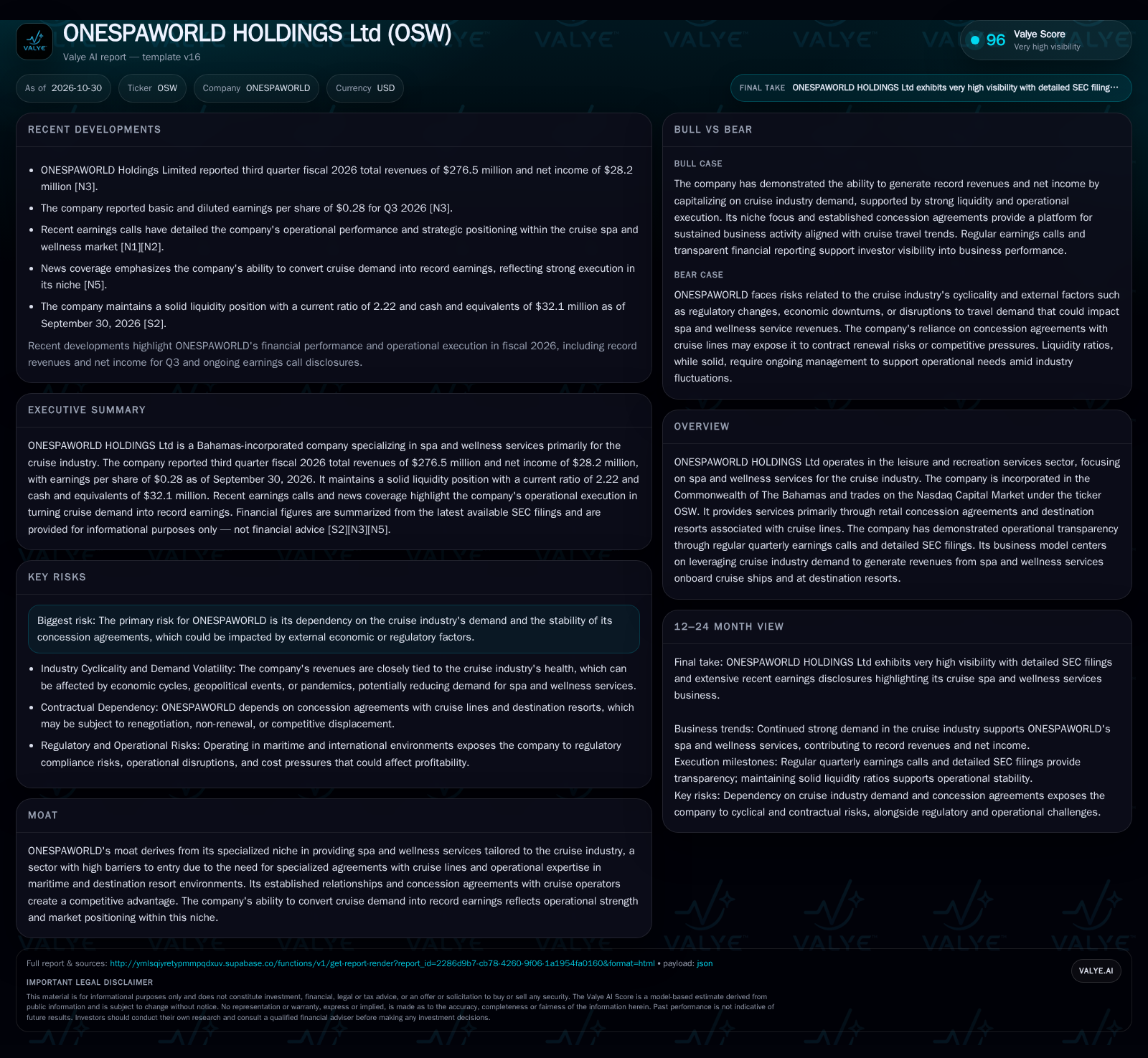
OneSpaWorld posted $276.5 million in Q3 2026 revenue and $28.2 million in net income, reflecting strong operational execution in cruise spa services. While its liquidity metrics are solid, the business remains exposed to cruise industry swings and the renewal terms of its key concession agreements. The company’s current strength is clear, but long-term resilience will depend on navigating cyclical downturns and evolving its business model.
OneSpaWorld has emerged as a standout in the niche of cruise-based spa and wellness services, most recently translating the cruise sector’s post-pandemic rebound into record quarterly earnings. With $276.5 million in revenue and $28.2 million in net income for Q3 2026, the company is demonstrating the earnings power of its specialized model. Yet, as much as operational execution has delivered, OneSpaWorld’s exposure to cruise line cycles and the nuances of concession agreements means that future stability is far from guaranteed. The next phase will test whether its current momentum is structural or simply a function of favorable external conditions.
Quarterly Results Reveal High Cruise Exposure and Strong Execution
OneSpaWorld reported Q3 2026 revenue of $276.5 million and net income of $28.2 million, with basic and diluted EPS at $0.28 [S2] [N3]. The company’s cash and equivalents stood at $32.1 million, and its current ratio was 2.22 as of September 30, 2026 [S2]. These results reflect not only the ongoing recovery and strength in cruise travel but also the company’s ability to capitalize on that demand through its spa and wellness services. News coverage and recent earnings calls have highlighted this operational execution, suggesting that the company is effectively converting the sector’s momentum into bottom-line results [N5]. However, these numbers also reinforce OneSpaWorld’s dependence on the health of the cruise industry and the resilience of its concession agreements for sustained performance.
How Cruise Spa Concessions Translate Demand into Profits
OneSpaWorld’s revenue model centers on concession agreements with cruise lines, allowing it to operate spa and wellness services onboard ships and at affiliated destination resorts. The company’s top line is therefore tightly coupled to cruise passenger volume, occupancy rates, and consumer discretionary spending aboard ships. Variable revenue drivers include service utilization per passenger, product attachment rates, and the pricing of high-margin wellness treatments. Fixed costs are likely dominated by staffing, equipment, and the minimum guarantees or revenue-sharing terms negotiated in its concession contracts.
Operating leverage is a core feature: as cruise volumes rise, incremental spa visits and upsell opportunities can flow through to the bottom line with limited additional overhead. However, the model is vulnerable to sudden declines in cruise activity, which can leave fixed costs exposed and compress margins. The company reported cash and liquidity metrics for the period; these figures do not by themselves establish operating runway, investment capacity, financial flexibility, or financing capacity. OneSpaWorld’s ability to negotiate favorable contract terms and manage labor costs will be a major determinant of margin sustainability.
Cruise Spa Niche: Barriers, Substitutes, and the Threat of Renegotiation
OneSpaWorld benefits from meaningful barriers to entry in the cruise spa segment. Its moat stems from long-standing relationships and specialized concession agreements with major cruise lines, which require operational expertise in maritime environments and compliance with stringent health and safety standards. New entrants face a steep learning curve, regulatory complexity, and the challenge of winning contracts with cruise operators who value reliability and guest satisfaction.
However, switching costs for cruise lines are not insurmountable. If a competitor can offer better economics, superior guest experiences, or innovative wellness concepts, contract renewal risk rises. Substitutes—such as cruise lines bringing spa operations in-house, or partnering with global wellness brands—could erode OneSpaWorld’s share. On land, the company faces competition from resort spas and wellness providers, though these are less direct threats. The competitive landscape is defined by concession model incumbency, but the risk of competitive displacement at contract renewal remains a persistent overhang.
Sustained Cruise Growth and Contract Extensions Drive Earnings Above Trend
A bullish scenario sees cruise passenger volumes continuing to surpass pre-pandemic levels, driven by pent-up travel demand and demographic tailwinds. If cruise lines expand fleets and itineraries, OneSpaWorld could see both organic volume growth and opportunities to negotiate new or expanded concession agreements. Successful cross-selling of higher-margin wellness products, digital services (e.g., onboard health apps), or premium service tiers could further boost average revenue per passenger.
The upside would be confirmed by consistent revenue outperformance relative to cruise industry benchmarks, disclosure of new or extended multi-year contracts, and evidence of margin expansion through operational efficiencies or product mix shift. A reduction in customer concentration or successful entry into adjacent hospitality verticals would further de-risk the story and support a higher earnings base.
Cruise Cyclicality Keeps Growth Lumpy Despite Operational Strength
The most plausible path is that OneSpaWorld continues to perform in line with the cruise industry’s broader cycles: strong results during periods of high demand, but with periodic slowdowns tied to macroeconomic shocks, geopolitical events, or health scares. Contract renewals generally proceed in OneSpaWorld’s favor, but terms may tighten as cruise operators seek more favorable economics or introduce competitive bidding. Margins remain healthy, but wage inflation and rising operational costs put a ceiling on further expansion.
This scenario would be confirmed by quarterly earnings that closely track cruise passenger growth, relatively stable but not expanding margins, and periodic contract announcements with existing cruise partners. A lack of meaningful diversification outside the cruise channel would maintain the company’s exposure to industry-specific volatility.
Contract Losses or Cruise Downturns Expose Fixed Costs and Squeeze Margins
A negative turn for OneSpaWorld could materialize if cruise demand falls due to economic recession, geopolitical instability, or renewed public health concerns. In this environment, cruise lines could renegotiate concession agreements on less favorable terms, or even bring spa operations in-house to cut costs. If OneSpaWorld loses key contracts or faces shortened renewal periods, revenue could decline sharply while fixed costs remain, leading to margin compression and the risk of cash burn.
Evidence of this scenario would include sequential revenue declines outpacing cruise industry contraction, disclosures of lost or non-renewed contracts, rising SG&A as a percentage of revenue, or negative operating cash flow. Inability to pivot toward land-based or alternative wellness channels would exacerbate the impact.
Signals That Will Determine If OneSpaWorld’s Cruise Earnings Are Built to Last
The cadence and terms of major concession agreement renewals or new wins with key cruise line partners. Disclosure of multi-year contract extensions, new ship launches, or expanded partnerships would be especially telling.
Trends in cruise industry passenger volumes and occupancy rates, as these directly influence OneSpaWorld’s addressable market and utilization rates.
Gross margin and operating margin evolution—particularly any evidence of wage inflation, cost pressures, or improvements from operational efficiency.
Revenue and profit concentration by cruise line or geography. Increased customer diversification would reduce risk.
Development or acquisition of new wellness offerings (e.g., digital wellness, land-based resorts) that could reduce dependency on the cruise channel.
Quarterly cash flow from operations versus net income, as a test of earnings quality and working capital discipline.
If disclosed, churn or renewal rates for existing contracts, and any commentary on the competitive bidding environment for cruise spa concessions.
Disclosure of minimum guarantees, revenue-sharing thresholds, or contract payment terms to better understand the company’s risk exposure in downturns.
Disclaimer: This is research-only, informational analysis and not investment advice. It may include AI-generated interpretation and general industry context. Always verify important details using primary sources.

Comments