
AA Mission Acquisition Corp. II: Sourcing, Execution, and the China Nexus in a Challenging SPAC Market
AA Mission Acquisition Corp. II is an early-stage SPAC with a management team deeply tied to the food and beverage sector and China-related deal flow. With $115 million in IPO proceeds and no operating revenues, its success hinges on sourcing and closing a high-quality business combination, all while navigating regulatory headwinds and a narrowing pool of targets.
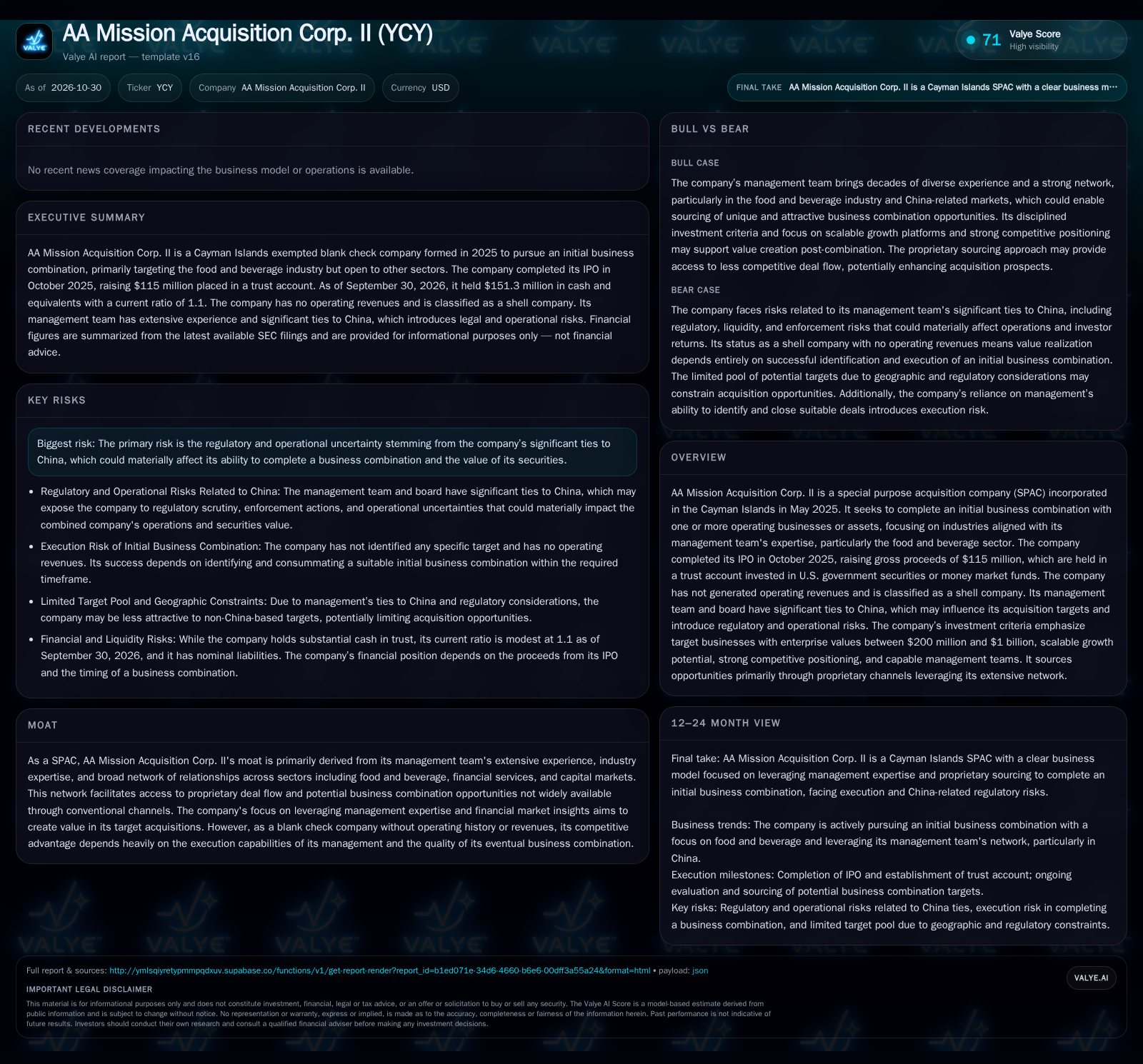
AA Mission Acquisition Corp. II has raised $115 million in IPO proceeds and is actively seeking a business combination, focusing on the food and beverage sector but not limited to it. The management team’s strong China ties provide proprietary deal sourcing advantages but also introduce regulatory and execution risks. The company’s lack of operating revenue and modest current ratio underscore the urgency and importance of deal execution. Success or failure will depend on the team’s ability to identify, negotiate, and close a transaction with a scalable, competitively positioned target within the regulatory and market constraints it faces. [S2]
AA Mission Acquisition Corp. II stands at a familiar crossroads for early-stage SPACs: flush with IPO proceeds, but with the clock ticking on sourcing and closing a transformative business combination. With $115 million in trust and a management team whose expertise and networks center on the food and beverage sector and China-related deal flow, the company’s future will be defined by its ability to identify and execute a deal that meets its investment criteria—while contending with regulatory scrutiny, a narrowing pipeline of targets, and the shifting sands of cross-border capital markets. The stakes are high: without a successful combination, the SPAC faces the prospect of returning capital to shareholders, while a poorly executed deal could destroy value and erode investor trust.
IPO Proceeds, Cash Position, and the Search for a Target
As of September 30, 2026, AA Mission Acquisition Corp. II reported $151.3 million in cash and equivalents, total current assets of $286.7 million, and current liabilities of $261.1 million, yielding a current ratio of 1.1 and a cash ratio of 0.58. These figures underscore its status as a pre-combination SPAC, with nearly all resources held in trust and no operating revenues generated to date. The company completed its IPO on October 2, 2025, raising $115 million, and has not yet selected or entered into substantive negotiations with a business combination target. The company’s investment criteria target businesses with enterprise values between $200 million and $1 billion, a range that aligns with its available capital and the need for a scalable, growth-oriented opportunity. [S2]
The management team’s extensive ties to China and the food and beverage industry shape both its sourcing strategy and the regulatory risk landscape. Notably, the company will not pursue targets employing variable interest entity (VIE) structures—a nod to heightened regulatory scrutiny in cross-border transactions involving China. These elements are critical, as the company’s future rests entirely on the successful execution of a business combination within the SPAC’s defined timeframe.
SPAC Economics: Trust, Dilution, and the High-Stakes Business Combination
As a SPAC, AA Mission Acquisition Corp. II’s economics are binary and event-driven. Until a business combination is consummated, the company earns only modest interest income from trust assets, while incurring public company and deal-sourcing expenses. The real economic engine will be the target business it acquires; thus, all future revenue, margin, and cash flow projections are contingent on the nature of that target and the terms of the transaction.
SPACs typically face significant dilution from sponsor shares and warrants, which can erode post-combination value for public shareholders if the acquired business does not deliver rapid operational and financial improvement. The company’s $115 million in gross IPO proceeds (now $151.3 million in cash and equivalents due to interest income) sets the upper bound for available capital, though actual deal proceeds may be reduced by redemptions if shareholders opt to exit rather than participate in the post-combination entity.
The investment criteria—targeting businesses valued between $200 million and $1 billion—suggest the company will likely need to supplement trust capital with PIPE (private investment in public equity) financing, seller rollover equity, or debt. The quality, scalability, and cash generation profile of the eventual target will determine whether the post-merger company can support public market scrutiny, justify the dilution, and deliver the operating leverage needed to create value.
Deal Sourcing, Proprietary Networks, and the China Regulatory Backdrop
AA Mission Acquisition Corp. II’s competitive edge—as with many SPACs—lies in the credibility, sector knowledge, and networks of its management team. The team’s experience in food and beverage, capital markets, and cross-border transactions, especially with China, positions the SPAC to access proprietary deal flow that may not be widely available through traditional M&A channels.
However, the same China nexus that provides access also brings substantial counterforces: regulatory uncertainty, geopolitical risk, and investor wariness regarding PRC exposure. The company’s explicit avoidance of VIE structures limits some of the more opaque or risk-prone China-linked targets, but does not eliminate the potential for regulatory intervention, delays, or retroactive policy changes affecting cross-border listings or capital flows.
In the current market environment, where many SPACs are competing for a shrinking pool of high-quality targets, these proprietary networks could provide an advantage. Yet, the company also faces competition from direct acquirers, private equity, and other SPACs—many of whom are now offering more founder-friendly terms or targeting less regulated sectors.
If Sourcing and Execution Align: Unlocking Value Through a High-Quality Acquisition
The most favorable outcome for AA Mission Acquisition Corp. II would involve leveraging its management team’s sector expertise and China connections to source an attractive, scalable target in the food and beverage sector (or adjacent industries), one that is not easily accessible to other acquirers. If the chosen target demonstrates strong growth prospects, operational leverage, and a credible management team willing to remain post-combination, the SPAC could successfully close a deal, minimize redemptions, and attract additional PIPE financing to support future growth.
Confirmation of this upside scenario would include the announcement of a definitive agreement with a target that meets the stated investment criteria, limited shareholder redemptions, positive PIPE participation, and early evidence of post-deal revenue growth or margin expansion. The ability to navigate regulatory hurdles—especially those involving cross-border capital flows or approvals—would further bolster confidence in the deal’s value creation potential.
Falsification would come from a failure to secure a PIPE, high redemption rates, or regulatory blocks that delay or derail the transaction—particularly if the target’s business model or ownership structure triggers additional scrutiny.
Most Likely Outcome: Deal Sourcing Remains Challenging Amid Regulatory and Market Headwinds
The most probable path for AA Mission Acquisition Corp. II is a protracted search for a suitable business combination, with the deal environment increasingly competitive and regulatory scrutiny of China-linked transactions remaining high. The proprietary sourcing network may yield unique opportunities, but these could be offset by elevated due diligence costs, longer timelines, or the need to settle for a less differentiated target to meet de-SPAC deadlines.
In this scenario, the company may announce a deal with a mid-sized, growth-oriented target—possibly in the food and beverage sector, but not necessarily China-based. The transaction could require significant PIPE participation to offset shareholder redemptions, and the post-merger entity may face a challenging path to establishing credibility with public market investors.
Confirmation would involve a deal announcement within the SPAC’s required timeframe, moderate redemptions, and a PIPE raise that bridges any capital shortfall. Falsification would be failure to announce a deal before the deadline, or a transaction that is abandoned due to redemptions, regulatory pushback, or lack of investor support.
Deal Failure, Redemption Wave, or Regulatory Block: Capital Return Looms
The adverse scenario for AA Mission Acquisition Corp. II is defined by failure to secure a viable business combination within the allotted timeframe, a wave of shareholder redemptions that drains available capital, or a regulatory intervention that blocks or materially delays the proposed transaction—particularly if the target is China-linked.
In this case, the SPAC would be forced to return trust capital to shareholders, eroding any sponsor equity and negating the value proposition for all parties. Even if a deal is announced, high redemptions or an inability to secure PIPE financing could leave the post-merger company undercapitalized, illiquid, and unable to execute its growth plan, leading to poor aftermarket performance and potential delisting.
Early warning signs would include repeated extensions of the combination deadline, lack of deal announcements, or press reports of heightened regulatory scrutiny. Falsification would require the company to announce and close a deal with low redemptions and no regulatory delay.
Milestones That Will Define AA Mission Acquisition Corp. II’s Outcome
Announcement of a definitive agreement with a business combination target, including target sector, size, and ownership structure.
Disclosure of PIPE financing commitments and the terms of any supplemental capital raise, if disclosed.
Level of shareholder redemptions at the time of the business combination vote, as a measure of investor confidence and available deal capital.
Regulatory approvals or commentary, especially regarding cross-border transactions or China-linked assets.
Details of the target’s revenue growth, margin profile, and management retention plans, if disclosed.
Any amendments to the SPAC’s combination deadline or requests for shareholder extensions.
Indicators of competitive interest in the same target from other SPACs, private equity, or strategics, if disclosed.
Public commentary or disclosure regarding the company’s ability to avoid VIE structures and maintain compliance with U.S. and Chinese regulations.
Disclaimer: This is research-only, informational analysis and not investment advice. It may include AI-generated interpretation and general industry context. Always verify important details using primary sources.

Comments