
Cherry Hill Mortgage: Merger Uncertainty, Core Asset Strategies, and the Economics of a Transitional REIT
Cherry Hill Mortgage Investment Corporation faces a pivotal moment as it navigates a pending merger with MITT, recent earnings volatility, and the operational consequences of its internalized management structure. The company's integrated approach to RMBS and servicing assets, combined with prudent leverage and hedging, shapes its risk–reward profile amid sector headwinds and consolidation risks.
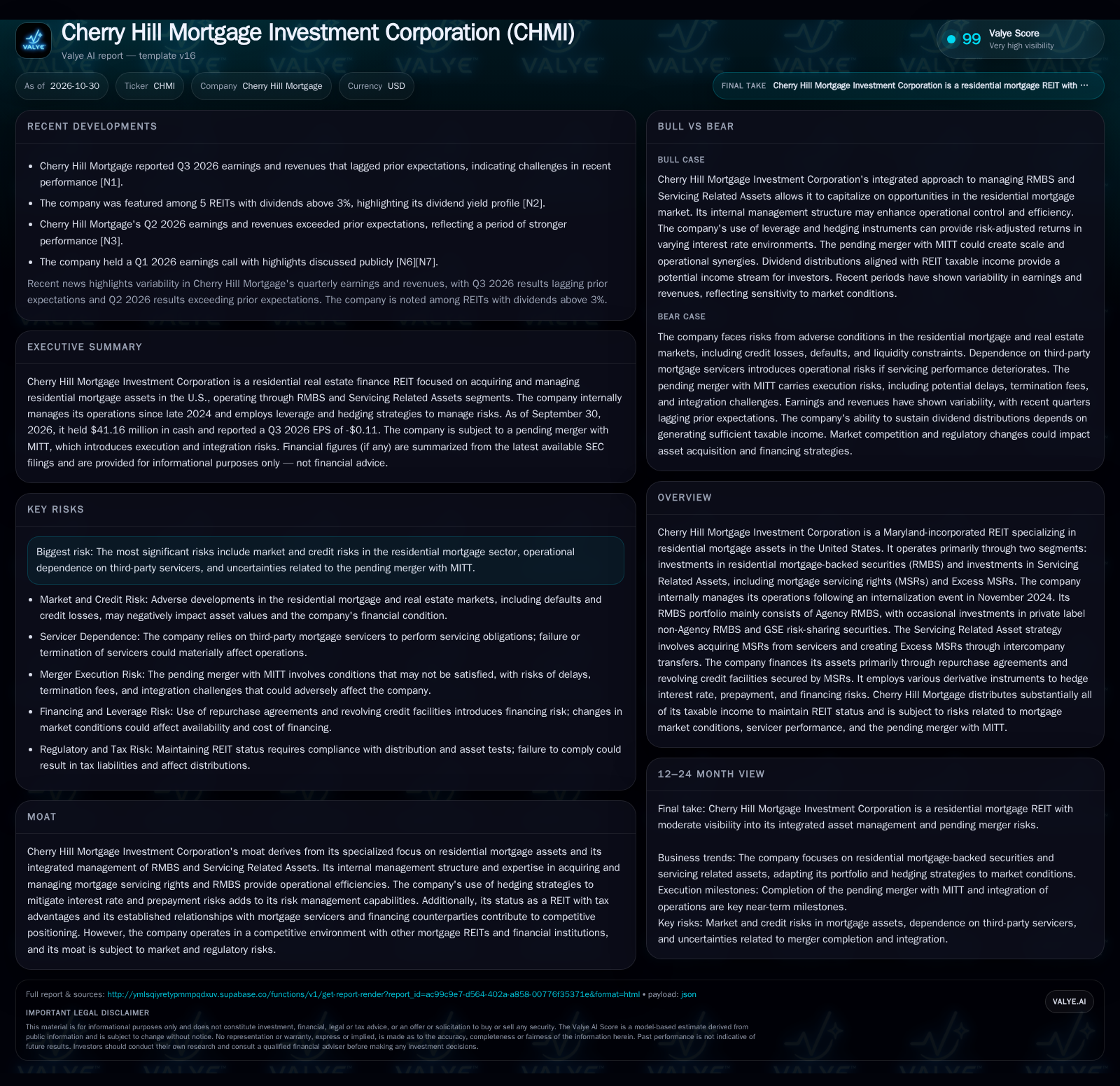
Cherry Hill Mortgage Investment Corporation, a residential mortgage REIT, is contending with a pending merger, earnings volatility, and the operational impact of a recent internalization. Its dual focus on Agency RMBS and mortgage servicing rights defines its economics, but the business is exposed to interest rate, credit, and servicer performance risks. The outcome of the MITT merger and the company's ability to stabilize earnings are key near-term variables. [S2] [N1] [N3]
Cherry Hill Mortgage Investment Corporation finds itself at a strategic crossroads. After internalizing management in late 2024 to streamline operations, the company now faces a pending merger with MITT, which brings both potential scale and significant integration risks. Recent quarterly results have swung from outperformance to underperformance, underscoring the inherent volatility in its mortgage-focused REIT model. Cherry Hill’s approach—balancing Agency RMBS, mortgage servicing rights, prudent leverage, and hedging—offers risk mitigation but also exposes the company to the sector’s structural challenges. The next phase hinges on the merger’s outcome, earnings stabilization, and operational resilience in a shifting mortgage finance landscape. [S2] [N1] [N3]
Merger Overhang, Earnings Volatility, and Internalization Define the Present
Cherry Hill Mortgage’s most material current facts are: (1) Q3 2026 earnings and revenues lagged expectations, reversing Q2’s outperformance; (2) the company completed internalization of management in November 2024; (3) it is subject to a pending merger with MITT, which introduces execution risk, dividend caps, and uncertainty regarding future strategy and integration; and (4) as of September 30, 2026, it held $41.16 million in cash and reported a Q3 EPS of -$0.11. These developments matter because they frame the company’s near-term potential financial flexibility, signal operational transition risk, and set the stage for potentially transformative corporate action. The cited source reports dividend-related activity; that disclosure alone does not establish dividend-policy continuity, management confidence, or a material constraint on capital flexibility. [S2] [N1] [N3]
How Cherry Hill Mortgage Makes—and Risks—Money in Residential Finance
Cherry Hill Mortgage’s business model is built on managing a portfolio of Agency residential mortgage-backed securities (RMBS) and mortgage servicing rights (MSRs), occasionally complemented by non-Agency RMBS and GSE risk-sharing securities. Revenue comes from net interest income on the spread between asset yields and funding costs, as well as servicing fee income and excess servicing strip economics. The company finances most RMBS positions with short-term repurchase agreements, and MSRs through revolving credit facilities, introducing significant exposure to short-term funding market dynamics. [S2]
The economics of this model are acutely sensitive to the shape of the yield curve, prepayment speeds, and credit spreads. Agency RMBS offer lower credit risk due to government backing but are highly exposed to interest rate movements and convexity risk. MSRs, by contrast, benefit when prepayment activity is low (extending the income stream) but are operationally complex and expose the company to servicer performance risk. Operating leverage can cut both ways: increases in portfolio size or spread can drive outsized gains, but rapid changes in rates or funding costs can quickly erode equity. Internalization of management shifts fixed costs in-house, which could improve long-term alignment and reduce external fee drag, but also increases overhead and requires robust internal controls. [S2]
The company reported cash and liquidity metrics for the period; these figures do not by themselves establish operating runway, investment capacity, financial flexibility, or financing capacity. While prudent leverage can enhance returns, it also magnifies downside in stressed environments. The cited source reports dividend-related activity; that disclosure alone does not establish dividend-policy continuity, management confidence, or a material constraint on capital flexibility.
Where Cherry Hill Stands in the Mortgage REIT Competitive Landscape
Cherry Hill Mortgage operates in a crowded field of residential mortgage REITs, competing against both larger diversified players and niche peers focused on Agency RMBS, MSRs, or hybrid strategies. Its principal advantages stem from internal management (potentially better alignment and lower long-term costs post-internalization), specialization in both RMBS and servicing assets, and established relationships in the mortgage servicing ecosystem. The company’s use of derivatives for hedging and its ability to flex portfolio mix in response to market conditions are important defensive tools.
However, competitive counterforces are significant. Larger REITs may benefit from lower cost of capital, broader access to repo counterparties, and greater scale in hedging and asset acquisition. Substitution risk arises from alternative yield vehicles (such as other REITs, BDCs, or structured credit funds) and from technology-enabled lending and servicing platforms that may disrupt traditional mortgage finance economics over time. The sector’s regulatory environment and the commoditized nature of Agency RMBS mean that sustainable margin advantage is hard to achieve outside of niche asset selection or servicing execution.
A critical area of vulnerability is the company’s dependence on third-party servicers for MSR performance—if these partners stumble, operational risk can quickly become financial risk. The pending merger with MITT may offer scale and diversification, but also raises the specter of integration missteps and culture clash, especially as both firms navigate a volatile rate and credit environment. [S2]
If Integration Succeeds and Spreads Normalize, Returns Could Recover Sharply
The most favorable outcome for Cherry Hill Mortgage would see the merger with MITT completed smoothly, with minimal disruption and effective integration of operations, teams, and asset bases. If the combined entity leverages greater scale to secure better financing terms, optimizes portfolio allocation across RMBS and MSRs, and achieves operating synergies (such as reduced overhead and improved hedging efficiency), earnings power could improve meaningfully. A stable or declining interest rate environment would further support RMBS valuations and reduce funding costs, while subdued prepayment activity would enhance MSR income streams.
Evidence that would confirm this scenario includes: (1) timely and successful merger close, (2) clear communication of post-merger strategy and synergy capture, (3) improvement in quarterly net interest margin and normalized EPS, (4) restoration or growth of dividend distributions post-merger, and (5) stable or growing book value. Conversely, delays, integration issues, or persistent earnings volatility would falsify or delay this outcome. [S2] [N3]
A Transitional Period: Earnings Choppiness Continues as Merger Unfolds
The most plausible near-term path is that Cherry Hill Mortgage continues to experience earnings volatility as it navigates the merger process and sector headwinds. Quarterly results may fluctuate with interest rate movements, repo market conditions, and the performance of underlying mortgage assets. The merger with MITT may close on schedule but require several quarters for integration and synergy realization, during which time dividend distributions remain capped and cost savings are incremental.
Confirmation of this scenario would come from continued swings in quarterly EPS, limited or incremental improvements in net interest spread, cautious management commentary about merger progress, and a measured approach to asset allocation and leverage. Falsifying evidence would be either a rapid, dramatic improvement in profitability and book value (suggesting upside scenario) or severe integration or market shocks leading to capital impairment (suggesting downside). [S2] [N1] [N3]
Merger Disruption or Market Stress Could Trigger Capital Erosion
In the adverse scenario, the merger with MITT is delayed, terminated, or results in significant integration challenges—leading to uncertainty, distraction, and elevated costs. Simultaneously, a sharp rise in funding costs, widening RMBS spreads, or a spike in mortgage prepayment rates could erode net interest income and book value. Operational missteps by third-party servicers or regulatory changes affecting MSR economics would further compound pressure.
Confirmation would include: (1) repeated quarterly EPS losses, (2) growing gap between asset yields and funding costs, (3) repo or credit facility availability tightening, (4) declines in book value per share, and (5) negative management updates on merger status or integration. Recovery from such a scenario would likely require significant portfolio repositioning, capital raising, or strategic re-evaluation. [N1] [S2]
What Will Test the Cherry Hill Mortgage Thesis Amid Transition and Consolidation
Quarterly net interest margin and EPS trends—if disclosed—will reveal whether spread management and hedging are effective in the current rate environment.
Progress and milestones on the MITT merger, including regulatory approvals, closing timeline, and disclosed synergy targets, will be essential for assessing integration risk.
Book value per share and changes in tangible equity will indicate balance sheet resilience or vulnerability to market shocks.
Servicer performance metrics—such as delinquency, advance recoveries, or MSR runoff rates—would help gauge operational risk if disclosed.
Trends in leverage ratios and repo facility utilization, if disclosed, will show the company’s risk appetite and funding flexibility.
Any changes in the portfolio mix between Agency RMBS and MSRs could indicate evolving risk posture and market view.
Management commentary on hedging effectiveness and funding market access during earnings calls would provide qualitative risk context.
Disclaimer: This is research-only, informational analysis and not investment advice. It may include AI-generated interpretation and general industry context. Always verify important details using primary sources.

Comments