
Covista Inc.: Healthcare Education Scale, Online Leverage, and the Strategic Stakes of Liquidity and Competitive Saturation
Covista’s position as America’s largest healthcare educator rests on a portfolio of five accredited institutions and a 100,000-strong student body.
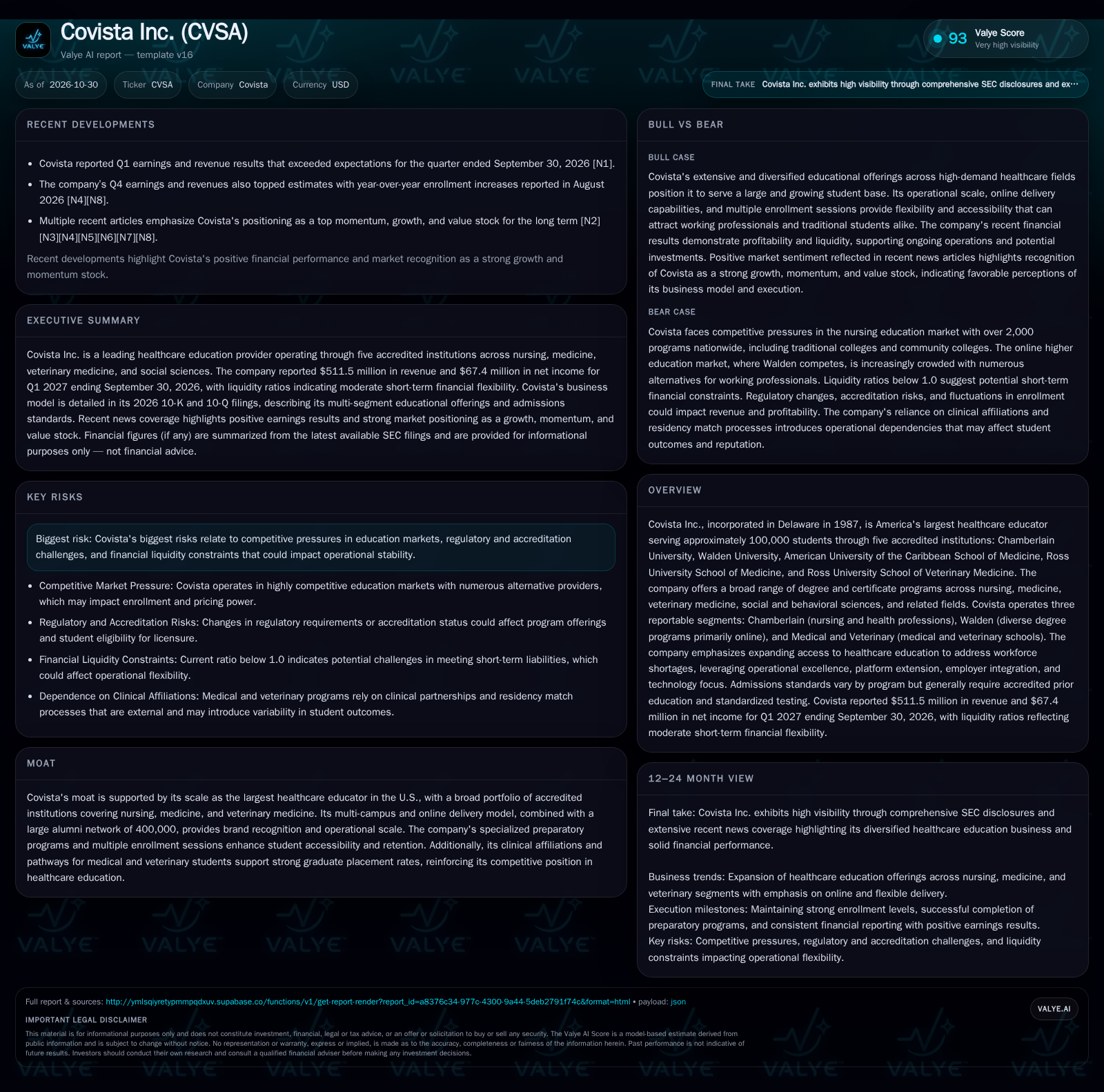
Covista reported $511.5 million in revenue and $67.4 million in net income for the quarter ended September 30, 2026, confirming its status as the largest U.S. healthcare educator by enrollment. Its diversified model across nursing, medicine, veterinary, and online programs supports scale and brand strength, but a current ratio of 0.81 and a crowded competitive landscape highlight potential operational and financial vulnerabilities. The company’s next phase will likely hinge on its ability to convert scale into sustainable pricing, defend enrollments amid intensifying alternatives, and address short-term liquidity pressures without compromising educational quality or reputation. [S1] [S2]
Covista Inc. has emerged as a powerhouse in U.S. healthcare education, leveraging operational scale, diverse program offerings, and a blended delivery model spanning campus-based and online platforms. Its recent financial results highlight both profitability and reach, but the company operates in a sector marked by aggressive competition, regulatory complexity, and growing scrutiny of educational quality and student outcomes. As demographic shifts and healthcare workforce shortages drive demand for training, Covista’s ability to maintain its growth trajectory will depend on converting its scale advantages into durable enrollment and pricing power—while managing liquidity and defending its reputation in a field where alternatives abound.
Latest Financials and Enrollment Underscore Scale—and Spotlight Liquidity Questions
Covista reported $511.5 million in revenue and $67.4 million in net income for the quarter ended September 30, 2026, confirming its operational scale as the largest U.S. healthcare educator by student count, with approximately 100,000 students enrolled across five accredited institutions and an alumni network of 400,000. [S1] [S2] This breadth provides both brand visibility and a diversified revenue base spanning nursing, medicine, veterinary medicine, and social and behavioral sciences.
[S2] In the context of continued growth ambitions, this financial posture could limit flexibility for investments or shock absorption if competitive or regulatory pressures intensify.
The interplay between Covista's sizable student population and its liquidity position is critical, particularly in the context of operational cash flow cycles that may experience seasonal fluctuations. Given the tuition-driven revenue model, timing of tuition payments relative to disbursement of operational expenses can create short-term liquidity mismatches. If the company cannot optimize working capital management or access flexible credit lines, this could constrain its ability to invest in strategic initiatives or respond to emergent competitive threats. Furthermore, the balance sheet composition—such as the proportion of current liabilities to current assets—will influence the firm's resilience to unexpected financial shocks, especially in a sector where regulatory compliance costs and clinical partnership fees can be volatile.
Another dimension to consider is the impact of potential demographic shifts and policy changes on enrollment demand and cash flow stability. While healthcare workforce shortages generally support enrollment growth, any changes in federal or state funding for student aid or shifts in healthcare licensing requirements could affect the affordability and attractiveness of Covista's programs. This introduces uncertainty into revenue projections and consequently into liquidity planning. The company's ability to forecast and model these external variables, and to build financial buffers accordingly, will be key to maintaining operational continuity and supporting long-term growth ambitions.
How Covista’s Multi-Segment Model Drives Revenue and Cost Structure
Covista’s business economics are shaped by a blend of fixed and variable costs, multi-segment program offerings, and a dual delivery model (on-campus and online). Tuition and fees are the primary revenue driver, with pricing power influenced by accreditation status, brand strength, and perceived value in high-demand fields like nursing and medicine. Programs such as Chamberlain’s pre-licensure BSN and RN-BSN completion, Walden’s online degrees for working professionals, and the AUC/RUSM medical doctorates provide a mix of price points and target demographics. [S1]
The company’s ability to deliver courses online—particularly through Walden University’s 100+ degree and certificate programs—offers operating leverage by enabling incremental enrollments with lower marginal delivery costs. However, clinical programs in medicine and veterinary medicine carry higher fixed costs due to facility requirements and dependence on external clinical affiliates. Multi-enrollment sessions per year and preparatory pathways (e.g., MedOrigin, MERP) may help smooth revenue seasonality and improve student throughput.
Capital needs are moderate but persistent, centered on campus maintenance, technology upgrades for online delivery, and investment in student support and placement infrastructure. If liquidity remains constrained, Covista may need to prioritize investments, negotiate favorable terms with clinical partners, or consider alternative financing to support growth and maintain quality.
The cost structure associated with clinical partnerships is particularly nuanced, as these relationships often involve negotiated fee arrangements, shared resource commitments, and compliance with evolving healthcare regulations. Variability in clinical placement availability can lead to underutilization of fixed assets or necessitate investment in alternative training modalities, which may increase per-student costs. Additionally, the scalability of online programs is contingent on maintaining platform stability and student engagement metrics; failure to do so could erode the operating leverage benefits. Hence, continuous investment in technology infrastructure and pedagogical innovation is essential, but must be balanced against liquidity constraints and capital allocation priorities.
Competitive Dynamics: Scale Advantage Meets Market Saturation and Substitution Threats
Covista’s competitive edge lies in its scale, broad program portfolio, and hybrid delivery model, but these advantages are increasingly tested by market saturation and evolving alternatives. The U.S. nursing education market alone features over 2,000 programs—including community colleges and traditional universities—creating intense competition for students, faculty, and clinical placements. [S1]
In online education, Walden faces a crowded field of nonprofit and for-profit universities targeting working professionals with flexible, often lower-cost offerings. Switching costs for students are moderate, as accreditation status and perceived job placement outcomes strongly influence enrollment decisions. Covista’s large alumni network and clinical affiliation pathways may support retention and reputation, but the risk of commoditization and pricing pressure is real if student outcomes or employer partnerships falter.
Substitutes are also emerging in the form of micro-credentials, certificate programs, and employer-sponsored upskilling, which could erode demand for traditional degree programs, especially in non-licensure fields.
Converting Scale and Online Reach into Margin Expansion and Enrollment Growth
A favorable scenario for Covista would see the company leveraging its scale, brand, and online infrastructure to capture incremental enrollment in high-demand healthcare fields while expanding margins through operating leverage. This could occur if demographic shifts (aging population, healthcare workforce shortages) sustain robust demand for nursing and medical education, and if Covista’s multi-enrollment calendar and preparatory programs drive higher student throughput.
Evidence that would confirm this scenario includes sustained or accelerating enrollment growth, margin expansion on stable fixed costs, and successful renewal or expansion of clinical affiliations—particularly in markets with constrained healthcare labor supply. Increased employer partnerships and improved graduate placement rates would further reinforce pricing power and brand differentiation. Conversely, a slowdown in new enrollments, margin compression, or loss of key clinical partnerships would falsify the scenario.
Multi-Segment Stability Amid Competitive Headwinds and Measured Investment
The most plausible trajectory for Covista is steady enrollment and revenue growth anchored by its diversified program portfolio and operational footprint, but with margin pressure from competitive pricing and rising costs for clinical placements and student support. The company is likely to maintain profitability, though liquidity constraints may limit the pace of new investment in technology, facilities, or program expansion until the balance sheet strengthens.
Confirmation of this scenario would come from enrollment and revenue figures tracking in line with prior years, stable (but not expanding) margins, and ongoing renewals of clinical affiliations.
Liquidity Pressures and Market Crowding Trigger Enrollment or Reputation Slippage
This could be exacerbated by loss of accreditation or clinical partnerships, regulatory changes affecting student aid eligibility, or negative publicity about graduate placement and student debt.
Downside confirmation would include declining enrollment, deteriorating margins, missed or costly refinancing events, or forced cuts to programs and staff. Regulatory or accreditation setbacks would further amplify pressure on both reputation and operating flexibility.
What Will Determine Covista’s Ability to Defend Its Franchise in Healthcare Education?
Enrollment growth or decline by segment (Chamberlain, Walden, Medical and Veterinary) as reported in subsequent quarters.
Gross margin and operating margin trends, especially in relation to investments in online delivery and clinical partnerships.
Renewal, expansion, or disruption of key clinical affiliations and residency match rates for medical and veterinary graduates.
Liquidity ratios and free cash flow generation; a useful metric would be quarterly operating cash flow if disclosed.
Student retention and graduation rates, as well as placement rates in healthcare professions—if disclosed, these would indicate educational quality and employer demand.
Changes in tuition pricing, scholarship/discounting levels, or student aid eligibility that could signal shifts in pricing power or demand elasticity.
Any regulatory or accreditation actions affecting program status, student aid access, or licensure eligibility.
Disclaimer: This is research-only, informational analysis and not investment advice. It may include AI-generated interpretation and general industry context. Always verify important details using primary sources.

Comments