
Asure Software: Cross-Selling Ambitions and the Stakes of Margin Expansion in Workforce Management
The challenge is whether operational leverage and deeper customer penetration can overcome sector competition and structural cash constraints.
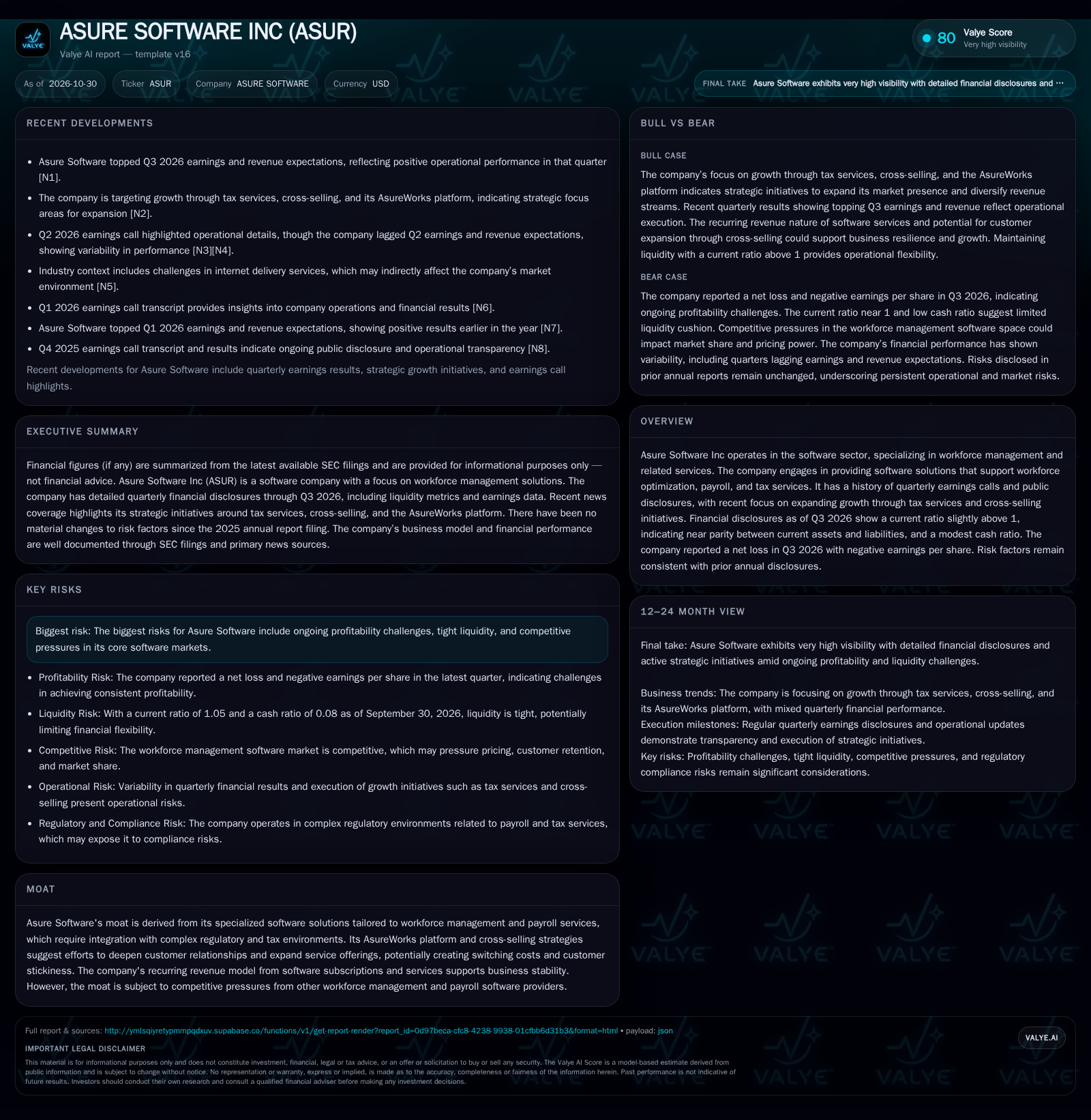
Asure Software topped Q3 2026 estimates after a weak Q2, but remains unprofitable with a slim liquidity buffer as of September 30, 2026. The company is prioritizing tax services, cross-selling, and its AsureWorks platform to drive growth, but faces a crowded workforce management software market and ongoing margin pressure. The next phase depends on converting these initiatives into sustainable profitability and improved cash flow, with little margin for operational misstep. [S2] [N1] [N4]
Asure Software is navigating a pivotal phase defined by ambitious growth initiatives and tight financial constraints. While the company topped Q3 2026 earnings expectations, it remains unprofitable and operates with a liquidity cushion barely above minimum thresholds. Management is betting on tax services, cross-selling, and its AsureWorks platform to drive recurring revenue and customer stickiness. The critical question is whether these strategies can deliver the operational leverage needed to offset persistent net losses and withstand intense competition in the workforce management software sector. Execution in the next few quarters will be decisive, as there is little room for strategic missteps or external shocks.
Recent Results Highlight Fragile Progress and Financial Constraints
Asure Software exceeded Q3 2026 earnings and revenue estimates, marking a rebound from Q2, when it lagged expectations. Despite this positive headline, the company reported a net loss of $604,000 and negative EPS of -$0.02 in Q3 2026, continuing a pattern of inconsistent profitability. [S2] [N1] [N4]
As of September 30, 2026, Asure’s current assets of $236.96 million barely outpaced its current liabilities of $225.54 million, yielding a current ratio of 1.05. The cash and cash equivalents position was $16.78 million, resulting in a cash ratio of just 0.08. The company reported cash and liquidity metrics for the period; these figures do not by themselves establish operating runway, investment capacity, financial flexibility, or financing capacity. [S2]
Strategic focus areas include growing tax services, cross-selling to existing customers, and scaling the AsureWorks platform—initiatives that aim to stabilize and diversify revenue streams. However, no material changes to risk factors have been disclosed since the 2025 annual report, underscoring persistent structural challenges. [N2] [S2]
Revenue Mix, Margin Structure, and the Leverage Challenge
Asure Software’s business model revolves around software solutions for workforce management, payroll, and tax compliance. Revenue likely comes from a mix of recurring software subscriptions, service fees, and potentially transaction-based charges for payroll and tax filings. The recurring nature of software revenue, if anchored by multi-year contracts or high retention, could support operating leverage—but the company’s persistent net losses suggest that fixed costs (including R&D, sales, and compliance) remain high relative to gross profit.
The company’s push into tax services and cross-selling could increase average revenue per user (ARPU) and improve customer lifetime value, especially if these services are bundled or deeply integrated. However, the economics depend on upsell success and the ability to limit incremental support and implementation costs. If cross-sold services carry higher margins or reduce churn, margin expansion is plausible. In contrast, if customer acquisition costs rise or incremental service delivery proves resource-intensive, profitability will remain elusive.
This heightens the importance of cash conversion and margin improvement from existing operations.
A critical dimension to assess is the scalability of Asure's cost base relative to incremental revenue growth. Software companies often face a cost structure with high fixed expenses—such as product development, compliance, and customer support—and comparatively low variable costs. If Asure can increase subscription volumes and cross-sell services without proportionally increasing support and implementation costs, gross margins could expand meaningfully. However, if the complexity of integrating tax services and workforce management solutions demands significant customization or ongoing client-specific support, the cost leverage may be limited, constraining margin improvement despite revenue growth.
Navigating a Crowded Field: Differentiation and Defensibility
The workforce management software sector is marked by intense competition, with numerous established and emerging vendors targeting payroll, HR, and compliance needs. Asure’s differentiation hinges on its AsureWorks platform and specialized tax services, which may offer deeper regulatory integration or workflow automation tailored to mid-market clients.
Potential defensibility could come from product breadth, compliance expertise, and the friction of switching payroll or tax platforms. However, in practice, switching costs in this sector are moderate—especially for smaller enterprises—and price competition is common. Larger or better-capitalized competitors may be able to bundle services, undercut pricing, or outspend Asure on product innovation and marketing.
The company’s cross-selling and platform strategies could deepen customer relationships, but the risk is that these initiatives will be matched—or exceeded—by rivals. Without clear evidence of a unique value proposition or superior retention, Asure’s position remains vulnerable to both direct competitors and adjacent software providers expanding into workforce management.
If Cross-Selling and Platform Depth Deliver Margin Expansion
A favorable scenario would see Asure’s tax services and AsureWorks platform drive successful cross-selling, raising ARPU and improving customer retention. If operational leverage materializes—meaning incremental revenue increasingly drops to the bottom line—net losses could narrow or flip to profitability, especially if gross margin improves and fixed costs are contained.
Confirmation would come from sequential improvement in gross and operating margins, sustained growth in revenue per client, and evidence of higher retention or lower churn rates. An uptick in operating cash flow, even in the absence of headline profitability, would also support the upside thesis.
Additional evidence would include disclosures of multi-year customer contracts, expanded wallet share from existing clients, or announcements of new product modules that increase the platform’s stickiness.
Mixed Execution Extends Margin Pressure and Operating Volatility
The most plausible path is continued uneven performance: Asure may achieve periodic revenue growth from new service launches and cross-selling, but these gains are offset by ongoing margin pressure and high operating expenses.
This scenario is confirmed by continued swings in quarterly results—some quarters topping expectations, others lagging—without a clear, sustained trend toward profitability. If the company continues to report a current ratio barely above 1, with little improvement in cash flow or margin profile, the base case holds.
Falsification would require either a clear, sustained move into profitability or a material deterioration in liquidity or revenue momentum.
Liquidity Erosion and Intensifying Competitive Headwinds
In an adverse scenario, Asure’s revenue growth initiatives fail to gain traction, while competitive pressures force price concessions or lead to customer churn.
Lost customer accounts, declining ARPU, or public disclosures of elevated churn would further pressure confidence.
Confirmation of this scenario would come from missed earnings/revenue targets, a worsening current or cash ratio, or any announcement of cost-cutting, layoffs, or capital raises undertaken out of necessity rather than opportunity.
What Will Reveal If Asure’s Growth Initiatives Can Offset Margin and Liquidity Risks?
Quarterly trends in gross and operating margins, as improving margins would indicate successful leverage of fixed costs and effective cross-selling (if disclosed).
Changes in operating and free cash flow, signaling whether the business is moving toward self-sustainability or requiring external capital (if disclosed).
Customer retention and churn rates, which would reveal the stickiness of the AsureWorks platform and effectiveness of cross-selling (a useful metric if disclosed).
Average revenue per user/client (ARPU), especially growth driven by tax services and bundled offerings (would help test the thesis).
Announced multi-year contracts or expansions with existing customers, providing evidence of deepening relationships and future revenue visibility.
Disclosures of external financing, cost-cutting, or restructuring moves, which would indicate pressure points or strategic pivots.
Market commentary or competitive actions (e.g., pricing moves by larger rivals) that could impact Asure’s market share and pricing power.
Disclaimer: This is research-only, informational analysis and not investment advice. It may include AI-generated interpretation and general industry context. Always verify important details using primary sources.

Comments