
Restaurant Brands International: Multi-Brand Scale, Franchise Economics, and the Stakes of Liquidity Management
Restaurant Brands International Limited Partnership leverages its globally recognized portfolio—Tim Hortons, Burger King, Popeyes, and Firehouse Subs—through a franchising-heavy model and international reach. The core thesis hinges on whether brand strength and operational leverage can offset competitive pressures and balance-sheet constraints.
The company’s ability to manage operational complexity and sustain franchise-driven cash flow will determine how effectively it can navigate a highly competitive quick-service restaurant landscape. Watch for evidence of improved cash flow, margin stability, and international segment performance as leading indicators.
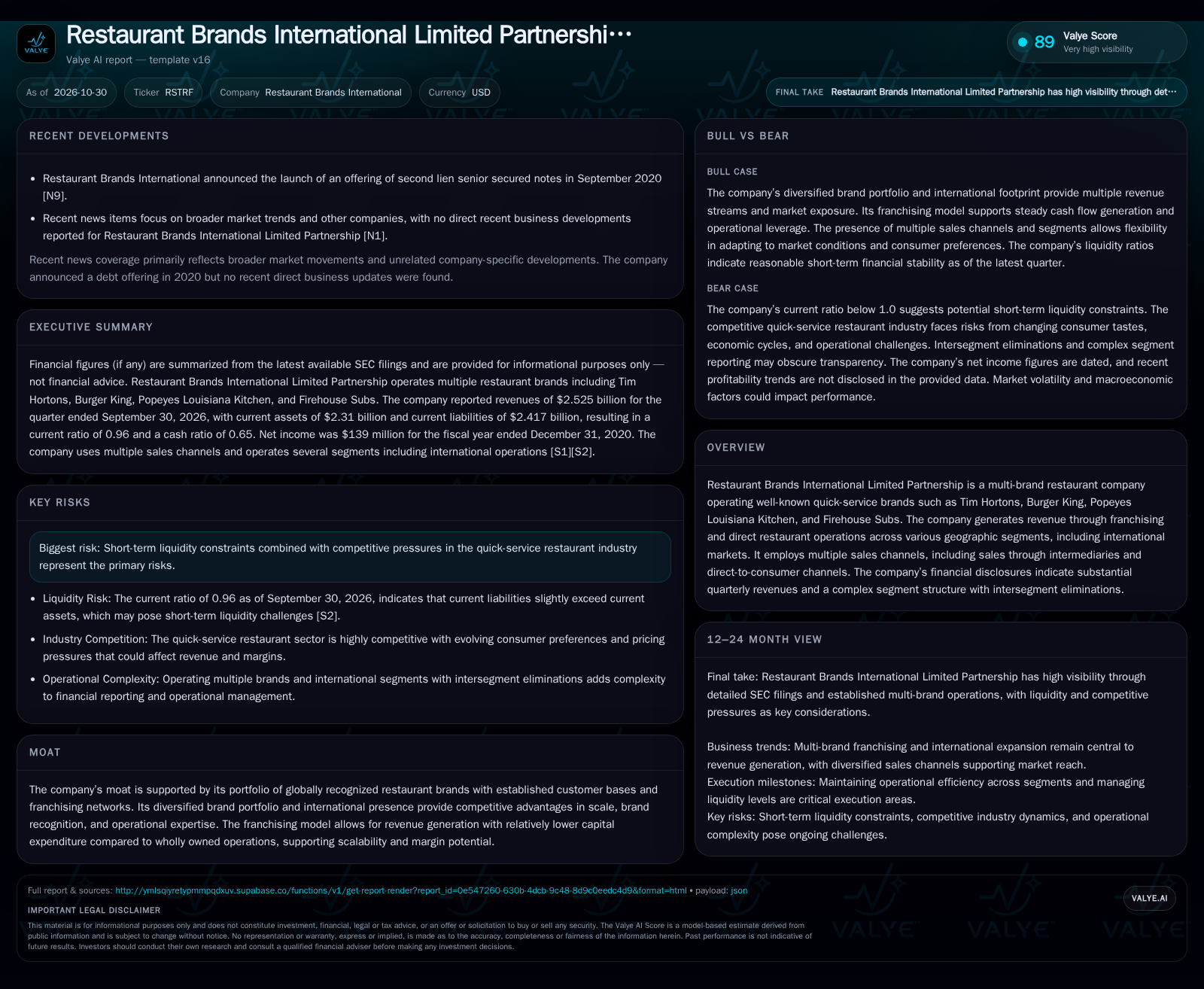
Restaurant Brands International Limited Partnership, the parent behind Tim Hortons, Burger King, Popeyes, and Firehouse Subs, sits at the intersection of global scale and franchise-driven efficiency. Its latest quarterly results show substantial revenue generation, but a current ratio of 0.96 signals that near-term liquidity management is a live issue. As the quick-service restaurant sector faces intensifying competition and shifting consumer habits, the company’s performance will be shaped by its ability to translate brand power and operational leverage into sustainable cash flow while navigating operational complexity and balance-sheet constraints.
Latest Filings Reveal Revenue Strength and Liquidity Friction
Restaurant Brands International reported $2.525 billion in revenue for the quarter ended September 30, 2026, reflecting the scale and reach of its diversified brand portfolio [S2]. The company’s current assets totaled $2.31 billion against current liabilities of $2.417 billion, resulting in a current ratio of 0.96 and a cash ratio of 0.65 as of the same date [S2]. This means that, while the business is generating substantial sales, its short-term obligations slightly exceed its liquid assets, highlighting a need for careful liquidity management. The company continues to operate through multiple segments—Tim Hortons, Burger King, Popeyes, Firehouse Subs, and international operations—each contributing to revenue and operational complexity [S2].
How Franchise Economics and Brand Mix Shape Profit Potential
At its core, Restaurant Brands International relies heavily on a franchising business model, collecting royalties and fees from franchisees who operate most of its stores. This structure typically yields high-margin, recurring revenue streams with lower direct capital requirements compared to company-owned operations. The company’s multi-brand approach enables cross-segment diversification, spreading risk across multiple consumer segments and geographies.
The mix of direct-to-consumer and intermediary sales channels allows for flexible market penetration strategies. Franchising also supports operating leverage: as system sales grow, incremental royalty income can surpass incremental operating costs, especially when brand-driven traffic increases. However, the company still bears certain fixed costs—corporate overhead, brand marketing, and technology investments—that can pressure margins if systemwide sales growth stalls.
Capital needs are generally modest at the parent level due to franchising, but investments in technology, marketing, and international expansion can be material.
The franchising model’s scalability advantage hinges on maintaining a healthy pipeline of franchisees and ensuring unit-level economics remain attractive despite rising input costs or competitive pressures. If franchisees face margin compression, the parent company’s royalty streams could stagnate or decline, eroding the high-margin revenue base. Additionally, the multi-brand portfolio necessitates differentiated marketing and operational strategies, which can dilute centralized cost efficiencies. The company’s ability to leverage shared services, such as supply chain management or digital platforms, across brands will be critical to sustaining margin expansion. Moreover, investments in technology aimed at enhancing franchisee support and consumer engagement could yield incremental revenue but require careful cost-benefit analysis to avoid margin dilution.
Brand Recognition, Scale, and the Realities of a Crowded Global Market
Restaurant Brands International’s core advantage comes from its stable of globally recognized brands, each with established customer loyalty and significant franchisee networks. This scale supports procurement leverage, marketing efficiency, and brand-driven pricing power in certain markets. The company competes with other large quick-service restaurant operators—both diversified holding companies and single-brand giants—as well as regional players and new fast-casual entrants.
Industry-wide, the quick-service sector faces persistent substitution risk from grocery, meal kits, and evolving fast-casual formats that promise fresher, healthier, or more personalized options. Price competition is intense, and consumer preferences can shift rapidly, requiring continuous menu innovation and digital engagement. While the franchising model insulates the parent from some operating risk, it can also limit direct control over service quality and local adaptation.
International expansion presents both opportunity and complexity: new markets can drive growth, but also expose the company to currency volatility, regulatory risk, and the challenge of establishing local relevance. The ability to maintain and grow systemwide sales per location, as well as franchisee satisfaction and unit-level economics, will be critical to sustaining long-term competitive advantage.
In a global quick-service market characterized by rapid innovation and shifting consumer expectations, the company's ability to adapt its brand propositions locally without sacrificing global consistency is vital. The franchising model inherently limits direct control over store-level execution, so incentivizing franchisees to align with evolving brand standards and innovation cycles is a complex governance challenge. Furthermore, procurement scale advantages can be offset by regional supply chain disruptions or inflationary pressures, which may necessitate localized sourcing strategies that reduce cost efficiencies. Currency fluctuations in international markets add another layer of complexity, potentially impacting reported earnings and requiring hedging strategies. The company’s competitive positioning will also depend on how effectively it can differentiate its offerings in crowded markets while managing the risks of brand dilution or cannibalization across its portfolio.
If Brand Investments and International Expansion Deliver Systemwide Sales Gains
A favorable outcome for Restaurant Brands International would see continued investment in brand refreshes, digital ordering, and menu innovation translating into higher same-store sales and accelerated new unit openings, especially in underpenetrated international markets. If franchisees are incentivized to expand their footprints due to attractive unit economics, systemwide sales could rise, boosting high-margin royalty streams for the parent.
In this scenario, operating leverage would improve margins as fixed corporate expenses are spread over a larger revenue base. Enhanced digital engagement could also help capture a greater share of off-premise dining, meeting consumer demand for convenience and increasing average order values. Evidence supporting this trajectory would include accelerating systemwide sales growth, consistent increases in franchisee openings, and stabilization or improvement in operating margins. Confirmation would also come from improved liquidity metrics—such as a current ratio moving above 1.0 and positive trends in free cash flow—suggesting that revenue gains are translating into balance-sheet strength.
Multi-Brand Diversification Balances Growth and Complexity
The most plausible outcome is a continuation of modest systemwide sales growth, with the company leveraging its portfolio to offset market or regional softness in any one brand. Franchising will remain the dominant business model, producing steady royalty streams, but competitive intensity and shifting consumer preferences will cap pricing power and limit outsized margin expansion.
Operating complexity will persist, as management must coordinate marketing, supply chain, and innovation across disparate brands and geographies. Evidence for this scenario includes stable or slightly growing system sales, relatively flat margins, continued but measured international expansion, and liquidity metrics that hover near current levels without material improvement or deterioration.
Adverse Shocks Could Expose Liquidity Constraints and Franchisee Pressure
If economic headwinds, competitive pricing, or consumer behavior shifts erode same-store sales, franchisees may struggle with unit-level profitability, leading to closures or delayed new openings. This would reduce royalty income and could trigger negative operating leverage as fixed costs become harder to cover.
Further, operational complexity and intersegment eliminations could obscure the speed and location of deterioration, making it harder for management to respond in real time. Evidence supporting this scenario would include declining systemwide sales, franchisee attrition or increased closures, shrinking margins, and deteriorating liquidity metrics—such as a further drop in the current ratio or negative free cash flow. An inability to refinance or access additional credit on favorable terms would exacerbate the downside risk.
Signals That Will Reveal Whether Brand Power Can Outweigh Liquidity Stress
Systemwide sales growth rates by brand and geography, if disclosed, to assess whether brand investments are driving actual top-line momentum.
Trends in franchisee openings and closures, which would indicate the health of the network and the attractiveness of unit-level economics.
Operating margin trajectory, as a measure of whether incremental revenue is translating into sustainable profitability.
Free cash flow generation and conversion rates, if disclosed, to test whether reported profits are translating into available funds for debt service or reinvestment.
International segment performance—including revenue growth and margin contribution—as a barometer of overseas expansion success and risk.
Any new debt issuance, refinancing events, or changes in credit facility terms, which would signal management’s approach to funding and liquidity management.
Evidence of menu innovation or digital engagement initiatives being adopted at scale, which could support larger baskets and customer retention.
Disclaimer: This is research-only, informational analysis and not investment advice. It may include AI-generated interpretation and general industry context. Always verify important details using primary sources.

Comments