
GLPI’s Tenant Reliance, Gaming Asset Complexity, and the Real Stakes of Bally’s Distress
Gaming & Leisure Properties, Inc. (GLPI) demonstrates strong recent REIT fundamentals and portfolio management, but its concentrated exposure to Bally’s Corporation—amid that tenant’s acute financial distress—creates a highly asymmetric risk profile. The unique regulatory and operational hurdles of re-leasing specialized casino assets amplify both the downside and the need for rigorous scenario planning.
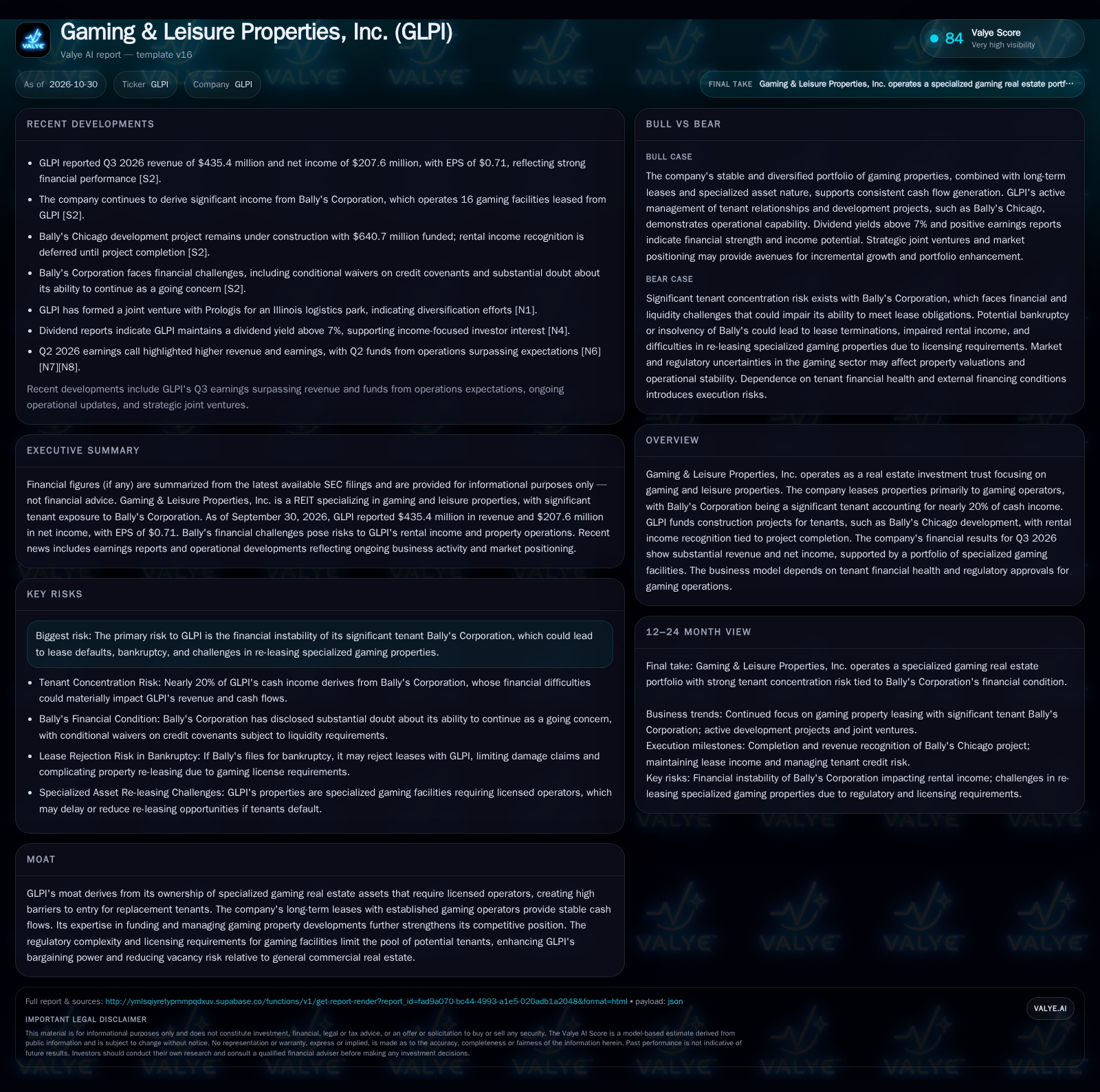
GLPI’s financial performance remains robust, but nearly 20% of its cash income comes from Bally’s Corporation, which is now under severe financial strain. Bally’s has received only a temporary credit waiver and has disclosed doubts about its ability to continue as a going concern. GLPI’s exposure is heightened by its ongoing $940 million funding commitment to Bally’s Chicago development, with rental income recognition deferred until completion. The specialized nature of GLPI’s gaming properties means that re-leasing in a default scenario could be slow and complex, exposing the company to prolonged cash flow disruption.
Gaming & Leisure Properties, Inc. (GLPI) stands at a strategic crossroads: its recent financial results reflect strength and stability typical of well-run REITs, yet its business model is acutely exposed to the fate of a single major tenant—Bally’s Corporation. Nearly one-fifth of GLPI’s cash income now hinges on Bally’s, whose financial fragility and looming liquidity crunch threaten to disrupt GLPI’s cash flows and asset utilization. The company’s ongoing capital commitment to the Bally’s Chicago project only raises the stakes, while the specialized, highly regulated nature of its casino real estate could make any tenant transition slow and costly. This confluence of factors creates a risk-reward profile that is unusually sensitive to counterparty health and regulatory timelines.
Tenant Concentration and Financial Contagion: The Immediate Landscape
As of September 30, 2026, GLPI derived 19.4% of its total cash income from leases with Bally’s Corporation and its affiliates, which operate 16 GLPI-owned gaming properties [S2]. This concentration is not merely theoretical: Bally’s has received a conditional waiver on its revolving credit facility, with the waiver lasting through March 31, 2027 and subject to strict liquidity maintenance. More concerning, Bally’s has publicly disclosed substantial doubt about its ability to continue as a going concern, excluding any new financings it may pursue [S2].
GLPI is also deeply financially involved with Bally’s Chicago, having funded $640.7 million out of a $940 million commitment for construction costs as of September 30, 2026. While rental payments are being made monthly, accounting recognition of this income is deferred until the project is complete [S2]. The combination of large financial exposure, deferred income recognition, and acute tenant distress means that any default or bankruptcy by Bally’s could have an outsized and immediate impact on GLPI’s financials and operations.
How GLPI’s Lease-Driven Model Amplifies Both Stability and Fragility
GLPI’s core business model is built around owning specialized gaming real estate and leasing it on a triple-net basis to casino operators. This structure ordinarily offers stable, predictable cash flows and low operating expenses, as tenants bear responsibility for property taxes, maintenance, and insurance. Fixed rental escalators and long-term contracts can create operating leverage, allowing GLPI to grow cash flows with minimal incremental capital expenditure—provided tenants remain solvent.
However, the economics are highly sensitive to tenant credit quality, especially given GLPI’s high degree of rental income concentration. When a tenant like Bally’s encounters financial distress, the fixed-cost nature of the business becomes a double-edged sword: GLPI’s obligations to fund new projects (such as the $940 million Chicago commitment) and its own overhead persist even if rental income is interrupted. Deferred revenue recognition on major projects further complicates cash flow timing, creating a mismatch between capital outlays and realized income. Capital needs are therefore not only a function of growth but also of risk mitigation, requiring liquidity reserves or external financing to bridge any tenant default or lease rejection event.
Barriers to Entry, Re-Leasing Frictions, and Competitive Dynamics in Gaming Real Estate
GLPI’s competitive moat is rooted in its ownership of special-purpose gaming properties that require licensed operators—a feature that both protects against generic competition and creates unique risks. The regulatory complexity of casino operations means that the pool of potential replacement tenants is small and highly regulated, unlike most commercial real estate where re-leasing is relatively straightforward. This raises the stakes if a major tenant defaults: the process to secure a new, qualified operator can be protracted and subject to state gaming commission approvals.
Peers in the gaming REIT space, including other specialty landlords, face similar tenant concentration and regulatory risks, but GLPI’s exposure to Bally’s is currently more acute than most. The company’s recent joint venture with Prologis for an Illinois logistics park points to a diversification effort, but the core portfolio remains dominated by gaming assets. Substitution risk is limited by the asset type, but the downside is that asset illiquidity and tenant scarcity can magnify the impact of any single operator’s distress.
If Bally’s Stabilizes: Pathways to Cash Flow Resilience and Growth
The most favorable scenario for GLPI is that Bally’s successfully secures additional financing, meets the conditions of its credit waiver, and brings the Chicago property to completion. In this sequence, deferred rental income from the Chicago project would be recognized, potentially boosting reported revenue and cash flows. Bally’s continued operations would preserve GLPI’s largest cash income stream, and the company could leverage its specialized portfolio to pursue further development or acquisition opportunities.
Evidence that would confirm this scenario includes public announcements from Bally’s regarding new financings, positive covenant compliance disclosures, and timely completion of the Chicago project. A reduction in GLPI’s tenant concentration—either through new tenant acquisitions or successful portfolio diversification—would further bolster the upside case. Conversely, any reported delays in Chicago construction, missed rental payments, or negative revisions to Bally’s liquidity outlook would weaken the plausibility of this outcome.
Navigating Status Quo Volatility: Rental Streams Continue, but Fragility Remains
The most plausible scenario is that Bally’s remains operational under the terms of its waiver through at least March 2027, making required rental payments and allowing GLPI to continue recognizing income from existing leases. Construction on the Chicago project proceeds, with rental income recognition deferred until completion, prolonging the mismatch between cash outflows and reported revenue. GLPI’s overall financials remain solid in the near term, but the risk of tenant default continues to overhang the stock and business model.
This scenario would be confirmed by steady quarterly rental payments from Bally’s, progress updates on the Chicago development, and maintenance of liquidity buffers by both parties. Falsifying evidence would include any breach of waiver conditions, negative updates on Bally’s refinancing efforts, or early signs of regulatory intervention that could disrupt operations at GLPI’s properties.
Bally’s Bankruptcy: Lease Rejection, Cash Flow Disruption, and the Long Tail of Regulatory Re-Leasing
Should Bally’s fail to secure new financing or violate its credit waiver conditions, a bankruptcy filing could follow, granting Bally’s the option to reject its leases with GLPI. In this event, GLPI’s damage claims would be capped and subordinated in bankruptcy proceedings, while the properties themselves could sit idle for an extended period due to the need for state gaming license transfers to any new operator. The specialized nature of the assets means that re-leasing is not only slow but also uncertain, as few operators may be both interested and qualified.
Cash flow disruption would be immediate and severe, especially given the large exposure to Bally’s. The ongoing capital commitment to the Chicago project could become a stranded asset, further straining GLPI’s balance sheet. Evidence confirming this scenario would include missed rent payments, bankruptcy filings, or public statements from Bally’s or lenders regarding acceleration of indebtedness. Early regulatory or legal filings about license transfers or lease rejections would also serve as clear warning signs.
Milestones That Could Reshape GLPI’s Risk-Reward Equation
Monthly and quarterly rent collection status from Bally’s Corporation, especially any missed or late payments, would help test the durability of GLPI’s cash flows.
Updates on Bally’s compliance with the conditions of its revolving credit facility waiver, particularly liquidity maintenance thresholds, are critical for near-term risk assessment.
Progress reports and milestone achievements on the Bally’s Chicago project—such as construction completion percentages and regulatory approvals—would clarify the timing of deferred income recognition.
Announcements of new tenant acquisitions, lease diversification, or expansion into non-gaming real estate (e.g., logistics joint ventures) would indicate meaningful risk mitigation.
Disclosures related to regulatory or licensing developments affecting the ability to re-lease gaming properties in the event of a tenant default would help test re-leasing risk.
Any public statements from Bally’s regarding additional financing, restructuring plans, or asset sales would provide insight into its ongoing viability.
GLPI’s own liquidity management, including cash balances, undrawn credit facilities (if disclosed), and capital allocation decisions, would indicate its preparedness for potential rental income disruptions.
A useful metric would be the weighted average lease term (WALT) for the portfolio, broken out by tenant, to quantify duration risk and re-leasing timelines.
Disclaimer: This is research-only, informational analysis and not investment advice. It may include AI-generated interpretation and general industry context. Always verify important details using primary sources.

Comments