
The RealReal’s Inflection: Automation, Network Effects, and the High-Stakes Race for Sustainable Luxury Resale Margins
After years of operating losses, The RealReal has posted positive net income and raised its outlook, betting on automation and operational efficiency to solidify its place as the leader in authenticated luxury consignment. The question now: Can it convert network advantages and margin gains into durable, scalable profitability amid intensifying competition and capital constraints?
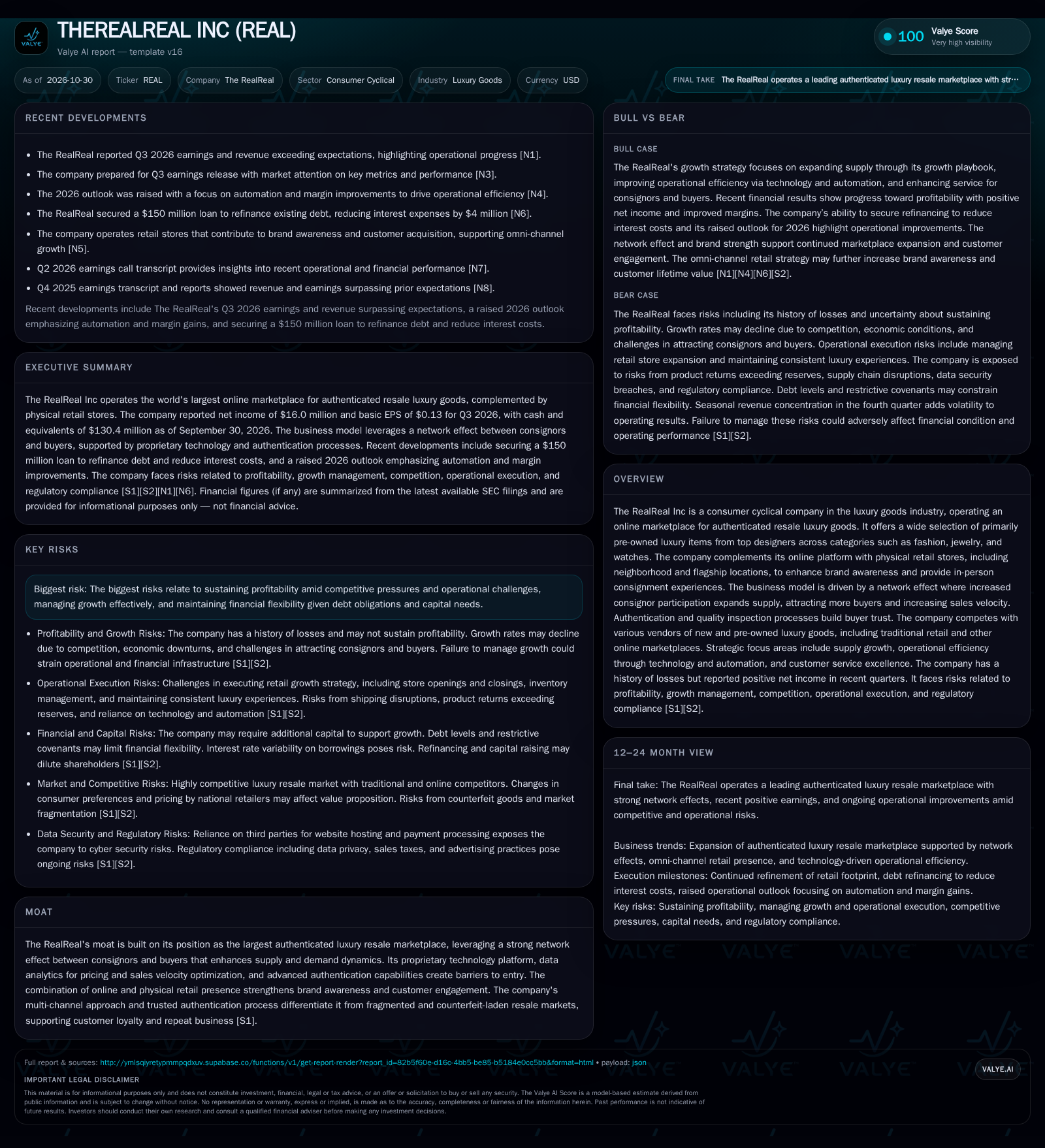
The RealReal reported its first sustained period of positive net income, reflecting progress on automation and margin initiatives, and raised its 2026 outlook. Execution on automation, supply unlocking, and brand trust will be decisive in the next phase. [S2] [N1] [N4]
The RealReal stands at a pivotal moment as it transitions from years of persistent losses to reporting positive net income and raising its financial outlook for 2026. This inflection is underpinned by a renewed focus on automation, operational efficiency, and a robust network effect connecting luxury consignors and buyers. The next twelve to twenty-four months will reveal whether The RealReal’s platform can deliver sustainable, scalable economics—or whether structural challenges will limit its breakthrough.
Positive Earnings, Automation Focus, and a Tight Financial Cushion: Where The RealReal Stands Now
The RealReal reported net income of $16.0 million for the quarter ended September 30, 2026, a significant milestone after a multi-year history of operating losses. Basic EPS reached $0.13, though diluted EPS remained slightly negative at -$0.04, suggesting some share structure complexity or non-cash adjustments [S2]. The company simultaneously raised its 2026 outlook, emphasizing ongoing gains from automation and margin improvement initiatives [N4]. On the balance sheet, The RealReal held $130.4 million in cash and equivalents but faced current liabilities of $260.9 million versus current assets of $218.2 million, yielding a current ratio of 0.84—indicating a relatively tight liquidity position [S2]. To address debt costs and maturity risk, the company secured a $150 million loan to refinance prior obligations and reduce annual interest expense by $4 million. These moves signal both operational progress and the continued need for careful capital management.
Marketplace Leverage, Authentication Costs, and the Pursuit of Margin Expansion
The RealReal’s business model monetizes a take rate on consigned luxury goods, extracting value from both sides of its marketplace. Revenue is driven by transaction volume, commission rates, and the mix of high-value versus lower-value items. Automation and technology investments aim to reduce variable costs—such as authentication labor and fulfillment—while increasing throughput and accuracy. The potential for operating leverage is substantial if fixed costs (platform, authentication centers, retail footprints) can be spread over rising transaction volumes.
However, the economics are complex: Authenticating and processing luxury items is costlier than typical e-commerce fulfillment, and returns, fraud risk, and the need for skilled authenticators add friction. The company’s move toward automation seeks to compress these costs, but success depends on technology keeping pace with the nuanced, high-stakes demands of luxury verification. Physical retail stores, while enhancing brand trust and supply acquisition, introduce additional fixed costs and complexity, creating both opportunity for higher conversion and risk of margin dilution if store productivity lags.
Capital intensity is a watchpoint—inventory is consigned (not owned), but investments in technology, retail buildout, and periodic debt refinancing introduce ongoing funding requirements. If automation and scale can deliver durable gross margin improvement, incremental volume could disproportionately benefit bottom-line results. Conversely, persistent cost overruns or supply/demand mismatches would erode operating leverage gains.
Network Effects, Authentication Trust, and the Battle for Luxury Resale Loyalty
The RealReal’s core competitive asset is its network effect: more consignors attract more buyers, which in turn increases sales velocity and marketplace liquidity. This flywheel is reinforced by a trusted authentication layer—critical in a luxury segment where counterfeits and condition uncertainty are major buyer concerns [S1]. The company’s proprietary data and technology for pricing and sales optimization further distinguish its offering.
Yet, competitive pressures are intensifying. Incumbents span traditional consignment stores, auction houses, luxury brands entering the resale space directly, and both specialized and generalist online marketplaces. Many peers are investing in authentication, digital marketing, and omnichannel experiences, narrowing the differentiation gap. The question is whether The RealReal’s scale and brand trust can sustain a lead as new entrants leverage technology and luxury brands seek to control their own secondary markets.
Switching costs for buyers and consignors are moderate: while authentication and brand reputation create friction, alternative platforms and direct resale channels remain accessible. The RealReal must continuously invest in user experience, pricing transparency, and supply acquisition to maintain its network advantage.
How Automation and Marketplace Density Could Drive Durable Profitability
In a favorable scenario, The RealReal’s investments in automation and operational efficiency yield substantial reductions in per-unit processing and authentication costs. This, coupled with continued supply unlocking (more consignors, higher-value items) and growing buyer demand, expands both gross margin and sales velocity. Physical retail stores, if optimized, become high-ROI supply acquisition and conversion nodes, further reinforcing the network effect.
If automation enables scalable, accurate authentication, the company could see a step-change in throughput without proportional increases in labor costs. Meanwhile, higher customer retention, repeat purchases, and improved conversion rates would raise marketplace liquidity and pricing power. The result: a self-reinforcing cycle of improved profitability, internal cash generation, and reduced reliance on external financing.
Evidence supporting this scenario would include sustained gross margin expansion, declining SG&A as a percentage of revenue, repeat purchase rates rising, and positive operating cash flow across multiple quarters.
Operational Complexity Contained, but Margin Gains Remain Hard-Won
The most plausible near-term path is one where The RealReal achieves incremental margin improvement through automation and selective retail optimization, but faces ongoing pressure from competition and the inherent complexity of luxury authentication. Revenue continues to grow, albeit at a moderated pace, as network effects persist but gradually slow due to market maturation and competitive encroachment.
Gross margins improve modestly, but labor and technology costs for authentication remain significant, preventing dramatic operating leverage. The company maintains periodic profitability but with volatility tied to seasonality (notably Q4) and the timing of supply inflows.
Confirmation of this scenario would involve continued positive or near-breakeven net income, modest gross margin improvement, and stable cash balances, but with limited acceleration in free cash flow or dramatic shifts in market share.
Rising Costs, Stalled Supply, and Competitive Pressure Squeeze Profitability
A negative scenario unfolds if automation initiatives fail to deliver the anticipated cost reductions or introduce quality-control issues in authentication, eroding buyer trust. Consignor growth stalls due to competitive incentives elsewhere or waning consumer interest, constraining supply and reducing marketplace liquidity.
Meanwhile, fixed costs from retail locations and technology investments weigh on margins, and seasonal variability exposes the business to quarters of negative cash flow. If current liabilities continue to outpace assets and external financing becomes more expensive or unavailable, The RealReal could be forced to curtail investment, close stores, or dilute shareholders to raise capital.
Evidence of this downside would include rising SG&A or COGS as a percentage of revenue, declining repeat buyer rates, negative operating cash flow, and any signs of tightening supplier relationships or increased return rates.
Milestones That Will Define The RealReal’s Next Chapter in Luxury Resale
Quarterly gross margin trends: Sustained expansion would evidence successful automation and operational efficiency.
SG&A and technology expense as a percent of revenue: Declining ratios would indicate fixed-cost leverage and improved scalability.
Repeat purchase and retention rates (if disclosed): Higher rates would signal increased buyer loyalty and platform stickiness.
Consignor growth and average item value: These metrics would reveal success in unlocking high-quality supply and maintaining network effects.
Operating cash flow: Positive and growing operating cash flow would validate the shift from accounting profitability to true financial resilience.
Store-level productivity: Metrics on retail channel profitability and supply acquisition efficiency would clarify the ROI of physical locations.
Competitive moves by luxury brands or major platforms: Any shift in the competitive landscape could alter supply acquisition dynamics or buyer behavior.
Disclaimer: This is research-only, informational analysis and not investment advice. It may include AI-generated interpretation and general industry context. Always verify important details using primary sources.

Comments