
Immuneering’s Deep Cyclic Inhibitors: Clinical Progress, Capital Stakes, and the Unproven Economics of Oncology Innovation
Immuneering Corp advances its Deep Cyclic Inhibitor platform with a global Phase 3 trial for atebimetinib in pancreatic cancer, regulatory designations, and reported liquidity position—yet faces the pivotal test of translating clinical promise into commercial viability amid sector volatility and a fiercely competitive oncology landscape.
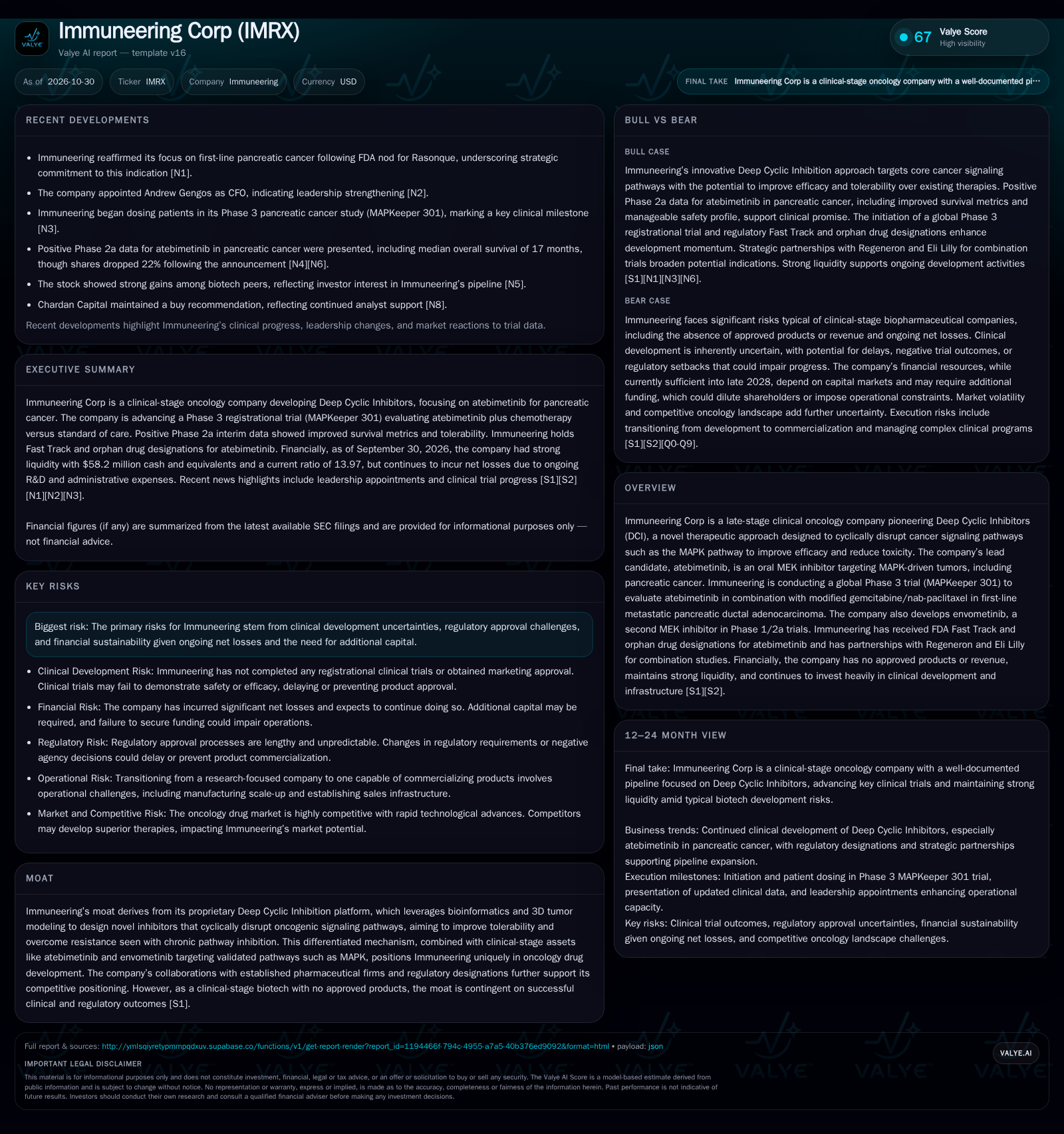
Immuneering is executing on a late-stage pipeline for its novel Deep Cyclic Inhibitors, highlighted by a Phase 3 trial in pancreatic cancer and regulatory Fast Track/orphan status for its lead candidate. While the company holds $58.2 million in cash and has attracted notable partnerships, it remains pre-revenue and dependent on clinical milestones and future capital infusions. The key question is whether its platform can deliver differentiated efficacy and safety to establish a foothold in a crowded and high-risk market [S1] [S2] [N1] [N3] [N6].
Immuneering Corp stands at a pivotal moment for clinical-stage biotech, advancing its Deep Cyclic Inhibitor platform with lead candidate atebimetinib in a global Phase 3 pancreatic cancer trial. Regulatory Fast Track and orphan drug designations, together with partnerships involving Regeneron and Eli Lilly, underpin a strategy to address high-unmet-need oncology indications. Yet with no approved products and pre-revenue financials, the company’s future depends on its ability to deliver compelling late-stage data, navigate regulatory hurdles, and ultimately convert clinical promise into a sustainable commercial model. The stakes are high: a successful outcome could validate a novel therapeutic approach and attract significant market share, but setbacks could quickly erode itsreported liquidity position and strategic optionality [S1] [S2] [N1] [N3] [N4] [N6].
Phase 3 Progress, Regulatory Designations, and a Precarious Pre-Revenue Reality
Immuneering’s most material recent developments are the dosing of patients in its global Phase 3 MAPKeeper 301 trial for atebimetinib in first-line metastatic pancreatic ductal adenocarcinoma, the receipt of FDA Fast Track and orphan drug designations for this asset, and the maintenance of $58.2 million in cash with a current ratio of 13.97 as of September 30, 2026 [S2] [N1] [N3]. Positive Phase 2a data reported a median overall survival of 17 months, though the stock dropped 22% following the announcement, highlighting persistent market skepticism or concerns about data interpretation, commercial prospects, or dilution risk [N4] [N6]. Notably, the company remains pre-revenue and continues to incur net losses, reflecting ongoing heavy investment in clinical development and infrastructure [S1] [S2]. These facts collectively underscore Immuneering’s transition from clinical promise to the high-stakes execution required for eventual commercialization.
How Immuneering’s Model Could Scale: From R&D Burn to Potential Oncology Royalties
Immuneering’s economics are, at present, purely prospective. The company’s cost structure is dominated by R&D and administrative expenses, with no product revenues to offset operating losses [S2]. If atebimetinib or a subsequent asset achieves regulatory approval, the commercial model could include direct sales, specialty oncology distribution, and/or royalty/licensing streams from co-development partners. Pricing power in oncology is typically shaped by demonstrated efficacy (often measured by overall survival or progression-free survival), tolerability, and the ability to secure premium reimbursement—particularly critical in indications like pancreatic cancer with high unmet need.
The gross margin potential for innovative small-molecule oncology drugs is high, often exceeding 80% in established franchises, but this is contingent on clinical differentiation and payer acceptance. Fixed costs—clinical trial expenses, regulatory compliance, and infrastructure—are significant until approval, after which commercial scaling could drive operating leverage if uptake is robust. Capex needs are moderate unless Immuneering pursues in-house manufacturing, but working capital requirements will rise with commercialization. Until approval, the company remains reliant on equity or partnership funding, with dilution risk persisting unless catalysts unlock access to non-dilutive capital or royalty streams.
Differentiation in a Crowded Market: Can Deep Cyclic Inhibition Surpass Standard MEK Inhibitors?
Immuneering’s Deep Cyclic Inhibitor technology aims to cyclically disrupt core cancer signaling pathways, such as MAPK, with the goal of improving efficacy and reducing toxicity relative to chronic inhibition. This is a potentially significant differentiator, as resistance and tolerability have limited the impact of existing MEK inhibitors in solid tumors. The company’s regulatory designations and partnerships with Regeneron and Eli Lilly suggest external validation and may facilitate broader combination strategies [S1].
However, the competitive landscape in oncology is intense, with large pharmaceutical companies and other clinical-stage biotechs pursuing both targeted therapies and immuno-oncology agents for pancreatic and other MAPK-driven cancers. Key counterforces include rapid-cycle innovation, the risk of being outpaced by more efficacious or better-tolerated regimens, and the potential for generics or biosimilars if approval is delayed. Success will likely depend on Immuneering’s ability to demonstrate not just incremental, but clinically meaningful, improvements in survival and quality of life—validated by robust late-stage data and real-world outcomes.
Atebimetinib Delivers Compelling Phase 3 Results and Defines a New Standard in Pancreatic Cancer
The bull thesis pivots on atebimetinib demonstrating statistically significant and clinically meaningful improvements in overall survival and tolerability in the MAPKeeper 301 Phase 3 trial, leading to regulatory approval in first-line metastatic pancreatic cancer—a market with few effective options and high unmet need. Fast Track and orphan designations could facilitate expedited review and market access [S1] [N1].
Commercially, strong Phase 3 data would enable premium pricing, rapid guideline inclusion, and potentially favorable payer coverage. Partnerships with Regeneron and Eli Lilly could be expanded into broader combination regimens or additional indications, unlocking milestone payments or royalties. Confirmation would come from: positive top-line Phase 3 results, a clear regulatory path (including priority review), and evidence of early commercial interest from oncologists and payers. Falsification would occur if Phase 3 data fail to show clear efficacy or safety advantages, or if regulatory agencies question the trial’s design or endpoints.
A Gradual Path: Mixed Data, Incremental Uptake, and Ongoing Funding Needs
The most plausible scenario is that Phase 3 results for atebimetinib are mixed—demonstrating some improvement over standard of care, but with marginal or context-sensitive benefits that may limit immediate uptake. Regulatory approval could be achieved, but with narrower labeling or post-marketing requirements. In this scenario, payer negotiations may limit pricing power, and commercial ramp would be gradual, requiring significant investment in education, sales, and support.
Immuneering would likely need to raise additional capital—potentially through dilutive equity offerings or expanded partnership agreements—to fund ongoing development and pre-commercialization activities. Confirmation of this scenario would include regulatory approval with restrictive labeling or mandated follow-up studies, modest early sales, and continued net losses as operating expenses remain high. This scenario would be falsified by either clear clinical failure (moving toward the downside) or by unexpectedly strong market uptake and rapid margin expansion (moving toward the upside).
Setbacks in Phase 3, Regulatory Delays, and Capital Constraints Undermine Strategic Flexibility
The adverse scenario is that atebimetinib’s Phase 3 trial fails to meet primary endpoints, shows safety concerns, or yields ambiguous results, leading to regulatory rejection or significant delays. Without approval, Immuneering would remain pre-revenue, and its cash runway—while currently strong—would erode rapidly given ongoing R&D and fixed overhead.
In this context, the company could be forced to suspend or scale back pipeline programs, pursue unfavorable financing, or seek strategic alternatives under pressure. Confirmation would come from negative Phase 3 readouts, FDA requests for additional data, or management guidance signaling a strategic pivot or cost-cutting. Falsification would require a clear clinical/regulatory win or evidence of non-dilutive capital infusions that extend the runway without compromising core programs.
Milestones That Will Determine Whether Immuneering’s Platform Can Cross the Commercial Chasm
Top-line data from the MAPKeeper 301 Phase 3 trial for atebimetinib in first-line metastatic pancreatic cancer—timing, magnitude, and interpretation of overall survival and tolerability outcomes.
Regulatory feedback from the FDA and global agencies: acceptance for review, requests for additional data, or fast-track/priority review decisions.
Disclosure of commercial or licensing agreements—particularly any expansion of existing partnerships with Regeneron or Eli Lilly, or new deals that provide non-dilutive capital.
Progression of envometinib or other pipeline assets into later-stage trials—a useful metric would be the number of active clinical programs and advancement beyond Phase 1/2a, if disclosed.
Early commercial signals: pre-approval access requests, payer dialogues, or inclusion in clinical guidelines, if/when data warrant.
Management’s articulation of commercialization plans, infrastructure buildout, and any announced leadership or operational changes that signal readiness for launch.
Disclaimer: This is research-only, informational analysis and not investment advice. It may include AI-generated interpretation and general industry context. Always verify important details using primary sources.

Comments