
Midland States Bancorp: Consistent Earnings, Opaque Strategy, and the Stakes of Navigating Financial Services Cycles
Midland States Bancorp’s steady profitability and regular disclosures suggest operational discipline, but limited visibility into segment economics and growth drivers raises questions about long-term competitive positioning and resilience in a shifting regulatory and rate environment.
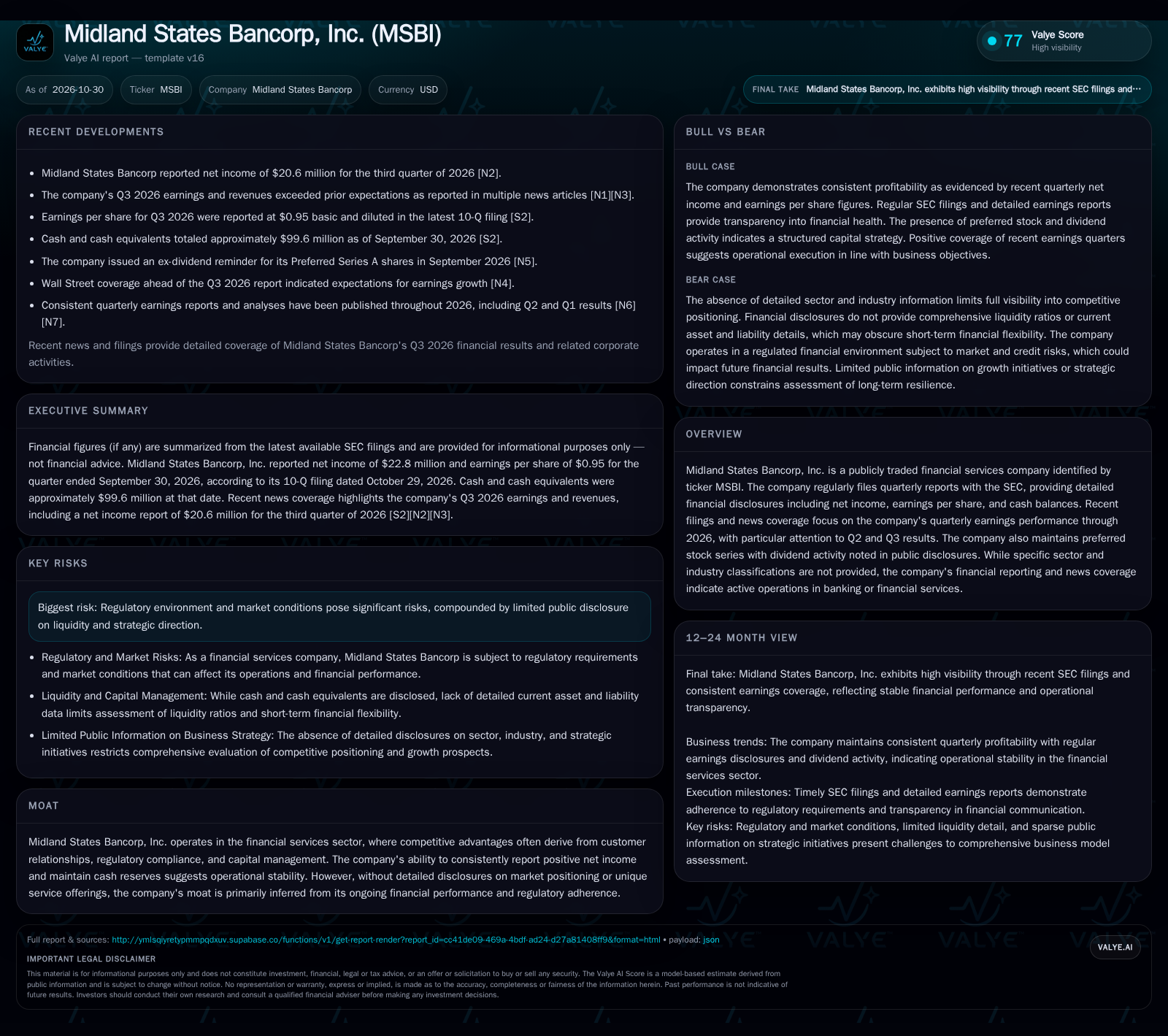
Midland States Bancorp reported $22.8 million in net income for Q3 2026, continuing a pattern of steady quarterly profits and transparent earnings disclosure. While these results highlight operational stability, the absence of detail on business mix, funding strategy, and growth initiatives leaves material questions about the company’s ability to defend margins and adapt to changing market or regulatory conditions. The thesis hinges on whether core profitability stems from sustainable lending and deposit franchises, or if underlying risks and strategic gaps could emerge in a less favorable cycle. [S2] [N2] [N3]
Midland States Bancorp continues to deliver consistent quarterly profits, reporting $22.8 million in net income and $0.95 earnings per share for Q3 2026. These headline results, coupled with regular SEC filings and positive coverage, point to a bank with operational discipline and transparency. However, the lack of detail on business mix, capital allocation, and strategic direction makes it difficult to assess how well positioned the company is for future market shifts or regulatory changes. The core question is whether Midland’s current profitability reflects a resilient and well-managed banking franchise, or whether underlying risks and competitive pressures could compromise returns in a less favorable environment. [S2] [N2] [N3]
Recent Profitability and Reporting Trends Shape Market Perception
Midland States Bancorp reported net income of $22.8 million for the quarter ended September 30, 2026, translating to basic and diluted earnings per share of $0.95 [S2]. This continues a streak of quarterly profitability, with Q3 2026 results exceeding prior expectations according to multiple news sources [N1] [N3]. The company’s cash and cash equivalents were approximately $99.6 million at the end of the quarter [S2]. Regular SEC filings and transparent reporting have kept the market informed, but the absence of granular segment or product-line disclosure leaves the sources and sustainability of earnings somewhat opaque.
How Midland States Bancorp May Generate Profits in a Commoditized Sector
As a regional financial institution, Midland States Bancorp likely earns the bulk of its revenue from net interest income—spreads between interest earned on loans and paid on deposits—and non-interest income from fees, service charges, and possibly wealth management or mortgage banking. The company’s steady quarterly net income suggests it has maintained a positive net interest margin in a period of shifting interest rates. However, without disclosure of loan/deposit mix, yield, or fee income breakdown, it is unclear how much earnings rely on traditional lending versus ancillary services, or how sensitive profitability is to funding costs and credit quality.
Operating leverage in banking is driven by scale in processing, technology, and branch operations, but also by credit costs and regulatory compliance expenses. The company reported cash and liquidity metrics for the period; these figures do not by themselves establish operating runway, investment capacity, financial flexibility, or financing capacity. [S2]
In addition to traditional interest income and fee revenues, Midland States Bancorp’s profitability dynamics are likely influenced by its approach to credit risk management and loan portfolio composition. The balance between secured and unsecured lending, as well as sectoral concentration, can materially affect loss provisioning and capital allocation. If the bank maintains a conservative underwriting standard and diversified loan book, it may reduce volatility in earnings during economic downturns. Conversely, a higher concentration in cyclical industries or riskier credits could amplify earnings swings and necessitate higher capital buffers, impacting return on equity. Understanding these risk-return trade-offs is crucial to evaluating the sustainability of Midland’s reported net income.
Another important consideration is the bank’s funding strategy and its sensitivity to interest rate fluctuations. Regional banks often rely on a mix of core deposits, brokered deposits, and wholesale funding, each with distinct cost and stability characteristics. If Midland’s funding base is predominantly low-cost, stable core deposits, it can better preserve net interest margins during rising rate cycles. However, if the bank depends significantly on more rate-sensitive or volatile funding sources, margin compression could occur when rates rise or competition intensifies. Without transparency on deposit composition or maturity profiles, assessing Midland’s vulnerability to funding cost shocks remains challenging.
Defining Competitive Edges in a Crowded Regional Banking Landscape
Regional banks such as Midland States Bancorp operate in a highly competitive environment, facing pressure from larger national banks, fintech entrants, community banks, and non-bank lenders. Sustainable competitive advantages often stem from local market relationships, cost-efficient deposit gathering, underwriting discipline, and the ability to cross-sell services. Regulatory compliance and capital management are necessary but not differentiators.
Midland’s consistent profitability and reporting transparency may reflect strength in customer relationships and operational execution, but the lack of detail on market share, digital offerings, or unique product capabilities makes it difficult to assess whether the company enjoys meaningful switching costs, pricing power, or network effects. Without evidence of distinctive technology, niche lending, or superior deposit franchise, Midland may be vulnerable to rate competition, technology disruption, or shifts in customer preference.
If Core Franchise Quality Underpins Resilience, Upside Could Follow
The most favorable scenario is that Midland’s recurring profitability is underpinned by a high-quality, well-diversified loan book, sticky low-cost deposits, and prudent risk management. If the company has invested in digital banking and relationship-driven commercial lending, it could sustain or expand margins even as competition intensifies or rates fluctuate. Upside would be further supported if non-interest income sources—such as wealth management or treasury services—are growing, providing diversification from traditional lending.
Confirmation of this scenario would require disclosure of stable or improving net interest margins, low loan losses, growing fee income, and evidence of customer retention or digital adoption. Strategic initiatives—such as targeted M&A, technology investment, or market expansion—would further bolster the case for long-term value creation.
Sustained Profitability, but Limited Growth and Margin Expansion Absent Strategic Shifts
The most plausible near-term trajectory is continued steady profitability, anchored in a traditional banking model with modest growth. Midland is likely to maintain positive net income as long as credit quality holds and funding costs remain manageable. However, without clear differentiation or new growth vectors, earnings may track industry averages, with limited room for margin expansion.
This scenario would be confirmed by ongoing quarterly profits, stable (but not rising) net interest margins, and muted fee income growth. Falsification would occur if credit costs spike, deposit outflows force higher funding costs, or if regulatory/compliance burdens erode profitability. Lack of disclosure on growth initiatives or technology investment would reinforce the case for a steady but unremarkable outlook.
Adverse Credit or Funding Shocks Could Reveal Hidden Vulnerabilities
The primary risk is that current profitability masks underlying exposure to credit deterioration, funding instability, or regulatory tightening. Should Midland’s loan portfolio be concentrated in vulnerable sectors, or if depositors shift rapidly to higher-yield alternatives, the company could face rising credit losses and funding costs. In a scenario where net interest margins compress and non-interest income stagnates, operating leverage would work in reverse, quickly eroding earnings.
Downside would be confirmed by a marked increase in nonperforming assets, provision expenses, or deposit runoff. Regulatory actions, such as heightened capital requirements or enforcement, could amplify stress. A sharp decline in quarterly net income, or a need to raise dilutive capital, would also signal emerging problems.
Company-Specific Developments That Could Shift the Midland States Bancorp Thesis
Quarterly trends in net interest margin (if disclosed) would clarify the sustainability of core earnings and the impact of funding costs.
Loan growth and credit quality metrics—including nonperforming asset ratios and charge-offs—would indicate underlying portfolio health.
Deposit mix and cost of funds (if reported) would reveal exposure to rate competition and the stability of funding sources.
Breakdown of non-interest income and its growth trajectory would show whether Midland is diversifying beyond traditional lending.
Any announced strategic initiatives—such as M&A, technology investments, or new product launches—would provide insight into management’s growth priorities.
Customer retention, digital adoption, or cross-sell metrics (if disclosed) would illuminate competitive positioning and switching costs.
Disclaimer: This is research-only, informational analysis and not investment advice. It may include AI-generated interpretation and general industry context. Always verify important details using primary sources.

Comments