
LPL Financial: Platform Scale, Asset Growth, and the Stakes of Integration in the Independent Advisory Ecosystem
LPL Financial’s transition back to profitability in Q3 2026, alongside expanded advisory asset flows and the integration of Commonwealth Financial Network, highlights both the economic leverage of its platform and the operational complexity of scaling in a competitive, regulated market. The next phase will be defined by the company’s ability to translate asset growth and acquisition scale into durable earnings while managing integration and regulatory risks.
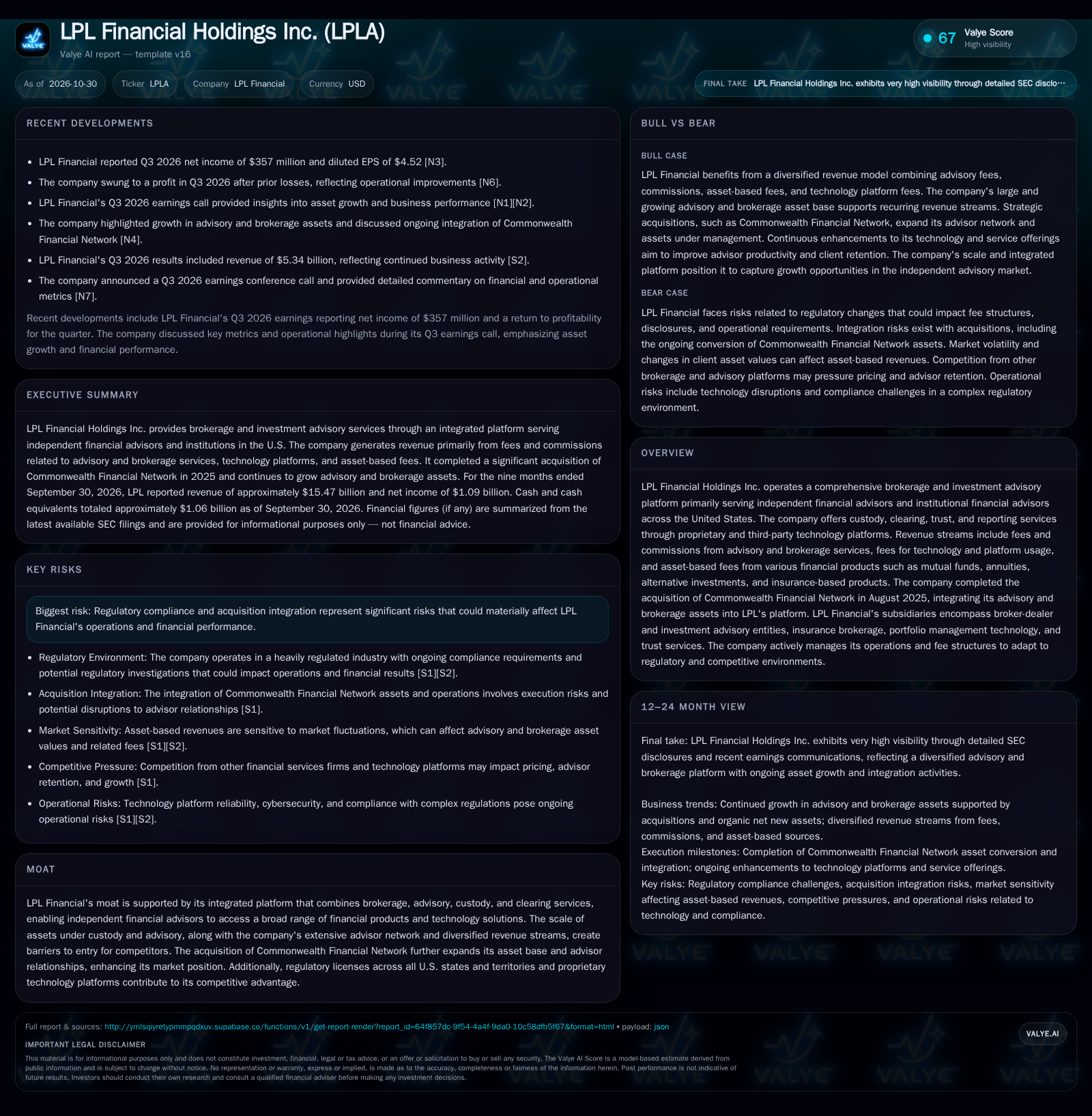
LPL Financial swung to a Q3 2026 profit as advisory and brokerage assets rose to $2.6 trillion, with advisory assets now comprising 61% of the total. The integration of Commonwealth Financial Network expands its platform and advisor network, but future earnings stability will hinge on successful integration, continued asset retention, and resilience to market and regulatory volatility. Interest rate sensitivity and competitive pricing pressures remain material factors for forward economics. [S2] [N6] [N4]
LPL Financial’s third-quarter 2026 results mark a turning point: the company returned to profitability after a period of losses, driven by operational improvements and significant growth in advisory and brokerage assets. The recent integration of Commonwealth Financial Network has both expanded LPL’s reach and heightened the stakes for seamless execution. As the independent advisory market grows more competitive and regulatory scrutiny persists, LPL’s ability to translate its scale and diversified revenue streams into sustainable earnings will depend on its ability to manage integration complexity, maintain advisor and asset retention, and adapt to shifting market and rate environments. [S2] [N6] [N4]
Profit Recovery, Asset Expansion, and the Integration Challenge
LPL Financial reported net income of $356.6 million for Q3 2026, reversing a net loss of $29.5 million in the prior-year quarter—an inflection attributed to operational improvements and business momentum. [S2] [N6]
Total advisory and brokerage assets reached $2.6 trillion as of September 30, 2026, up from $2.3 trillion a year earlier. Advisory assets now stand at $1.6 trillion—accounting for 61% of the total, and reflecting a 16% year-over-year increase. [S2] [N4]
The acquisition and ongoing integration of Commonwealth Financial Network, completed in August 2025, has materially expanded LPL’s asset base and advisor relationships. However, this integration process introduces execution risks, particularly around advisor retention and platform harmonization. [S2]
Net new assets for Q3 2026 totaled $29.1 billion, a significant decline from the prior year's $307.7 billion, suggesting that the pace of inorganic asset growth has normalized post-acquisition. [S2]
How LPL Converts Assets and Scale into Revenue Streams
LPL Financial’s business model relies on monetizing its vast platform of independent and institutional financial advisors through a mix of advisory fees, brokerage commissions, asset-based fees, and technology/platform charges. The largest and most durable revenue streams are tied to advisory and brokerage assets, with advisory-based revenues generally recurring and less transactional than commission income. The company’s scale allows it to negotiate favorable terms with product providers and deliver technology infrastructure to advisors—improving both retention and efficiency.
The economics are heavily volume-driven: asset growth—whether organic or via acquisition—directly increases fee-generating potential. Margins are influenced by the payout ratio to advisors (a substantial portion of gross revenue is paid out), technology and compliance costs, and the mix of asset-based versus transactional revenues. The integration of new assets and advisors, as with Commonwealth, can drive operating leverage if platform costs are spread over a larger base, but can also create transitional costs and risks if retention or harmonization falters.
Interest income and fees from cash sweep programs introduce sensitivity to prevailing interest rates. In the current environment, higher rates have boosted interest-related revenues, but this effect is not structural and could reverse if rates decline. Fixed costs in technology, compliance, and regulatory infrastructure are high—implying that incremental asset and revenue growth can drop disproportionately to the bottom line, but also that platform disruptions or regulatory changes can have outsized negative impact. [S2]
Barriers and Pressures in the Independent Advisor Ecosystem
LPL’s competitive position rests on its integrated, scale-driven platform that combines custody, clearing, advisory, and technology services. This breadth creates switching frictions for advisors, who would need to replicate both technology and product access elsewhere. The acquisition of Commonwealth augments LPL’s advisor network and asset base, reinforcing its position as a leading independent broker-dealer and RIA platform.
However, competitive dynamics are intense. Other large custodians, wirehouses, fintech advisory platforms, and direct-to-advisor technology providers all vie for advisor relationships. Pricing pressure is persistent—especially as digital platforms lower administrative costs and as advisors gain more negotiating power at scale. Product breadth, technology reliability, and service quality are critical to both retention and new advisor recruitment.
Substitution risk is present: advisors can shift to rival platforms offering lower fees, better technology, or more flexible product menus. Regulatory changes can also level the playing field or increase compliance costs for all, compressing margins. LPL’s ability to reinvest in technology and maintain regulatory compliance is both a moat and a required ongoing investment.
Leveraging Scale and Integration to Drive Earnings Outperformance
A favorable scenario for LPL would see the successful, seamless integration of Commonwealth Financial Network, resulting in minimal advisor attrition and rapid harmonization of technology and service offerings. If the combined platform enhances advisor productivity and client service, LPL could see both improved retention and organic recruitment, leading to sustained net new asset inflows.
Further, if equity markets remain stable or rise, asset-based fees would grow, magnifying operating leverage. High interest rates would continue to support cash sweep revenues, and technology investments could enable incremental margin expansion by automating compliance and advisor support functions.
Evidence confirming this scenario would include above-peer net new asset growth, improving advisor retention metrics (if disclosed), positive feedback from integrated Commonwealth advisors, and sustained or rising margins even as the asset base expands.
Earnings Normalization as Asset Flows Stabilize Post-Acquisition
The most plausible near-term outcome is a period of earnings normalization: asset growth moderates as the post-Commonwealth surge laps, and net new asset flows revert to industry averages. Advisory assets continue to comprise a growing share of the total, supporting recurring fee revenue, but the tailwind from interest-sensitive income may fade if rates decline.
Integration costs and some advisor attrition are likely, but broadly manageable. The company’s diversified revenue streams and scale allow it to absorb market volatility, though margins may fluctuate depending on the mix of asset-based and transactional revenues. Regulatory and competitive pressures remain constant, with ongoing investment in technology and compliance necessary to maintain platform integrity.
This scenario would be confirmed by steady advisory asset growth, modest net new asset inflows, stable or slightly improving operating margins, and no major disruptions or negative surprises in advisor retention or regulatory outcomes.
Integration Missteps or Market Shocks Undermine Platform Economics
A less favorable outcome could result if the Commonwealth integration triggers higher-than-expected advisor attrition or if the combined technology platform suffers reliability or service issues. In this scenario, net new asset flows could turn negative, compressing both top-line growth and margins.
A sharp decline in equity markets or a drop in interest rates would further pressure asset-based and interest income, exacerbating the impact of any advisor loss. Regulatory action—whether a new fee cap, disclosure requirement, or compliance penalty—could also raise costs or limit revenue flexibility.
Evidence supporting this downside would be a sustained drop in advisory or brokerage assets, unexpected spikes in attrition (if disclosed), margin compression, or negative commentary from advisors about integration pains or platform shortcomings.
Performance Markers That Will Shape LPL’s Integration and Growth Trajectory
Net new advisory and brokerage asset flows—especially the direction and magnitude of flows in the quarters following the Commonwealth integration—will indicate retention and growth momentum. [S2]
Advisory asset share of the total asset base: a rising proportion supports recurring fee revenue and margin stability. [S2]
Advisor retention and attrition rates, if disclosed, would provide direct insight into integration success and competitive positioning post-acquisition.
Operating margin trends and payout ratios: shifts here may signal leverage from scale or, conversely, cost pressure from integration and compliance.
Revenue and margin sensitivity to changes in interest rates (particularly cash sweep and margin lending income) will test the resilience of non-asset-based revenues.
Regulatory developments or enforcement actions that could alter fee structures, compliance costs, or operational requirements.
Feedback from Commonwealth advisors on platform transition and service experience (if available) would help gauge the qualitative success of integration.
Progress on technology platform enhancements, uptime, and cybersecurity incident rates—key operational risks for a scaled advisory platform.
Disclaimer: This is research-only, informational analysis and not investment advice. It may include AI-generated interpretation and general industry context. Always verify important details using primary sources.

Comments