
LSB Industries: Carbon Capture Ambitions, Commodity Volatility, and the Stakes of Execution in Fertilizer Markets
LSB Industries is leveraging strong operational momentum and liquidity to pursue a transformational carbon capture project, aiming to supply low-carbon ammonia and ammonium nitrate. The company’s trajectory now hinges on navigating regulatory hurdles, commodity price swings, and execution risks that could reshape its cost structure and market positioning.
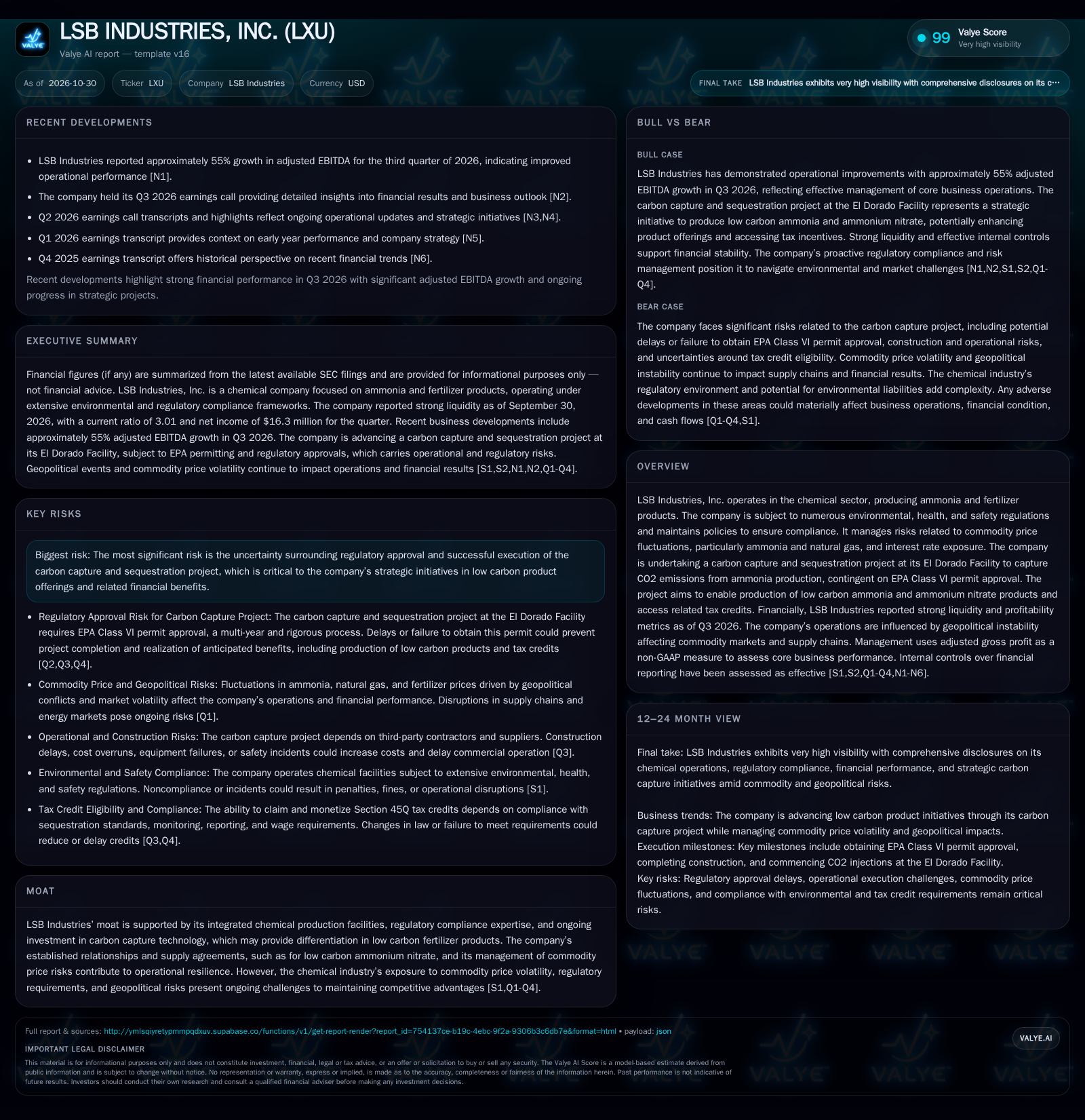
LSB Industries, a chemical producer specializing in ammonia and fertilizers, reported a 55% increase in adjusted EBITDA for Q3 2026 and maintains reported liquidity position. The company is advancing a $95 million carbon capture project at its El Dorado Facility, with future growth and low-carbon product differentiation contingent on EPA permit approval. Commodity price volatility and regulatory hurdles remain core risks to both operations and strategic ambitions. [S2] [N1]
LSB Industries is at a crossroads: operational momentum and a reported balance sheet position have enabled it to pursue a potentially game-changing carbon capture initiative, positioning the company to offer low-carbon fertilizers and access valuable tax credits. However, this strategic pivot is fraught with execution and regulatory risks, especially as global commodity markets remain volatile and environmental compliance standards tighten. The company’s near-term financial strength is undeniable, but its future will be determined by its ability to convert regulatory approval and project execution into sustainable competitive advantages.
Recent Performance, Balance Sheet, and Strategic Initiatives Define the Current Landscape
LSB Industries reported approximately 55% adjusted EBITDA growth in Q3 2026, indicating a significant improvement in operational efficiency or pricing power relative to the prior period. This profitability surge, alongside net income of $16.3 million for the quarter, underscores the company’s ability to capture value in a volatile market environment. [N1] [S2]
The company’s liquidity position is notable: as of September 30, 2026, LSB Industries had $37.7 million in cash, $165.8 million in short-term investments, and a current ratio of 3.01. [S2]
The most strategic development is the $95 million carbon capture and sequestration project at the El Dorado Facility, which is still awaiting EPA Class VI permit approval—a multi-year, high-stakes regulatory process. The company’s ability to produce and market low-carbon ammonia and ammonium nitrate, as well as to access Section 45Q tax credits, is directly tied to the success of this project. [S1]
How LSB Industries’ Economics Could Shift with Carbon Capture and Commodity Dynamics
LSB Industries’ core business remains the production and sale of ammonia and fertilizer products, which are highly sensitive to commodity price swings—particularly ammonia and natural gas. The company’s gross profit is exposed to input cost volatility, though some natural gas is sourced on fixed contracts to mitigate this risk. Pricing for end products is generally set by global and regional supply-demand dynamics rather than by company-specific pricing power. [S1]
The pursuit of carbon capture technology introduces both new revenue streams and cost structures. If successfully implemented, the El Dorado project could allow LSB Industries to command a premium for low-carbon ammonia and ammonium nitrate, especially as fertilizer buyers and industrial users increasingly seek to decarbonize supply chains. The project’s economics also hinge on eligibility for Section 45Q tax credits, which could materially enhance cash flows for each ton of CO2 sequestered, provided regulatory compliance is achieved.
Fixed costs may rise with the addition of carbon capture infrastructure and ongoing compliance monitoring, but variable costs tied to raw materials and energy are likely to remain the principal driver of margin volatility. The $95 million capital investment is significant relative to recent net income, and the return on this investment depends on both regulatory outcomes and market willingness to pay for low-carbon products.
Carbon Advantage, Compliance Rigor, and the Challenge of Industry Commoditization
In the commodity-driven chemical sector, differentiation is rare and often short-lived. LSB Industries’ legacy assets and regulatory compliance record provide some operational resilience, but do not in themselves confer pricing power. The company’s move into carbon capture and low-carbon fertilizers could create a first-mover or fast-follower advantage if regulatory approval is secured and if customers value low-carbon credentials enough to pay a premium.
Competitors in the North American fertilizer market include both integrated chemical giants and regional producers, many of whom are also pursuing decarbonization strategies. The question is whether LSB’s carbon capture investments will result in superior economics or merely keep pace with evolving industry standards.
Supply agreements for low carbon products may provide some commercial stickiness, but switching costs for customers are generally low unless regulatory mandates or ESG-driven procurement standards create true barriers. The moat here is conditional: it will be tested as more players bring low-carbon offerings to market and as regulatory frameworks evolve.
If Carbon Capture Execution and Regulatory Tailwinds Align, Margin Expansion and Market Share Gains Could Follow
The most favorable scenario for LSB Industries is one in which the El Dorado carbon capture project secures timely EPA Class VI permit approval, construction is completed on schedule and budget, and CO2 injection begins without major operational setbacks. In this world, the company would be able to supply verified low-carbon ammonia and ammonium nitrate, potentially commanding a price premium and securing long-term supply agreements with customers seeking to decarbonize.
Section 45Q tax credits could provide a meaningful cash flow boost, strengthening the return on invested capital for the project. If low-carbon products gain traction—either through regulatory mandates, ESG-driven demand, or voluntary sustainability commitments—the company could see both higher margins and increased market share relative to less advanced competitors.
Evidence that would confirm this scenario includes: successful permit approval and project commissioning, new or extended customer agreements explicitly tied to low-carbon offerings, and sustained adjusted EBITDA margin expansion in future quarters.
Most Plausible Outcome: Operational Progress Tempered by Regulatory Delays and Persistent Commodity Volatility
In the most likely scenario, LSB Industries continues to generate positive operating results from its core fertilizer business, benefiting from operational improvements and prudent risk management. The carbon capture project advances but faces regulatory delays or incremental compliance costs, slowing the timeline for commercial-scale low-carbon product sales and tax credit monetization.
Commodity price volatility remains a defining feature of the business, with margins fluctuating quarter-to-quarter based on input and product prices.
Indicators for this scenario would include: extended regulatory timelines, moderate progress on project construction, continued adjusted EBITDA growth but with plateauing margins, and customer adoption of low-carbon products only after regulatory or industry-wide tipping points.
Regulatory Roadblocks or Execution Failures Could Undermine Strategic Ambitions and Erode Profitability
A less favorable scenario would see the EPA Class VI permit delayed indefinitely or denied, effectively halting the carbon capture project. Construction or operational setbacks—such as cost overruns, equipment failures, or safety incidents—could further erode returns or trigger write-downs. In this case, LSB Industries is left with sunk costs and no new revenue streams or tax credits to offset them.
At the same time, commodity prices could turn against the company—either due to global oversupply, lower demand, or persistent geopolitical disruptions—compressing margins in the legacy fertilizer business. If competitors move faster or more effectively on decarbonization, LSB’s market position could deteriorate, leading to customer attrition and underutilized assets.
Evidence supporting this scenario would include: public disclosures of regulatory setbacks, increased project costs or schedule slippage, deteriorating gross and adjusted EBITDA margins, and loss of major customer relationships.
Milestones and Metrics That Will Determine Whether LSB Industries Delivers on Its Low-Carbon Thesis
Progress on EPA Class VI permit approval for the El Dorado carbon capture project—any announcement of approval, delay, or denial would be pivotal.
Actual capital expenditures versus the estimated $95 million budget for carbon capture infrastructure, and whether overruns are disclosed.
Timelines for commencement of CO2 injection and first commercial sales of low-carbon ammonia or ammonium nitrate.
Volume and pricing of low-carbon product sales—if disclosed—and whether these products achieve margin premiums over standard offerings.
Realized Section 45Q tax credits and any disclosures about compliance with sequestration and reporting standards.
Adjusted gross profit and adjusted EBITDA trends in future quarters—continued margin expansion would support the operational improvement thesis.
Commodity price exposure and hedging effectiveness, particularly for ammonia and natural gas inputs.
Any material changes in major customer or supply agreements, especially relating to low-carbon product adoption.
Disclaimer: This is research-only, informational analysis and not investment advice. It may include AI-generated interpretation and general industry context. Always verify important details using primary sources.

Comments