
Extreme Networks Pursues Enterprise Growth with AI-Driven Platforms and Wi-Fi 7—But Faces Liquidity and Execution Crosscurrents
Extreme Networks is leveraging next-generation networking technologies to target larger enterprise and government contracts.
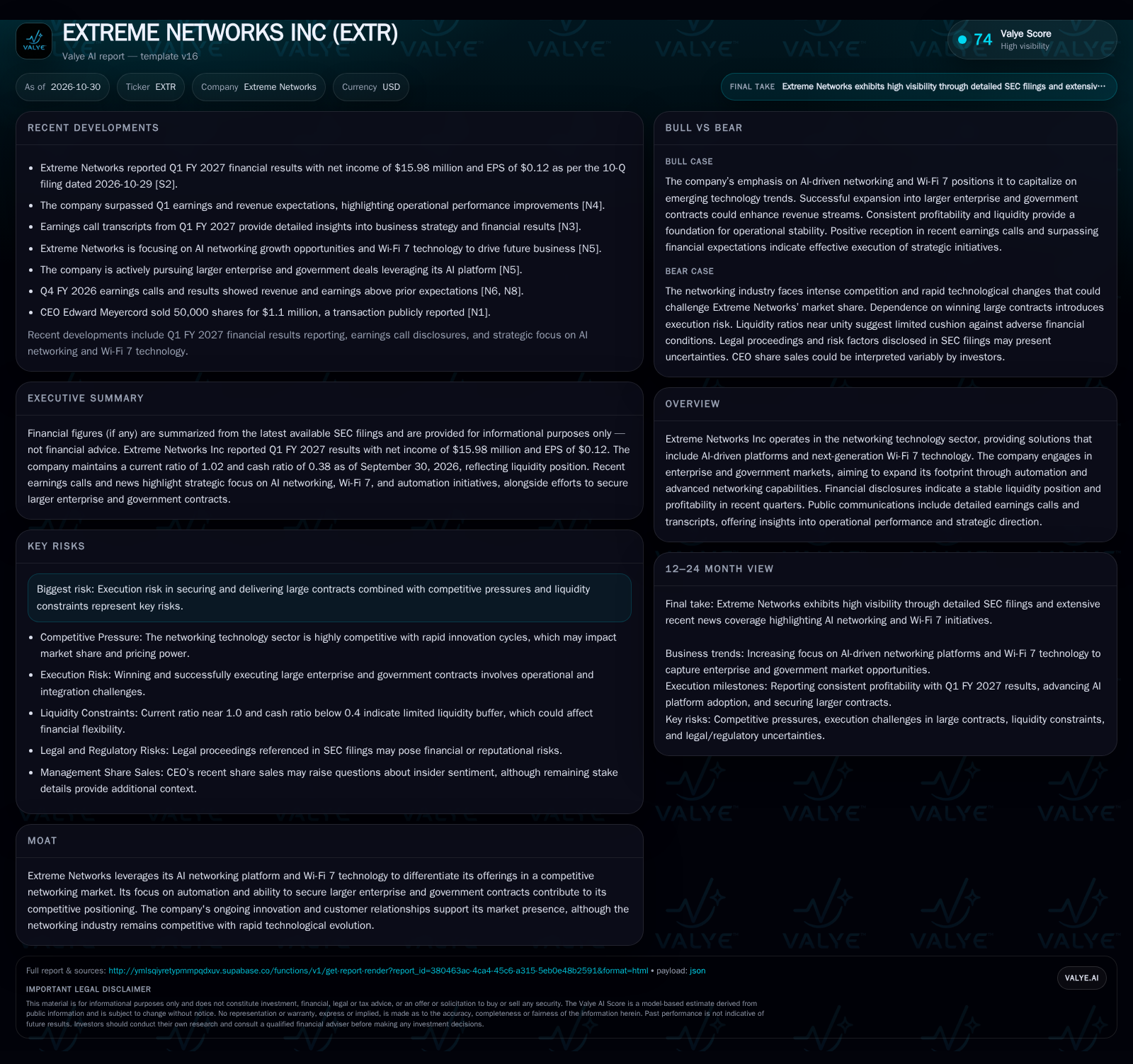
Extreme Networks reported Q1 FY 2027 net income of $15.98 million and EPS of $0.12, continuing a trend of surpassing earnings and revenue expectations. The company is focusing on AI networking and Wi-Fi 7 to drive growth, especially in larger enterprise and government segments. Competitive pressure and rapid innovation cycles remain key external risks. [S2] [N4] [N5]
Extreme Networks Inc is navigating a high-stakes inflection point: the company is betting on AI-driven networking platforms and Wi-Fi 7 technology to accelerate expansion into large enterprise and government segments. While recent quarters have seen not only profitability but also outperformance versus expectations, the company’s liquidity position remains tight, leaving little margin for error if execution falters or market conditions shift. As competition in networking intensifies and technological cycles accelerate, Extreme’s ability to deliver on its strategic ambitions will likely determine whether it can translate innovation into durable market share and earnings power.
Recent Profitability, Outperformance, and a Tight Liquidity Buffer Define the Current Landscape
Extreme Networks reported net income of $15.98 million and EPS of $0.12 for Q1 FY 2027, continuing a pattern of exceeding both earnings and revenue expectations in recent quarters. This operational momentum is central to management’s confidence in pursuing larger enterprise and government contracts, particularly as the company doubles down on AI networking and Wi-Fi 7 technology. The company reported a current ratio of 1.02 for the period. This means there is limited financial buffer if market or operational risks materialize. [S2] [N4] [N5]
How AI Networking and Wi-Fi 7 Could Reshape Revenue Mix and Margin Structure
Extreme Networks generates revenue primarily through the sale of network infrastructure hardware, software, and related services to enterprise and public-sector customers. The company is now emphasizing AI-driven platforms and Wi-Fi 7 technology, which may command premium pricing and enable higher-margin recurring software and service revenues if successfully adopted. However, the transition from traditional hardware sales to a more software- and services-centric model typically involves upfront R&D and go-to-market investments, with profitability hinging on the pace of customer adoption and the ability to scale new offerings across a broader base.
If Extreme succeeds in embedding its AI platform within large enterprise and government deployments, it could benefit from multiyear contracts, higher customer retention, and a more predictable revenue stream. However, the commercial structure—whether these are subscription-based, usage-based, or bundled with hardware—remains a critical unknown. Operating leverage could improve if fixed R&D and platform costs are spread over a larger installed base, but the risk is that slow adoption or pricing pressure could delay margin expansion and strain working capital needs.
Competitive Dynamics: Differentiation via AI and Automation in a Crowded Networking Market
The networking industry is characterized by intense competition, rapid innovation cycles, and well-capitalized incumbents. Extreme Networks is seeking to differentiate itself through the integration of AI-driven automation and the rollout of Wi-Fi 7 capabilities—features that could appeal to customers seeking higher network efficiency, security, and scalability. However, rival vendors, including large networking and cloud infrastructure providers, are also investing aggressively in similar technologies and courting the same enterprise and government accounts.
Switching costs in networking can be meaningful for large organizations due to integration complexity and risk of downtime, but price competition and bundled offerings from larger peers can erode this advantage. Extreme’s ability to win and retain large, strategically valuable contracts will likely hinge on demonstrable technical superiority, robust customer support, and a proven track record in delivering complex deployments.
In a market where incumbents possess entrenched relationships and economies of scale, Extreme Networks’ differentiation via AI and automation must translate into tangible operational benefits for customers, such as reduced network downtime, simplified management, or enhanced security. However, the rapid pace of innovation means that competitors can quickly replicate or surpass features, compressing product life cycles and increasing the need for continuous R&D investment. Furthermore, the company’s ability to demonstrate interoperability with existing infrastructure and cloud platforms will influence adoption rates, as enterprises prioritize minimizing disruption and preserving legacy investments.
If Extreme’s AI Platform Gains Traction, Multi-Year Contracts and Margin Expansion Could Follow
The most favorable scenario is one in which Extreme Networks’ AI-driven platform and Wi-Fi 7 offerings gain widespread adoption among large enterprise and government customers. In this case, the company could secure multiyear contracts with recurring revenue components, leading to improved visibility and operating leverage as platform costs are amortized across a larger customer base. Higher-margin software and services would begin to outweigh hardware revenues, supporting gross margin expansion.
Confirmation of this scenario would come from disclosed wins of large, multi-year contracts, evidence of increased software/services revenue mix, and explicit customer testimonials or case studies validating the value of Extreme’s AI platform. Accelerating revenue growth, improved gross margins, and sustained outperformance relative to consensus estimates would further validate the thesis. Conversely, weak adoption trends or lack of significant contract announcements would call this scenario into question.
Incremental Expansion: Steady Adoption, Ongoing Competitive Pressure, and Tight Financial Management
The most likely outcome is a measured pace of customer adoption for Extreme’s AI networking and Wi-Fi 7 solutions, with continued success in some large accounts but persistent competition limiting both pricing power and the pace of share gains. Revenue growth could remain solid but not break out dramatically, with profitability supported by careful cost discipline and ongoing product innovation.
Evidence supporting this scenario would include a stable or slowly improving revenue trajectory, moderate sequential gross margin improvement, and continued ability to match or slightly exceed consensus EPS. Evidence against it would be any signal of decelerating bookings, margin compression due to price competition, or operational setbacks in large contract rollouts.
Liquidity Constraints and Execution Missteps Could Expose Downside if Large Deals Slip or Costs Escalate
Signs confirming this scenario would include missed revenue or earnings targets, unexpected increases in short-term liabilities, negative operating cash flow, or the need to seek external financing on unfavorable terms. Delays in new product rollouts, customer losses, or evidence of integration or support failures in major contracts would further reinforce the downside risk.
Milestones That Will Determine Whether Extreme Networks Can Convert Innovation into Durable Growth
Disclosed wins of large enterprise or government contracts, with details on contract size, duration, and software/service mix, if reported, would provide crucial evidence of traction.
Quarterly revenue mix breakdown between hardware, software, and services—if disclosed—would help assess progress toward a higher-margin model.
Gross margin and operating margin trends: sustained improvement would indicate successful adoption and pricing power.
Updates on customer retention rates and renewal activity, if available, would shed light on switching costs and platform stickiness.
Cash flow from operations and changes in working capital needs: negative trends here would signal mounting liquidity risk.
Explicit management commentary on competitive wins/losses and the pace of adoption for AI and Wi-Fi 7 solutions.
Legal and regulatory disclosures or developments that could impact potential financial flexibility or reputation.
Disclaimer: This is research-only, informational analysis and not investment advice. It may include AI-generated interpretation and general industry context. Always verify important details using primary sources.

Comments