
Pebblebrook Hotel Trust: Urban Leisure Strategy Meets Operational Headwinds and Capital Market Crosscurrents
Pebblebrook’s portfolio of upper-upscale hotels in high-barrier coastal and resort markets provides exposure to diverse demand segments, but persistent net losses and reliance on third-party operators underscore the challenges of capital-intensive hospitality investment amid cyclical and competitive pressures. Preferred share yields above 8% and FFO outperformance suggest near-term financial resilience, yet the long-term thesis hinges on asset management execution, cost discipline, and navigating industry volatility.
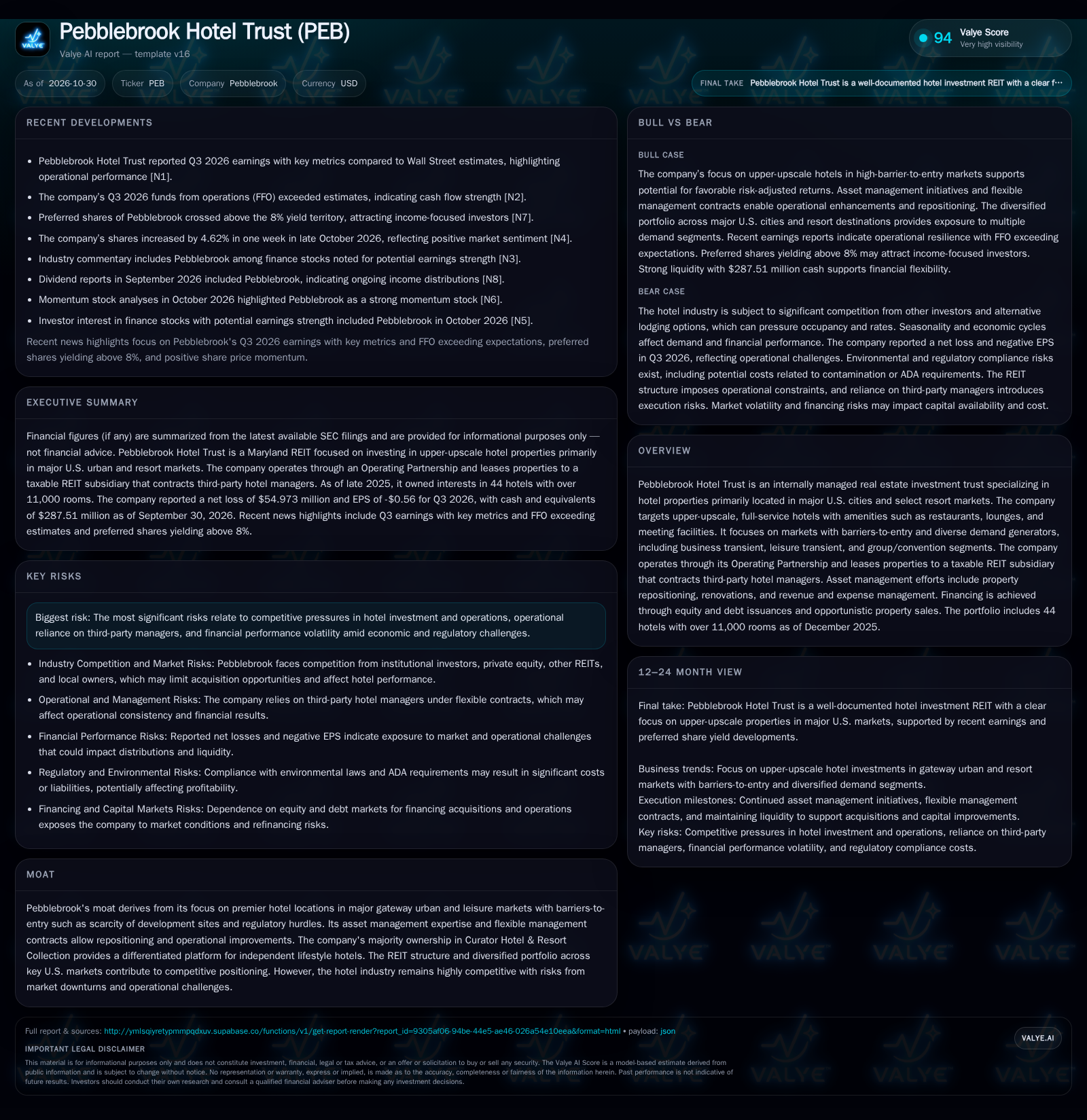
Pebblebrook Hotel Trust owns 44 upper-upscale hotels in major U.S. urban and resort markets, emphasizing asset management and operational improvements. Q3 2026 results showed a net loss but FFO above estimates, and preferred shares now yield over 8%. The company’s strategy targets high-barrier markets and diverse demand, but faces cyclical risks, reliance on third-party operators, and ongoing competition.
Pebblebrook Hotel Trust’s urban and resort-focused REIT model positions it at the intersection of premium hospitality demand and the structural challenges of hotel ownership. The company’s 44-property portfolio is anchored in high-barrier markets, leveraging asset management and flexible operations via third-party managers. While Q3 2026 showed FFO outperformance and preferred yields rising above 8%, persistent net losses and capital intensity highlight the delicate balance between income generation, operational risk, and market cyclicality. As the company leans into asset repositioning and portfolio optimization, the path forward will depend on both internal execution and external macro demand recovery.
Recent Earnings and Market Moves Define Pebblebrook’s Immediate Landscape
Pebblebrook Hotel Trust reported a net loss of $54.97 million and negative EPS for Q3 2026, continuing a pattern of operational challenges that have weighed on profitability [S2]. However, funds from operations (FFO) exceeded Wall Street estimates, suggesting that cash-generating capacity—central to REIT valuation—remains intact despite GAAP losses [N2]. The company’s preferred shares surpassed an 8% yield in October 2026, a level that may attract yield-focused investors but also reflects market caution regarding risk or future distribution sustainability [N7]. Shares climbed 4.62% in late October, likely buoyed by the FFO performance and income distribution continuity [N4] [N8]. The company reported cash and liquidity metrics for the period; these figures do not by themselves establish operating runway, investment capacity, financial flexibility, or financing capacity. [S2] These facts frame a thesis in which operational resilience and capital structure decisions are in tension with cyclical headwinds and competitive industry dynamics.
How Pebblebrook’s Asset-Intensive Model Translates to Cash Flow and Risk
Pebblebrook’s economics are defined by its ownership of upper-upscale, full-service hotels concentrated in high-barrier urban and resort markets. The company’s REIT structure requires it to lease properties to a taxable REIT subsidiary, which then contracts with third-party hotel managers. This separation means Pebblebrook does not directly operate its hotels, limiting operational control but allowing for compliance with REIT tax rules. Revenue is driven by a blend of business, leisure, and group demand, with seasonality producing higher occupancy and rates in Q2 and Q3 and weaker results in Q1 and Q4.
The capital structure is inherently leveraged: substantial upfront investment is required for property acquisitions, renovations, and repositioning, with returns dependent on occupancy, average daily rate (ADR), and operating efficiency. Pebblebrook’s asset management aims to drive incremental value through renovations, operational improvements, and capital allocation (including selective sales and acquisitions). However, the fixed-cost base is high—property taxes, insurance, and maintenance are largely invariant to short-term revenue swings, amplifying operating leverage. Variable costs (labor, utilities, consumables) flex with occupancy, but margin expansion can be difficult in periods of demand weakness or inflationary pressure.
Cash flow is measured primarily by FFO, which excludes non-cash depreciation and is the core metric for REITs. The recent outperformance on FFO suggests Pebblebrook’s properties are generating sufficient cash to cover distributions and maintenance capex, but persistent net losses highlight the tension between accounting profitability and distributable cash. Access to capital—both debt and equity—remains critical for funding renovations, acquisitions, and, if necessary, bridging periods of weak demand.
Urban and Resort Focus as a Double-Edged Sword in Hospitality Competition
Pebblebrook’s strategy emphasizes upper-upscale hotels in major U.S. cities and destination resorts, seeking locations with high barriers to entry such as regulatory constraints, limited developable land, and entrenched demand drivers. This can confer some protection against new supply and enable premium pricing, especially in markets like San Francisco, Boston, and Washington D.C. However, these same markets attract intense competition from institutional investors, private equity, other REITs, and local independent owners, driving up acquisition costs and compressing yields.
The company’s majority stake in Curator Hotel & Resort Collection provides a differentiated platform for independent lifestyle hotels, potentially enhancing brand value, distribution, and operational synergies. Yet, the reliance on third-party managers introduces execution risk and can dilute the benefits of direct operational innovation or cost control, especially relative to vertically integrated hotel operators or franchise models.
Alternative lodging options—ranging from short-term rentals to boutique competitors—continue to erode traditional hotel market share, particularly in leisure-heavy urban and resort locations. Pebblebrook’s ability to reposition assets and refresh amenities is a partial offset, but the industry’s low switching costs and high price sensitivity remain persistent threats to occupancy and rate integrity.
Unlocking Value Through Asset Repositioning and Demand Recovery
The favorable scenario for Pebblebrook hinges on successful execution of asset management initiatives—renovations, repositioning, and operational improvements—that drive higher ADR and occupancy in core urban and resort markets. If U.S. leisure and business travel demand continues to recover, especially in gateway cities and high-income destinations, Pebblebrook could realize outsized RevPAR (revenue per available room) growth relative to peers. This would expand margins due to the high fixed-cost base, translating into higher FFO and supporting dividend growth.
Confirmation of this scenario would come from sequential improvements in RevPAR, occupancy, and ADR across the portfolio, alongside evidence of sustained FFO growth outpacing industry averages. Asset sales above book value or at strong cap rates would reinforce the capacity to recycle capital and validate the company’s acquisition criteria. Finally, narrowing net losses or a return to GAAP profitability—while not essential for a REIT—would increase investor confidence in long-term value creation.
Navigating Cyclical Volatility with Defensive Asset Management
The most plausible trajectory for Pebblebrook is continued operational resilience anchored by its high-quality portfolio, but with episodic pressure on earnings and cash flows due to macroeconomic and industry cyclicality. The company’s asset management may yield incremental gains—selective renovations, cost discipline, and dynamic rate management—but is unlikely to fully offset external headwinds such as muted business travel, uneven leisure demand, or rising operating costs.
In this scenario, FFO remains sufficient to cover dividends and maintenance capex, but net losses persist due to heavy depreciation and interest expense. Preferred share yields remain elevated, reflecting a cautious market outlook, while equity price appreciation is limited by uncertainty around demand recovery and margin expansion. Confirmation would be a relatively stable FFO trend (with mild growth), consistent dividend payments, and portfolio occupancy/ADR in line with or slightly above urban market averages. Conversely, a sharp deterioration in occupancy or sustained negative FFO would falsify this scenario.
Intensifying Competition and Demand Shocks Erode Cash Flow and Capital Access
An adverse scenario emerges if economic conditions deteriorate—recession, sustained high interest rates, or external shocks (such as geopolitical events or health crises)—leading to significant drops in both business and leisure travel. Occupancy and ADR could fall sharply, compressing RevPAR and driving down FFO below dividend and capex coverage. In such a scenario, Pebblebrook’s high fixed-cost structure would amplify losses, forcing asset sales at distressed prices or dilutive equity issuance.
Additional downside risk stems from heightened competition in core markets, with new supply or aggressive discounting by peers and alternative accommodations eroding pricing power. Execution missteps by third-party managers could further undermine operational performance, while regulatory or environmental compliance costs could add to financial strain.
Testing the Pebblebrook Thesis: Operational Metrics, Capital Choices, and Industry Signals
Quarterly FFO per share trends—especially versus urban hotel REIT peers—would help gauge the effectiveness of asset management and resilience to market shocks.
Portfolio RevPAR (revenue per available room) growth, if disclosed, is a critical indicator of pricing power and demand across core markets.
Occupancy and ADR data by market segment (business, leisure, group) would clarify exposure to demand volatility and the success of repositioning initiatives.
Progress and returns on capital from recent or ongoing renovations and repositionings would test management’s value-creation claims.
Asset sale activity, pricing relative to book value or replacement cost, and proceeds redeployment would illuminate capital allocation discipline.
Preferred and common dividend coverage ratios—FFO payout and cash flow sufficiency—are key to assessing income sustainability.
Changes in debt maturity schedules, interest coverage, and refinancing activity would signal evolving capital market risk and liquidity posture.
Any disclosure or commentary on third-party manager performance or changes in management contracts would help assess operational risk.
Disclaimer: This is research-only, informational analysis and not investment advice. It may include AI-generated interpretation and general industry context. Always verify important details using primary sources.

Comments