
Merit Medical Systems: Diversification, Innovation, and the Stakes of potential Financial Flexibility in a Shifting Healthcare Landscape
Solid Q3 profitability, a strategic acquisition, and a diversified product base position Merit Medical for continued relevance in interventional medicine. Yet, debt covenants, geopolitical uncertainty, and integration execution risks highlight the importance of disciplined capital allocation and operational resilience.
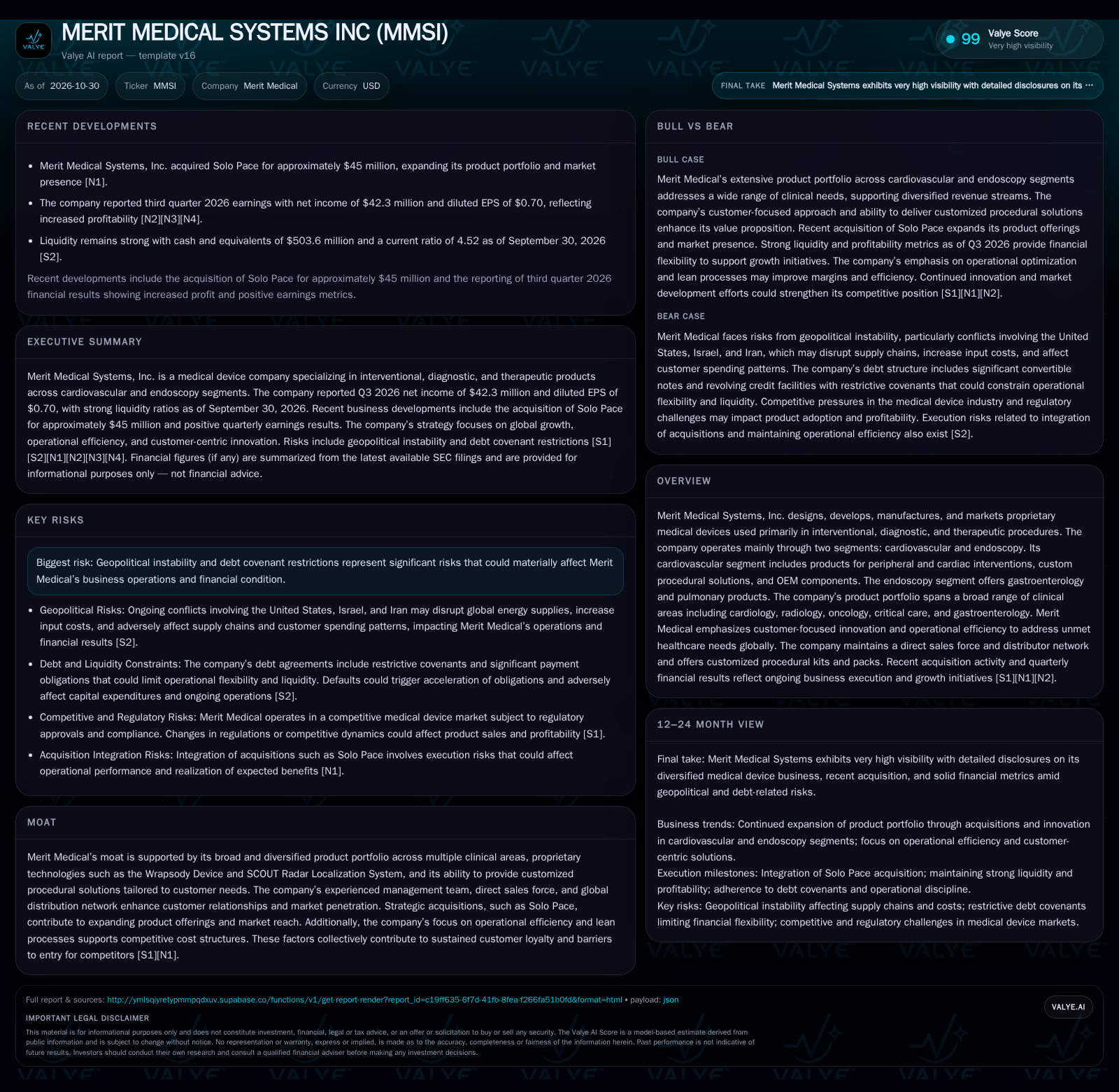
Merit Medical reported increased Q3 profit and completed the $45 million Solo Pace acquisition, signaling ongoing expansion in its core markets. Liquidity as of September 30, 2026, included over $500 million in cash and a reported current ratio. The company’s broad cardiovascular and endoscopy portfolio supports diversified revenue streams, but restrictive debt covenants and geopolitical risks could constrain flexibility and disrupt supply chains. Integration of recent acquisitions and sustained innovation will be key determinants of future performance. [S1] [N1] [N2] [N3] [N4] [S2]
Merit Medical Systems enters Q4 2026 on the back of increased profitability, a strategic tuck-in acquisition, and a diversified product set spanning cardiovascular and endoscopy interventions. However, the company’s sizable convertible debt, restrictive credit covenants, and exposure to global supply chain volatility mean that operational discipline and careful capital allocation will be central to sustaining momentum. The next phase hinges on integrating new assets, maintaining innovation, and navigating a medical device landscape defined by both opportunity and risk.
Recent Profit Gains, Acquisition, and Financial Position Define the Current Landscape
Merit Medical Systems reported net income of $42.3 million and earnings per diluted share of $0.70 for Q3 2026, reflecting continued profitability and operational execution. The acquisition of Solo Pace for approximately $45 million signals ongoing investment in expanding the company’s product portfolio and addressable market, particularly in its core cardiovascular and endoscopy segments. As of September 30, 2026, the company’s liquidity position is characterized by $503.6 million in cash and equivalents, current assets of $1.2 billion, and a current ratio of 4.52. However, the company also carries $747.5 million in 3.00% convertible senior notes due 2029 and access to a $700 million revolving credit facility, both of which are subject to restrictive covenants that could impact operational flexibility. These developments collectively set the stage for Merit’s near-term strategic and financial choices. [N1] [N2] [N3] [N4] [S2]
How Merit Medical Earns: Product Breadth, Customization, and the Economics of Scale
Merit Medical generates revenue primarily from the sale of proprietary medical devices used in interventional, diagnostic, and therapeutic procedures, with its cardiovascular segment (including peripheral and cardiac interventions, custom procedural solutions, and OEM components) forming the economic backbone. The endoscopy segment adds category diversification through gastroenterology and pulmonary products. Pricing power is typically constrained by hospital procurement practices and payer reimbursement regimes, but product differentiation—via proprietary technologies and custom procedural kits—can support premium pricing and customer stickiness.
The company’s ability to bundle devices into procedural kits and offer tailored solutions can increase basket size and embeds its products deeper into provider workflows, potentially increasing switching costs. Fixed costs are significant, given the need for ongoing R&D, regulatory compliance, and a direct sales force, but variable costs (materials, manufacturing, distribution) scale with volumes. This structure creates operating leverage: as sales volumes rise, margins can expand if fixed costs are contained.
Capital needs are shaped by the demands of innovation, regulatory approvals, and periodic acquisitions. The sizable convertible note and revolving credit facility imply both access to capital and a need for disciplined debt management, as restrictive covenants could limit future investment or operational agility if financial performance falters. The economics of OEM supply—selling components to other device makers—may offer steady, lower-margin revenues, while proprietary finished devices have higher margin potential but greater exposure to competitive and regulatory pressures.
Defending Share in a Crowded Medical Device Arena
Merit Medical competes against a range of global medical device manufacturers, from multinational conglomerates to specialized niche players. Its broad and diversified portfolio is a double-edged sword: while it creates multiple revenue streams and customer touchpoints, it also exposes the company to intense competition and the need to continually innovate across several categories. Proprietary products like the Wrapsody Device and SCOUT Radar Localization System help differentiate Merit’s offerings, but competitors often have larger R&D budgets and more established global distribution networks.
Custom procedural solutions—such as tailored kits and trays—create additional value and may help sustain customer relationships, especially when integrated into provider workflows. However, rivals can potentially replicate this approach or undercut on price. The company’s direct sales force and global distributor relationships are assets, but the same channels are leveraged by larger competitors and new entrants alike. Regulatory hurdles and the complexity of clinical adoption may slow the entry of smaller disruptors, but also increase compliance costs for all players.
The recent Solo Pace acquisition demonstrates Merit’s intent to expand via inorganic growth, but successful integration and realization of synergies will be necessary to capture intended advantages. The company’s moat is thus defined by a combination of product breadth, customer-centric customization, and operational discipline—none of which are insurmountable for well-capitalized peers.
Innovation and Seamless Integration Could Drive Margin Expansion
A favorable scenario for Merit Medical would see the successful integration of Solo Pace, resulting in expanded product offerings and cross-selling opportunities across existing customer channels. Operational optimization, including further lean manufacturing initiatives and supply chain efficiencies, could drive incremental margin improvement.
Confirmation of this scenario would come from sequential margin expansion, new product launches with rapid clinical adoption, and evidence of increased average order values or new customer wins attributable to the combined product portfolio. Monitoring disclosure of integration milestones, R&D pipeline progress, and successful navigation of debt covenants would further validate this pathway.
Sustained Diversification Balances Opportunity and Constraint
The most plausible near-term outcome is continued steady performance driven by the company’s diversified product set and established customer relationships. Organic growth in cardiovascular and endoscopy segments, supplemented by incremental contributions from Solo Pace, would support mid-single-digit revenue expansion. Margins may remain stable as operational improvements offset competitive pricing and input cost pressures, provided supply chain disruptions are contained.
The company is likely to maintain a conservative financial posture, prioritizing debt covenant compliance and disciplined capital allocation. Confirmation would include stable or modestly growing operating margins, ongoing cash generation, and no material breaches of debt covenants. Evidence of successful acquisition integration without major operational disruptions would also support this scenario.
Supply Chain Disruptions and Debt Constraints Could Derail Momentum
A less favorable scenario would see geopolitical instability—particularly conflicts affecting the U.S., Israel, and Iran—disrupting supply chains, increasing input costs, and delaying critical components, thereby impairing Merit’s ability to fulfill orders or maintain margins. Simultaneously, if revenue growth slows or integration of Solo Pace proves more complex than anticipated, operating results could deteriorate, increasing the risk of breaching restrictive debt covenants.
This could trigger forced reductions in capital expenditures, limit strategic flexibility, or even require raising additional capital on unfavorable terms. Confirmation of this downside scenario would include margin compression, negative operating cash flow, missed integration milestones, or explicit disclosures regarding covenant stress or supply chain impairments.
Factors That Will Shape Merit Medical’s Competitive and Financial Trajectory
Quarterly gross and operating margin trends—evidence of margin expansion or compression would reveal the success of operational optimization and pricing discipline.
Progress on Solo Pace integration, including cost synergies, product cross-sell rates, and retention of key personnel.
Disclosure of R&D pipeline advancements, particularly new device launches or regulatory approvals that could refresh the product portfolio and drive growth.
Trends in average order value and customer retention rates, if disclosed, to test the stickiness of custom procedural solutions.
Updates on debt covenant compliance and any changes to the company’s revolving credit facility or convertible note terms.
Indicators of supply chain reliability or disruptions, especially in the context of ongoing geopolitical risks.
Competitive developments—such as major new product launches, price changes, or regulatory shifts from peer companies—that could alter the market landscape.
Disclaimer: This is research-only, informational analysis and not investment advice. It may include AI-generated interpretation and general industry context. Always verify important details using primary sources.

Comments