
Seagate’s Next Act: HAMR Technology, Data Center Demand, and the Stakes of Defending HDD Economics in an AI World
Seagate’s fiscal 2026 results highlight robust demand from data center and AI-driven workloads, a pivotal transition to advanced HAMR drives, and the persistent risks of technological disruption and customer concentration. The company’s ability to balance capital intensity, product innovation, and the economics of high-capacity storage will determine whether it can sustain its leadership amid shifting storage paradigms.
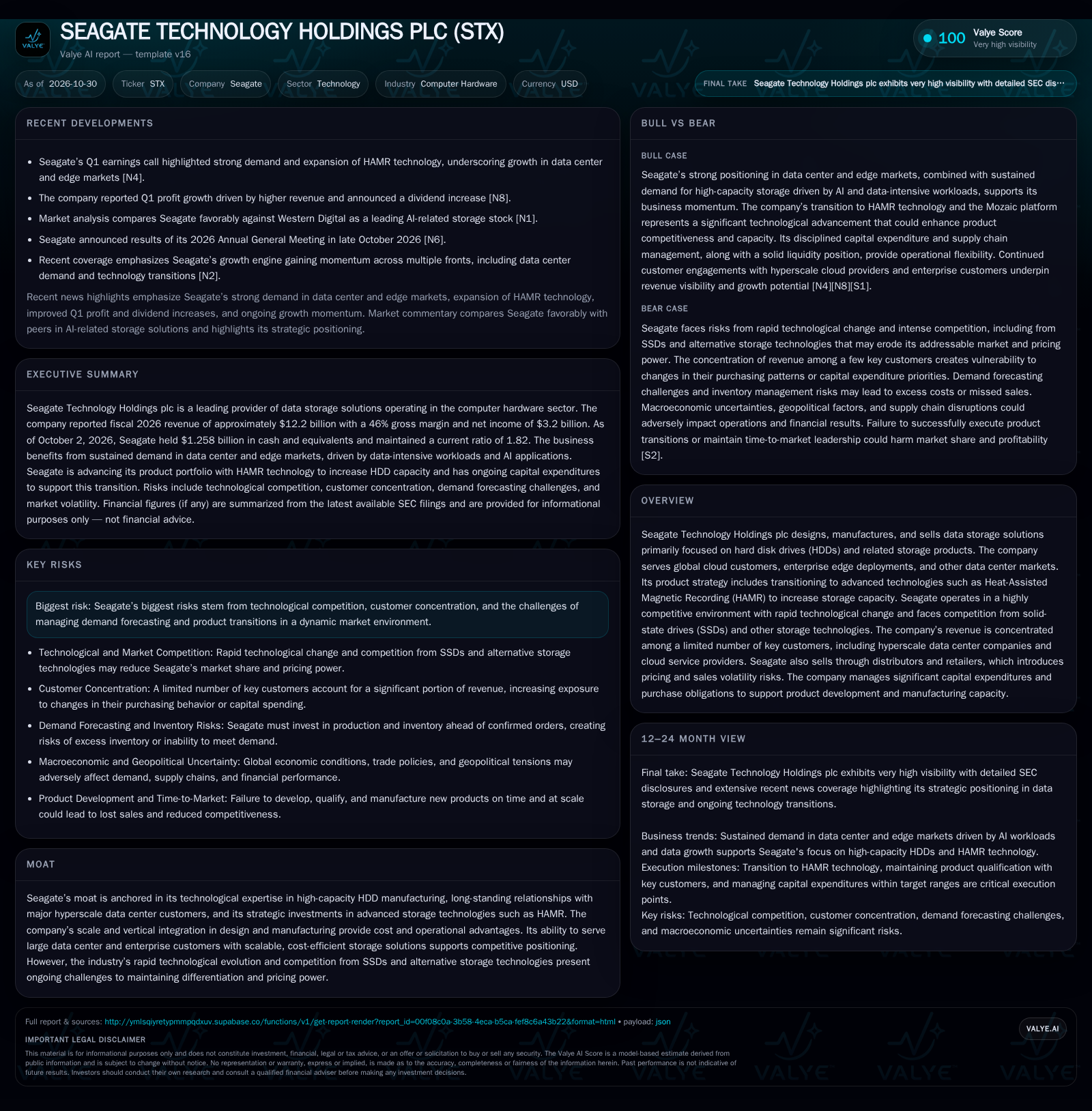
Seagate reported $12.2 billion in fiscal 2026 revenue with a 46% gross margin, driven by strong data center and AI-related demand. The transition to HAMR technology aims to defend HDD relevance against SSD encroachment and increase storage capacity. However, substantial customer concentration and rapid technological change remain central risks. Capital expenditures are set to rise in fiscal 2027 to support the HAMR ramp, with execution on product development and customer qualification as key near-term milestones. The long-term thesis hinges on Seagate’s ability to sustain scale and differentiation as storage workloads and architectures evolve.
Seagate Technology’s fiscal 2026 performance underscores the company’s pivotal role in the global data infrastructure ecosystem, particularly as the surge in AI workloads and data-intensive applications drive unprecedented demand for high-capacity storage. With $12.2 billion in annual revenue and a 46% gross margin, Seagate’s core HDD business shows resilience, but the landscape is rapidly evolving. The ongoing transition to HAMR technology is both an opportunity and a challenge, demanding substantial investment and flawless execution. At the same time, customer concentration and competitive threats from SSDs and emerging storage paradigms pose existential questions about the durability of Seagate’s business model.
Data Center Demand, HAMR Transition, and Financial Discipline Define 2026
Seagate closed fiscal year 2026 with $12.2 billion in revenue, a 46% gross margin, and $3.2 billion in net income, reflecting substantial demand from data center and AI-driven workloads [S1]. The company shipped 789 exabytes of HDD capacity, underscoring its scale and relevance in bulk storage. Execution on capital allocation was visible: Seagate reduced outstanding debt by $1.4 billion and ended the quarter with $1.258 billion in cash and equivalents [S2]. The company’s technology roadmap is in transition, with plans for higher capital expenditures in fiscal 2027 to support the volume ramp of next-generation HAMR drives [S1]. Seagate’s customer base remains concentrated, with hyperscale cloud and enterprise clients accounting for a significant revenue share, introducing both revenue visibility and risk [S2]. These factors collectively set the stage for a high-stakes period of innovation, execution, and competitive defense.
How Seagate’s Storage Model Turns Scale and Technology into Cash Flow
Seagate’s economics are fundamentally driven by its ability to manufacture and deliver high-capacity HDDs at scale for data center and enterprise customers. The business leverages significant fixed costs—R&D, manufacturing infrastructure, and supply chain commitments—against large-volume orders, creating operating leverage as demand rises. Gross margins (46% in FY26 [S1]) suggest that scale, vertical integration, and manufacturing efficiency remain key to profitability. However, the HDD market is structurally exposed to price pressure, especially as SSDs encroach on higher-capacity and performance segments. Seagate’s product mix is increasingly skewed toward data center and AI workloads, which typically demand higher-density drives; this mix shift can support margin stability if technology transitions (such as HAMR) are executed well and adopted by customers.
The company reported cash and liquidity metrics for the period; these figures do not by themselves establish operating runway, investment capacity, financial flexibility, or financing capacity. [S1] Yet, the capital intensity is rising: capex is expected to increase in FY27 to 4-6% of revenue, reflecting the need to qualify and ramp up HAMR drives [S1]. The company’s purchase obligations ($2.1 billion as of July 2026, mostly short-term [S1]) highlight the necessity of accurate demand forecasting and inventory management—errors here can quickly erode profitability. Seagate’s commercial mechanics with hyperscale and OEM customers likely involve volume-based pricing and long qualification cycles, which support revenue visibility but also limit pricing flexibility. Sales through distributors and retailers add another layer of volatility and price erosion risk.
Defending the HDD Moat as SSDs and AI Architectures Shift the Landscape
Seagate’s competitive position rests on its technological expertise in high-capacity HDD manufacturing, longstanding data center relationships, and the scale to deliver cost-effective storage. The transition to HAMR technology is designed to sustain HDD relevance by boosting areal density and lowering per-terabyte costs, directly countering the threat from SSDs, which continue to fall in price and gain performance. In the near term, HDDs retain an advantage in cost per bit for massive, cold, or archival storage—a segment where hyperscale and AI applications still drive substantial demand.
However, the competitive landscape is shifting. SSDs, powered by ongoing reductions in NAND cost and improvements in durability, are increasingly encroaching on workloads that were formerly HDD-exclusive. Meanwhile, new storage architectures (e.g., computational storage, storage-class memory) and cloud-native solutions could further erode the total addressable market for HDDs. Seagate’s primary peers include Western Digital and Toshiba in HDDs, but the real long-term threat comes from the broader storage ecosystem, including NAND manufacturers and cloud providers designing custom storage solutions. Customer concentration is a double-edged sword: it provides deep engagement and high-volume orders but increases vulnerability to shifts in purchasing or technology preferences by top clients.
If HAMR Delivers and AI Workloads Stay Explosive, Seagate Could Outrun Disruption
The favorable scenario hinges on successful execution of HAMR technology, enabling Seagate to deliver higher-capacity drives at attractive cost per bit and maintain or expand margin in the face of SSD price declines. If AI and data-intensive workloads continue to outpace storage density improvements, demand for bulk HDD storage could remain robust, especially for cold or archive data. This would allow Seagate to leverage its manufacturing scale, maintain high utilization, and potentially lock in long-term relationships with hyperscale customers.
Evidence that would confirm this scenario includes rapid customer qualification and volume adoption of HAMR drives, stable or expanding gross margins despite rising capex, and continued growth in exabytes shipped to data center and AI customers. Additional signs would be Seagate’s ability to maintain or grow its share of major cloud and hyperscale contracts, and positive commentary from key clients on the value proposition of next-generation HDDs versus SSDs and alternative storage.
A Tenuous Balance: Incremental Growth but Margin Headwinds as Storage Paradigms Evolve
The most plausible outcome is that Seagate achieves a measured ramp of HAMR drives, maintaining relevance in high-capacity, cost-sensitive storage while gradually yielding ground to SSDs in performance and mid-capacity workloads. Revenue remains stable or grows modestly as data center and AI demand offsets ongoing price declines and some share loss to SSDs. Margins may compress moderately due to the capital intensity of new technology and incremental pricing pressure from hyperscale customers.
Confirmation would come from steady exabyte shipments, revenue stability in the core data center segment, and moderate gross margin compression. Signs of base-case drift would include persistent customer concentration but no major defections, and continued requirement for material capex to sustain technology transitions. Falsification would involve either a dramatic drop in HDD relevance (e.g., hyperscale customers accelerating SSD adoption for all workloads) or a failure to achieve technical and cost milestones on HAMR.
Disruption Outpaces Defense: SSDs, Customer Churn, or Technology Missteps Imperil the Model
The adverse scenario features one or more of the following: rapid erosion of the bulk storage HDD market as SSDs become cost-competitive at large capacities; major hyperscale customers shift procurement strategies or in-house storage architectures, sharply reducing demand for Seagate’s core products; or execution failures on HAMR lead to delays, cost overruns, or poor qualification with key clients. In this world, Seagate faces severe margin compression, inventory write-downs, and possible loss of scale advantages.
Confirmation would include a sudden drop in exabyte shipments, severe gross margin contraction, or public statements from major customers indicating a pivot away from HDDs. Failure to control inventory and purchase commitments could exacerbate losses. Falsification would require evidence of resilient HDD demand and successful HAMR adoption even as SSD prices fall.
Milestones and Metrics That Will Reveal Seagate’s Resilience in Storage’s Next Era
Quarterly exabytes shipped, broken out by end market (cloud, enterprise, edge, if disclosed), to track real demand shifts and technology adoption.
Gross margin trends as HAMR ramps—evidence of cost competitiveness and manufacturing yield improvements.
Capex as a percentage of revenue, and whether it stays within or above the 4-6% target range during the HAMR transition.
Revenue concentration by top customers and any signs of customer churn, renegotiation, or contract repricing.
Inventory levels and purchase obligations relative to revenue—early warnings of demand forecasting errors or supply chain imbalances.
Public disclosures or customer commentary regarding HAMR qualification, adoption timelines, and perceived value versus SSD alternatives.
Any changes in reported product mix (high-capacity vs. legacy drives) that indicate strategic progress or market share shifts.
Updates on technology roadmap milestones, especially around next-generation platforms like Mozaic and their impact on customer wins.
Disclaimer: This is research-only, informational analysis and not investment advice. It may include AI-generated interpretation and general industry context. Always verify important details using primary sources.

Comments