
Supernus Pharmaceuticals: Momentum in CNS Portfolio, Merger Implications, and Collaborative Growth Dynamics
Supernus Pharmaceuticals posts record Q3 2026 results on the strength of its diverse CNS therapeutics portfolio and key collaborations, while a pending merger with Indivior could reshape its financial and strategic landscape. Investors must weigh the sustainability of recent growth against substantial integration, partner, and regulatory risks.
Supernus Pharmaceuticals achieved record Q3 2026 revenue and profitability, driven by its expanding central nervous system (CNS) product portfolio and collaborations on launches like ZURZUVAE for postpartum depression. The company's pending merger with Indivior promises scale but introduces leverage and integration risks. While intellectual property and orphan-drug exclusivity underpin its competitive position, reliance on single-source suppliers and partners, along with regulatory and litigation headwinds, present ongoing challenges. The next phase will test whether Supernus can convert its product pipeline and partner-driven commercial model into durable, margin-accretive growth.
Supernus Pharmaceuticals stands at a crucial juncture: record-setting Q3 2026 results reflect the commercial momentum of its CNS portfolio—fueled by strategic partnerships and product launches—yet the company’s future will likely be defined by its pending merger with Indivior and the structural risks that come with scale. The next year will test whether Supernus can sustain growth, manage integration, and defend its market position in the face of collaborator reliance and regulatory uncertainty.
Record Performance, Orphan Drug Exclusivity, and Uncertainty Surrounding the Merger
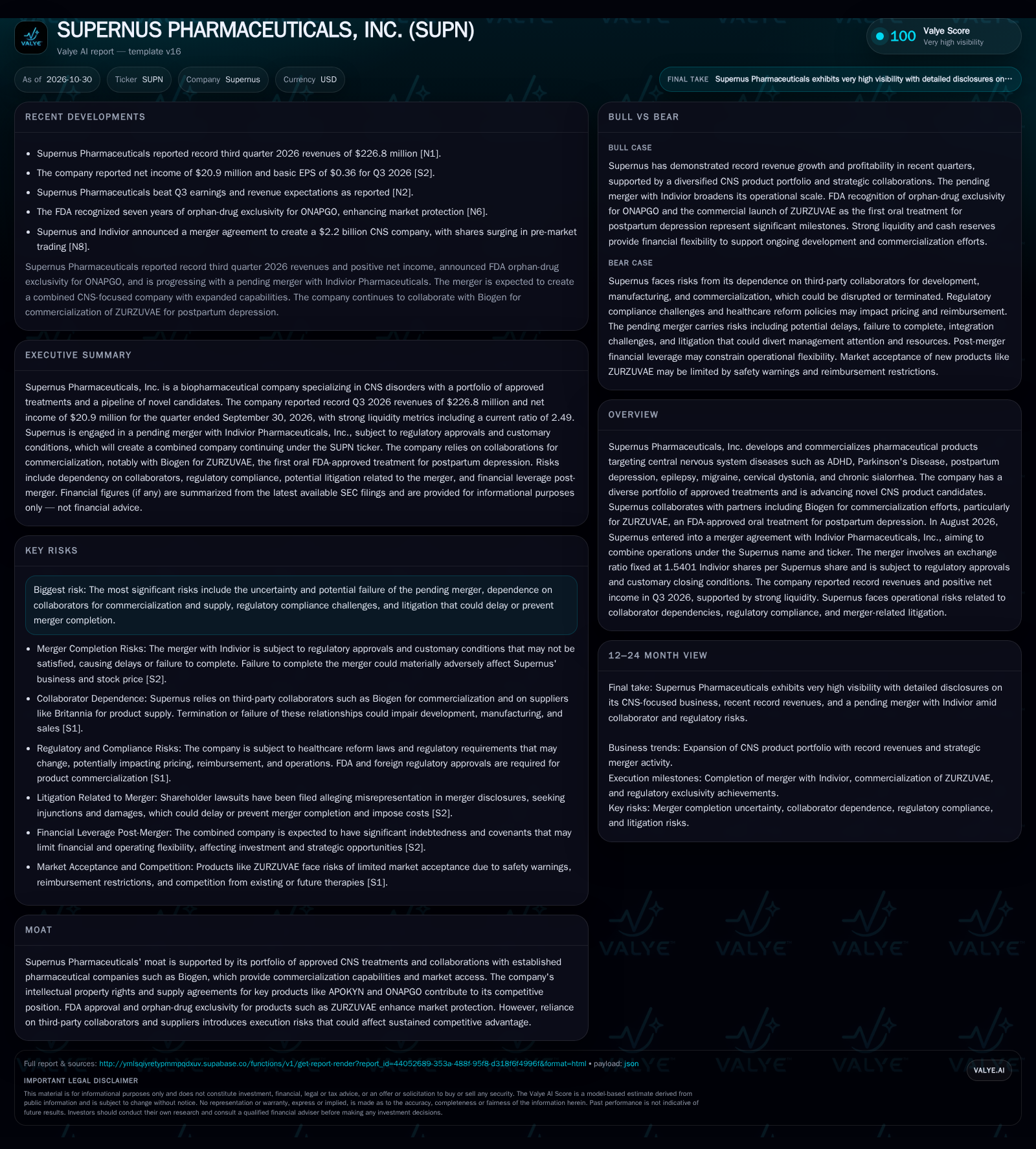
Supernus Pharmaceuticals reported record third quarter 2026 revenue of $226.8 million, net income of $20.9 million, and basic EPS of $0.36 [N1] [S2]. This performance reflects robust sales momentum, likely supported by recent product launches and established CNS therapies. The company’s reported liquidity position, with $175.9 million in cash and a current ratio of 2.49 as of September 30, 2026 [S2].
A notable regulatory development was the FDA’s recognition of seven years of orphan-drug exclusivity for ONAPGO, granting Supernus a period of limited competition for this indication [N6]. Meanwhile, the commercial launch of ZURZUVAE—the first oral treatment for postpartum depression—through a partnership with Biogen, marks a milestone in expanding the company’s CNS footprint [S1].
Strategically, Supernus entered into a merger agreement with Indivior Pharmaceuticals in August 2026, with the deal structured at a fixed exchange ratio (1.5401 Indivior shares per Supernus share) and subject to regulatory approvals [S2]. The merger, if completed, will form Supernus, Inc., but introduces risks related to integration, litigation (with shareholder suits filed over merger disclosures), and a more leveraged balance sheet [S2].
Commercial Realities of CNS Drug Development and Partner Collaborations
Supernus generates revenue primarily through the sale of branded pharmaceutical treatments targeting central nervous system disorders—an area where successful drugs can command premium pricing, especially if protected by exclusivity or strong intellectual property. The recently granted orphan-drug exclusivity for ONAPGO is likely to support pricing power and margins by limiting direct competition for seven years [N6].
The company’s model relies heavily on collaborations for commercialization, as seen with Biogen’s involvement in ZURZUVAE’s U.S. launch [S1]. Such partnerships may allow Supernus to access broader distribution channels and sales expertise, but typically involve revenue sharing or milestone payments, potentially capping gross margins compared to fully in-house commercialization. Where revenue is shared, the company’s share of economics will depend on contract terms, which are not fully disclosed.
Fixed costs in CNS drug development—including R&D and regulatory compliance—are significant, but once a drug achieves approval, incremental sales can drive operating leverage due to relatively stable manufacturing and overhead. However, reliance on single-source suppliers (as with ONAPGO) introduces supply risk and may limit the company’s ability to optimize cost of goods sold [S2].
Post-merger, the combined entity is expected to operate with higher leverage, which could constrain investment in R&D or limit flexibility to pursue additional acquisitions or new indications if cash flows falter [S2].
Portfolio Diversity, Market Exclusivity, and Boundaries of Collaboration-Driven Advantages
Supernus’ competitive position is underpinned by a diverse CNS portfolio, FDA approvals, and intellectual property. The grant of orphan-drug exclusivity for ONAPGO and the pioneering launch of ZURZUVAE for postpartum depression provide temporary barriers to entry and support for pricing [N6] [S1].
Partnerships with established pharmaceutical companies—such as Biogen—enhance market reach and can accelerate uptake for novel therapies. However, this collaboration-driven model creates dependency: if partners alter strategic priorities, terminate agreements, or underperform, Supernus’ ability to maximize product sales could be impaired [S1].
In the CNS space, competition comes from both branded and generic drug makers, as well as potential new entrants leveraging alternative mechanisms or delivery platforms. The company’s reliance on single-source suppliers for key products like ONAPGO also exposes it to supply disruptions, as was recently experienced and only partially mitigated by securing a second supplier (pending regulatory approval) [S2].
The expected merger with Indivior could enhance scale, pipeline diversity, and bargaining power, but will also pit the combined entity against larger, well-capitalized CNS and specialty pharma players. Integration effectiveness and the ability to retain key collaborations will be pivotal.
Pipeline Growth and Integration Success as Drivers for Margin Improvement
If Supernus successfully integrates with Indivior, the combined company could harness greater scale in commercial operations, R&D, and supply chain management—potentially driving margin expansion and strengthening its negotiating position with payers and partners. The deal’s structure, with a fixed share exchange, insulates Supernus shareholders from short-term market volatility, and a successful close would create a larger platform for future CNS launches [S2].
Sustained uptake of ZURZUVAE, especially if Biogen’s commercialization efforts drive strong adoption and reimbursement, could cement Supernus’ position in the postpartum depression market. Continued exclusivity for ONAPGO would further support revenue and margin stability [N6].
Upside would be confirmed by evidence of above-market CNS sales growth, successful new patient initiations for ONAPGO (now that supply has resumed), and positive clinical or regulatory milestones from the pipeline. Early signs of successful cost synergies, higher operating margins, and minimal merger-related disruptions would further validate the bullish case.
Continued CNS Expansion Amid Integration and Partnership Challenges
The most plausible trajectory is that Supernus continues to deliver steady CNS revenue growth, anchored by ZURZUVAE’s rollout and established products like ONAPGO and APOKYN.
However, growth is likely to remain partly dependent on partner execution (e.g., Biogen in PPD), reimbursement dynamics, and the company’s ability to manage supply chain risks. The pending merger with Indivior, if completed, will introduce integration complexity and higher leverage, potentially limiting near-term flexibility or R&D investment [S2].
The base case would be confirmed by continued revenue and earnings growth in line with recent quarters, stable partner relationships, and no major supply or regulatory disruptions. Delays in merger completion, regulatory pushback on pricing, or partner underperformance would challenge this scenario but not upend it.
Risks from Partner Disruptions, Regulatory Challenges, and Merger Consequences
Downside risk centers on adverse developments across three fronts: (1) breakdowns or terminations in key collaborations (e.g., Biogen or single-source suppliers), (2) regulatory or reimbursement changes that erode pricing or restrict access, and (3) merger-related disruptions, including litigation delays or failure to integrate operations [S1] [S2].
If Supernus loses collaborator support or faces sustained supply shortages—especially with ONAPGO or other single-source products—sales could fall short of expectations, and cost structures could become less flexible. Regulatory moves to lower pharmaceutical prices or restrict orphan-drug protections would further pressure margins.
Merger failure or severe integration challenges could result in stranded costs, management distraction, or erosion of shareholder value. Downside would be confirmed by declining revenue, margin compression, adverse litigation outcomes, or evidence of lost market share to competitors or generics.
Factors Shaping Supernus’s CNS Growth Following the Merger
Quarterly sales trends for ZURZUVAE, especially new patient starts and retention rates, if disclosed, will indicate whether the product is gaining traction in the PPD market.
ONAPGO supply continuity—including regulatory approval and ramp-up of the second supplier—will be critical for maintaining revenue and capturing the benefit of orphan-drug exclusivity.
Progress toward regulatory approval and closing of the Indivior merger, including resolution of outstanding litigation and integration planning updates, will shape the strategic outlook.
Gross margin trends and operating expense discipline post-merger will reveal whether scale economies and cost synergies are being realized.
Any changes in collaborator agreements, especially with Biogen or Britannia, would test the resilience of Supernus’s partnership model.
Updates on regulatory or legislative developments affecting CNS drug pricing and reimbursement could materially impact revenue and profitability.
Pipeline milestones—such as positive clinical trial data, FDA submissions, or new product launches—would indicate whether Supernus can sustain innovation-driven growth.
Disclosure of merger-related restructuring costs, debt covenants, and potential financial flexibility will help assess the combined company’s ability to invest in future opportunities.
Disclaimer: This is research-only, informational analysis and not investment advice. It may include AI-generated interpretation and general industry context. Always verify important details using primary sources.

Comments