
Otis Worldwide: Service-Led Growth, Operational Overhaul, and the Stakes of Capital Efficiency in a Mature Industry
Otis Worldwide's Q3 2026 outperformance highlights the strength of its service segment and ongoing transformation efforts.
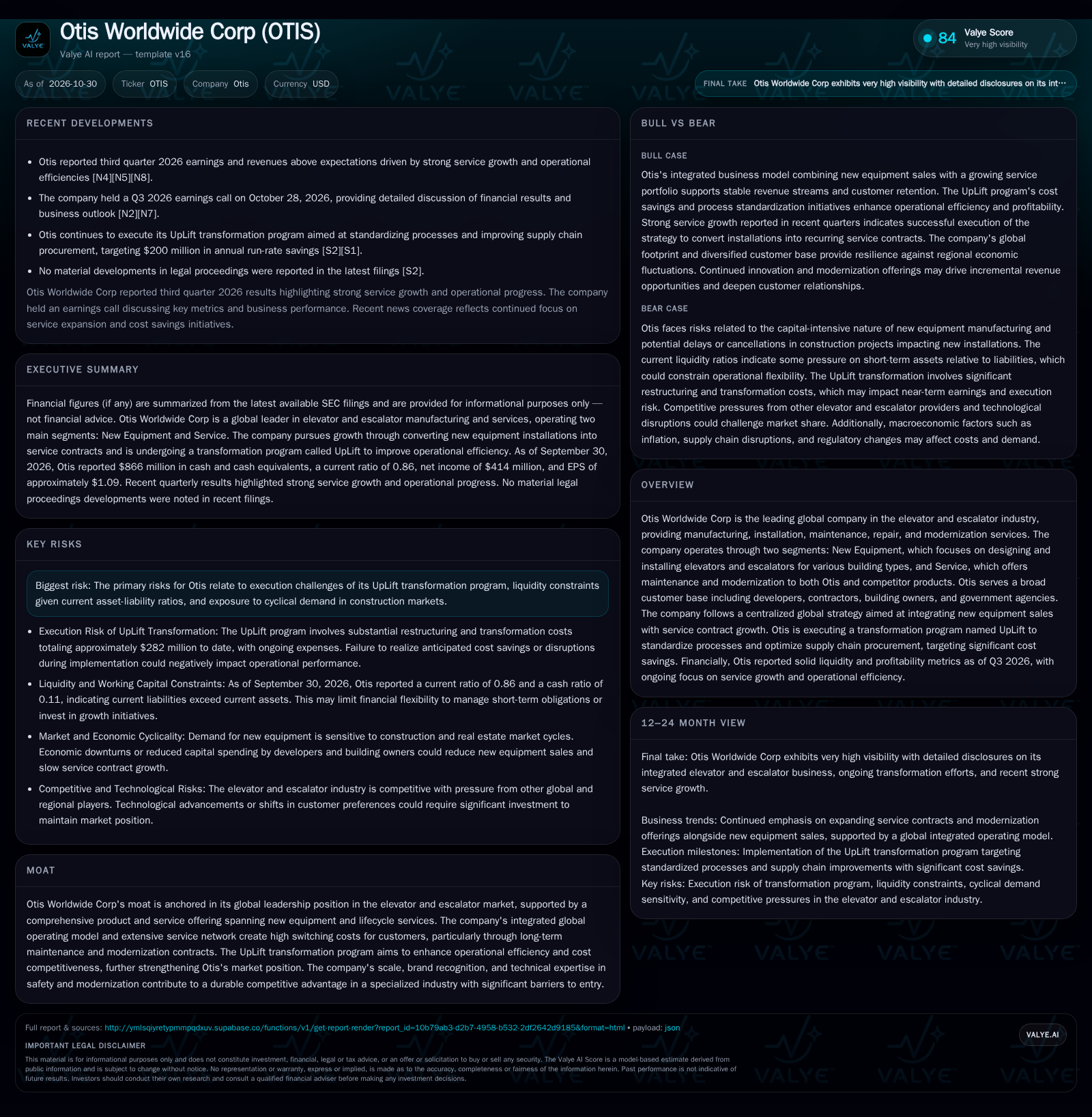
Otis Worldwide delivered above-expectation Q3 2026 revenues on the back of robust service growth, while pushing forward with its $200 million UpLift transformation program. The company’s current ratio of 0.86 and $866 million in cash underline short-term asset pressure, making successful execution of cost-saving initiatives and continued conversion of new installations into recurring service contracts critical to its thesis. The interplay between operational efficiency, capital allocation, and resilience to construction cycles will shape Otis’s near-term trajectory. [S2] [N4] [N5] [N8]
Otis Worldwide Corp, the global leader in elevators and escalators, is navigating a period of operational transformation and shifting end-market conditions. Its Q3 2026 earnings reveal a company benefiting from strong service growth and above-expectation revenues, even as it faces a tight liquidity profile and the complexity of delivering $200 million in annual cost savings through its UpLift program. The stakes are high: Otis’s ability to execute on process standardization, deepen its service portfolio, and maintain capital discipline will determine whether it can sustain its competitive edge and weather cyclical or technological disruptions in a mature, mission-critical industry.
Service Growth and Transformation Program Reshape Otis’s Landscape
Otis Worldwide’s Q3 2026 earnings and revenues beat expectations, with strong service segment growth cited as the main driver. This signals that the company’s strategy of converting new equipment installations into recurring maintenance and modernization contracts is bearing fruit in the current environment. [N4] [N5] [N8]
The company is deep into its UpLift transformation program, which began in July 2023 and aims to generate $200 million in annual cost savings through standardized processes and supply chain optimization. To date, Otis has incurred $282 million in associated restructuring and transformation costs. [S2] [S1]
On the balance sheet, Otis reported $866 million in cash and cash equivalents, with a current ratio of 0.86 and a cash ratio of 0.11 as of September 30, 2026. This reflects a position where short-term liabilities outpace current assets, underscoring the need for ongoing operational efficiency and prudent capital allocation. [S2]
The company’s focus remains on expanding its service portfolio, which could improve operational efficiency, and maintaining resilience in a market sensitive to construction and real estate cycles.
Recurring Service Revenue Anchors Cash Flow—But Capital Efficiency Is Under the Microscope
Otis’s business model hinges on a classic razor-and-blade dynamic: the New Equipment segment generates initial sales (typically lower margin and capital intensive) by installing elevators and escalators, while the Service segment locks in recurring, higher-margin revenue through long-term maintenance, repair, and modernization contracts. This service-led model provides a buffer against the cyclicality of construction markets, as maintenance is required regardless of new installations.
Pricing power in the service segment is supported by high switching costs—building owners and facility managers face significant operational and regulatory friction in switching service providers, especially for mission-critical vertical transportation assets. However, new equipment pricing remains more competitive, tied closely to construction cycles and subject to developer budget constraints.
Fixed costs are substantial in manufacturing and the global service network, but the UpLift program targets procurement and process efficiencies that could improve operating leverage. If Otis can realize the full $200 million in annual cost savings, incremental revenue should drop more cleanly to the bottom line, particularly in the service business.
Capital needs are ongoing: new equipment projects require working capital and supply chain investment, while service growth depends on technician headcount, digital tools, and fleet management. The company’s current asset-liability posture suggests limited short-term flexibility, so sustained free cash flow and disciplined capital allocation will be critical to fund both transformation and growth initiatives without overextending the balance sheet.
Integrated Model, Switching Costs, and Global Scale—But No Immunity to Disruption
Otis commands a leading global share in elevators and escalators, with its competitive moat rooted in brand, installed base, and a sprawling service network. The integrated model—whereby every new installation is a future service contract candidate—creates high customer retention and substantial switching frictions for building owners.
However, the industry remains contestable. Large multinational peers and regional specialists compete aggressively on both new installations and service conversion, often leveraging price, local presence, or technological differentiation (e.g., IoT-enabled predictive maintenance). Technological substitution risk is real: advancements in smart building systems, remote monitoring, and more modular elevator technology could compress service margins or enable new entrants to chip away at Otis’s installed base.
Otis’s UpLift program is a direct response to cost and efficiency pressures from both global competitors and rising customer expectations for digitalization and uptime. The ability to standardize processes and drive supply chain savings may widen the margin gap, but only if executed without degrading service quality or customer satisfaction.
If UpLift Delivers and Service Conversion Accelerates, Margin Expansion Could Outpace Cyclical Headwinds
The most favorable scenario involves Otis successfully executing the UpLift transformation, achieving or exceeding its $200 million annual cost saving target with minimal disruption to its workforce, supply chain, or service quality. This would enhance operating leverage, allowing incremental service revenues to drive faster margin expansion.
If the company can further accelerate the conversion of new installations into high-retention service contracts—including those for competitor equipment—its recurring revenue base would grow, improving cash flow predictability and reducing exposure to construction volatility.
Confirmation of this scenario would come from sustained service segment growth above industry averages, rising service margins, and public disclosure of realized cost savings in line with or above UpLift targets. Indicators would include improving free cash flow, higher EPS growth relative to revenue, and evidence of increased technician productivity or digital service adoption.
Falsification would be signaled by missed cost-saving milestones, service contract attrition, or margin compression despite topline service growth.
Stable Service Expansion and Incremental Efficiency—But Construction Cycles Still Matter
The most plausible outcome is gradual service portfolio growth as Otis continues to convert its new installations and retain existing contracts, partially offsetting cyclical swings in new equipment demand. The UpLift program delivers moderate process and procurement savings, but full $200 million annual run-rate is delayed or not fully realized, either due to implementation friction or higher-than-expected costs.
Operating margins improve modestly, but are restrained by ongoing investment needs, inflationary pressures, and competitive pricing in new equipment markets. The balance sheet remains tight but manageable, with free cash flow largely recycled into transformation, service network investment, and modest shareholder returns.
This scenario would be confirmed by steady, single-digit service revenue growth, incremental margin expansion, and public updates on UpLift showing progress but not dramatic outperformance. Falsification would involve a pronounced slowdown in service contract wins, persistent cost overruns in transformation, or material deterioration in working capital ratios.
Transformation Stumbles and Liquidity Constraints Amplify Cyclical Exposure
In a more adverse scenario, Otis’s UpLift program fails to deliver targeted savings—either due to execution missteps, labor disruption, or supply chain setbacks. The company’s tight current ratio and cash position become more problematic if construction markets weaken, reducing new equipment volumes and slowing the pipeline of future service contracts.
If inflation or supply chain shocks increase input costs, and Otis is unable to offset them with pricing or efficiency gains, margin compression could accelerate. A liquidity squeeze could force Otis to defer investments, reduce service quality, or seek external financing on unfavorable terms, eroding its historical resilience.
This scenario would be confirmed by missed or downward-revised earnings targets, negative free cash flow, rising short-term borrowings, or evidence of customer churn in the service segment. Falsification would require stabilization in working capital metrics, successful renegotiation of near-term liabilities, or a demonstrated ability to maintain service growth despite external shocks.
What Will Determine Otis’s Next Act? Concrete Markers for the Service-Led Thesis
Quarterly reported service revenue growth versus both internal targets and peer benchmarks.
Public disclosure of cumulative and annualized cost savings attributable to the UpLift program.
Trends in service contract retention and conversion rates from new installations, if disclosed.
Operating margin progression, particularly in the Service segment, as a test of efficiency gains.
Updates on working capital ratios and short-term liquidity management, especially during periods of construction market volatility.
Technician productivity metrics or digital service adoption rates, if Otis provides them.
Announcements regarding new or renewed multi-year service contracts, especially those involving competitor equipment.
Any management commentary on construction market outlooks or changes in capital allocation priorities.
Disclaimer: This is research-only, informational analysis and not investment advice. It may include AI-generated interpretation and general industry context. Always verify important details using primary sources.

Comments