
Fortrea Holdings: Expanding Early Phase Capabilities Amid Industry Shifts in Global Clinical Research
Fortrea’s acquisition-driven expansion and diversified service model position it to capture a growing share of outsourced clinical research, but integration risks, customer funding volatility, and operational complexity remain central to its thesis.
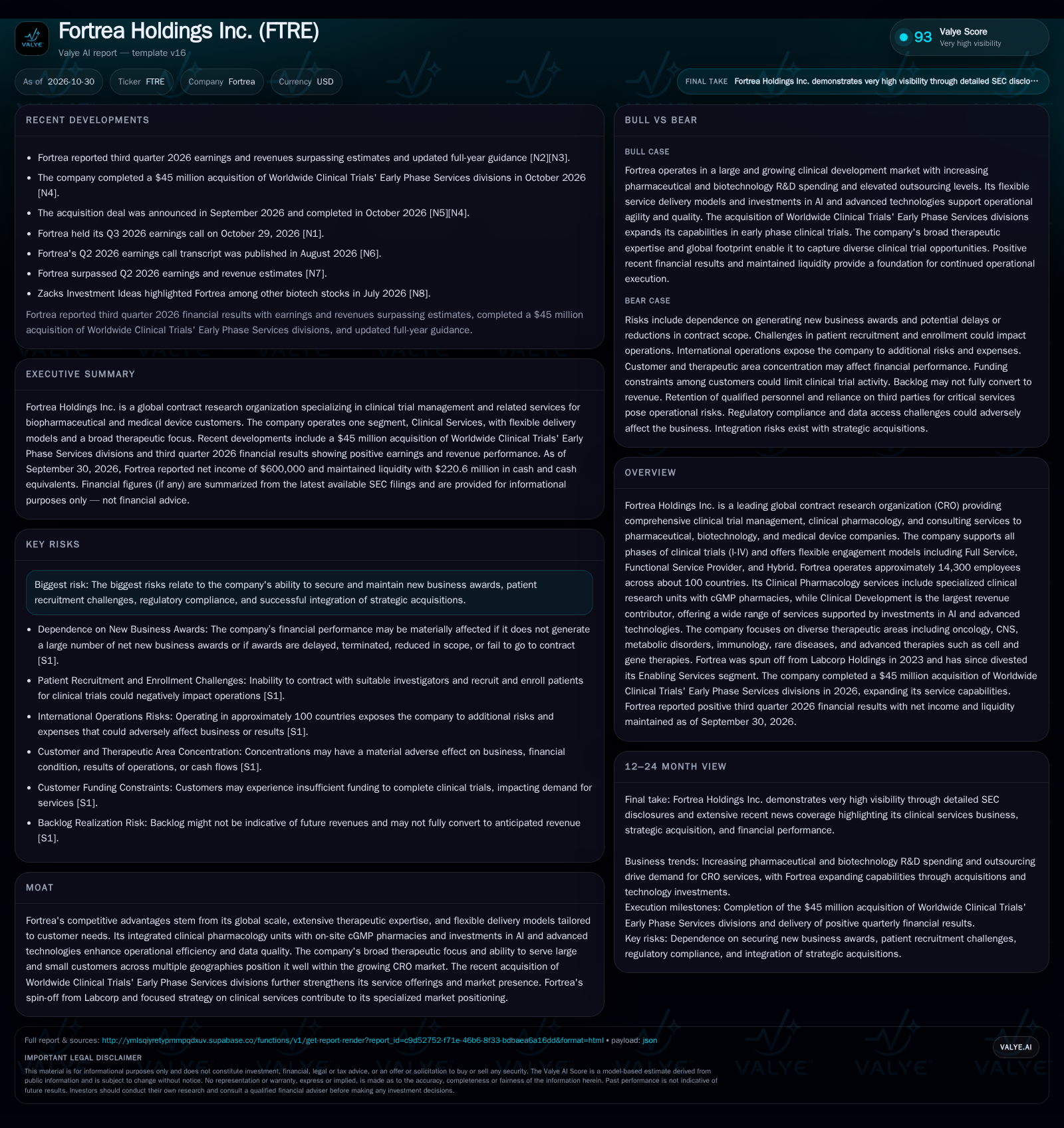
Fortrea Holdings, a global CRO, recently completed a $45 million acquisition to bolster its early-phase clinical trial services and reported positive Q3 2026 results with net income of $600,000. While its flexible service models and AI-driven process enhancements could drive operating leverage and differentiation in a consolidating market, success will hinge on execution in integrating acquired assets, sustaining new business awards, and navigating customer funding headwinds.
Fortrea Holdings Inc. stands at a strategic crossroads in the global contract research organization (CRO) industry following its recent $45 million acquisition of early phase clinical assets and the posting of positive third quarter 2026 results. With a footprint spanning 100 countries and a broad therapeutic focus, Fortrea is seeking to leverage flexible service models and technology investments to differentiate itself. However, the company’s ability to convert operational scale and new capabilities into sustained earnings growth will depend on successful integration, maintaining commercial momentum amid customer funding uncertainties, and managing the complexities inherent in global clinical services.
Recent Acquisition and Earnings Shape Fortrea’s Strategic Outlook
The most significant recent development for Fortrea is its $45 million purchase of Worldwide Clinical Trials’ Early Phase Services divisions, announced in September and closed in October 2026 [N4] [N5]. This move expands Fortrea’s footprint in early clinical development, a segment where speed, patient access, and technical capability are increasingly critical for pharmaceutical and biotech clients seeking to de-risk drug candidates earlier in the pipeline.
Operationally, Fortrea reported Q3 2026 net income of $600,000, with both earnings and revenues surpassing consensus estimates [N2] [N3]. Liquidity remains steady, with $220.6 million in cash and a current ratio of 0.97 as of September 30, 2026 [S2].
The company continues to operate with a single Clinical Services segment, offering flexible engagement models and a technology-enabled approach, while highlighting risks tied to business development, customer funding, and integration of new assets [S1] [S2].
How Fortrea’s Model Could Capture Value in a Shifting CRO Landscape
As a pure-play CRO, Fortrea’s economics are fundamentally driven by its ability to win, expand, and efficiently deliver clinical trial contracts for biopharma and medical device sponsors. Revenue is generally tied to services rendered across clinical trial phases, with contract structures ranging from full-service project management to functional outsourcing or hybrid engagements. Pricing is influenced by trial complexity, required geographies, and therapeutic expertise, while scale and technology investments can drive cost leverage over time.
Variable costs dominate, especially labor (14,300 employees) and third-party pass-throughs for trial sites, investigators, and patient management. Fixed costs include technology platforms, clinical research units, and compliance overhead. Investments in AI, workflow automation, and global delivery infrastructure may help Fortrea improve margin profile and win business from sponsors looking for faster, higher-quality, and more cost-effective trials [S1].
The recent acquisition adds early phase capacity, which typically carries higher per-project margins but may also be more volatile and capital-intensive due to the need for dedicated facilities and specialized expertise. The company reported cash and liquidity metrics for the period; these figures do not by themselves establish operating runway, investment capacity, financial flexibility, or financing capacity. [S2]
Differentiation and Pressure Points in the Global CRO Arena
Fortrea’s competitive advantages are rooted in its global scale, broad therapeutic reach, and flexible service models. Its presence in approximately 100 countries allows access to diverse patient populations and regulatory environments, a critical factor as sponsors seek faster, more representative trial enrollment [S1]. The company’s investments in AI and workflow automation could improve operational efficiency and data integrity, supporting both retention and new client wins.
However, the CRO market is highly competitive and consolidating, with large incumbents, technology-driven upstarts, and niche players all vying for market share. Pricing pressure is common, particularly for commoditized trial services or in geographies with lower barriers to entry. Customer concentration—if present—could expose Fortrea to revenue volatility if large clients reduce or delay projects.
Technology substitution is both an opportunity and a threat: while digital tools can reduce costs and improve differentiation, they also lower switching barriers for clients and can erode legacy process advantages. The acquisition of early phase assets may yield cross-selling opportunities but also introduces integration and execution risks.
If Integration and AI Investments Deliver, Operating Leverage Could Materialize
A favorable scenario for Fortrea would see the successful integration of Worldwide’s Early Phase Services, resulting in expanded client relationships and the ability to offer seamless end-to-end trial support. If investments in AI and workflow automation translate into faster patient recruitment, reduced protocol amendments, and improved data quality, Fortrea could win more business from both large pharma and emerging biotech sponsors seeking operational agility and predictable outcomes.
Operating leverage could emerge as fixed technology and global infrastructure costs are spread over a growing revenue base. Early signs confirming this scenario would include sustained outperformance on new business awards, margin expansion, and repeat business from major clients. Integration milestones—such as cross-utilization of early phase and later-phase teams, or the launch of new bundled service offerings—would further support the upside case.
Evidence that would falsify this scenario includes persistent margin compression, client attrition post-acquisition, or delays in realizing process improvements from technology investments.
Most Likely: Incremental Gains Amid Persistent Margin and Execution Pressures
The most plausible path is that Fortrea achieves incremental growth from the acquisition and technology initiatives, but faces ongoing headwinds from margin pressure, customer funding volatility, and the inherent complexity of global clinical operations. Revenue growth may outpace peers if early phase capabilities attract new clients, but improvements in operating margin are likely to be gradual, reflecting a continuous need to reinvest in talent, compliance, and digital infrastructure.
Execution risk remains, especially around integrating new assets and maintaining service quality across geographies and therapeutic areas. Client procurement cycles may lengthen if biotech funding conditions tighten, while project delays or cancellations could weigh on backlog conversion.
Confirmation of this scenario would come from steady—but not dramatic—growth in net new business awards, modest margin improvement, and stable client retention. Falsification would be signaled by missed revenue guidance, rising costs without offsetting revenue, or operational disruptions tied to integration.
What Could Go Wrong: Integration Missteps or Funding Shocks Erode Performance
In an adverse scenario, Fortrea could struggle to integrate its newly acquired early phase services, resulting in operational inefficiencies, client dissatisfaction, or unexpected costs. If customer funding for clinical trials tightens further—due to macroeconomic shocks or biopharma sector retrenchment—Fortrea’s project pipeline could shrink, amplifying the impact of fixed overhead and eroding margins.
Other plausible risks include delays in patient recruitment, regulatory hurdles in key markets, or the inability to retain critical personnel post-acquisition. A failure to realize anticipated synergies from technology investments could leave Fortrea exposed to both cost inflation and competitive displacement by more digitally native rivals.
Early warning signs would include project cancellations, revenue shortfalls, margin contraction, or negative client feedback tied to service disruptions or integration failures.
Milestones and Metrics That Will Test Fortrea’s Strategic Execution
Net new business awards and backlog growth, as disclosed, to gauge commercial momentum and pipeline visibility.
Gross margin and operating margin trends post-acquisition, to assess whether integration and technology investments are translating into improved profitability.
Client retention rates and repeat business, if disclosed, as indicators of service quality and competitive stickiness.
Progress on integration of acquired early phase assets, including employee retention and cross-selling between service lines.
Biotech and pharma customer funding trends, as external market conditions directly impact trial outsourcing demand.
Speed and efficiency of patient recruitment and trial enrollment, as these are critical differentiators in CRO performance—data here, if disclosed, would be highly informative.
Investment levels in AI and workflow automation versus realized operational improvements, to track the return on innovation spend.
Employee turnover rates, particularly in key technical and project management roles, as a lead indicator for operational stability.
Disclaimer: This is research-only, informational analysis and not investment advice. It may include AI-generated interpretation and general industry context. Always verify important details using primary sources.

Comments