
Universal Insurance Holdings: Catastrophe Exposure, Multi-Channel Reach, and the Economics of Surviving Florida’s Volatility
Universal Insurance Holdings leverages disciplined underwriting, strong reinsurance, and a hybrid agent-digital distribution strategy to compete in the hurricane-prone Florida homeowners market. The company’s recent profitability and capital actions highlight both the rewards and the persistent risks of underwriting in one of the most volatile P&C environments in the U.S.
Universal Insurance Holdings’ Q3 2026 results reflect the high-stakes dynamics of Florida homeowners insurance: strong premium retention, robust statutory capital, and active share repurchases underscore operational strength, but elevated catastrophe exposure and reinsurance costs remain central to the long-term thesis. The company’s ability to balance disciplined underwriting, digital and agent-driven growth, and claims management efficiency will determine its resilience as weather, litigation, and regulatory risks evolve. [S2] [N1] [N3]
Universal Insurance Holdings stands at the intersection of opportunity and risk in the U.S. property and casualty market, with a business model deeply tied to Florida’s homeowners insurance sector—a region notorious for its catastrophic weather volatility. Recent financial results highlight the company’s ability to generate steady premium growth, maintain strong renewal rates, and execute disciplined capital management, including share buybacks. Yet, the persistent threat of hurricanes, evolving litigation trends, and rising reinsurance costs mean that UVE’s financial strength is constantly tested. The company’s future will hinge on its ability to sustain underwriting profitability, adapt to regulatory shifts, and leverage both agent and digital distribution to manage both growth and risk. [S2] [N1] [N3]
Recent Results Reveal Profitability, Capital Actions, and Persistent Risk Concentration
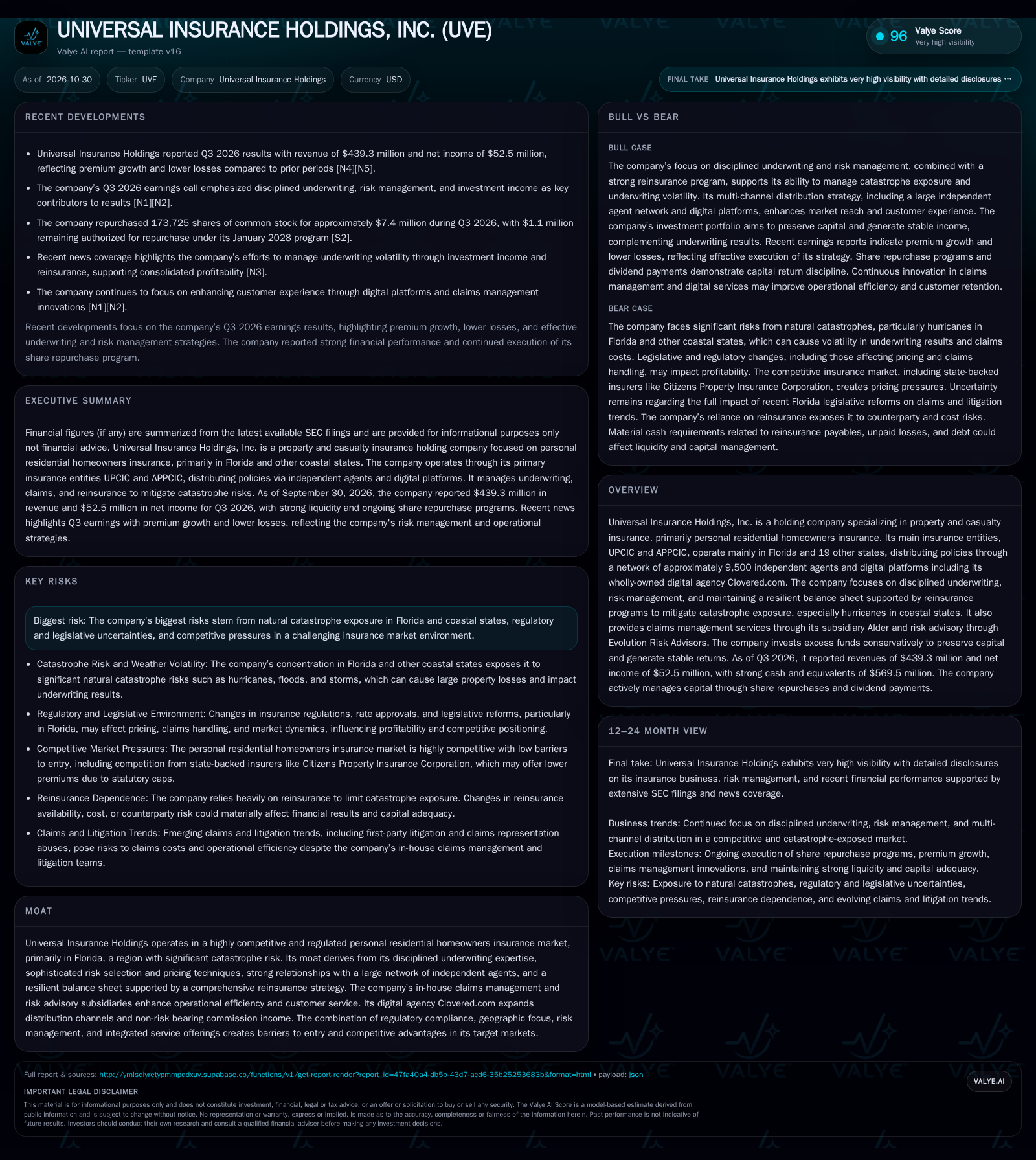
Universal Insurance Holdings reported Q3 2026 revenues of $439.3 million and net income of $52.5 million, with a combined statutory capital and surplus of $509.1 million as of year-end 2025. The company reported cash and liquidity metrics for the period; these figures do not by themselves establish operating runway, investment capacity, financial flexibility, or financing capacity. However, Florida remains the company’s dominant market, accounting for 72.6% of direct premiums written in 2025, underscoring the material risk from hurricanes and other natural catastrophes. The company’s cash and equivalents of $569.5 million are balanced against substantial cash requirements, including $605 million in reinsurance payables and $616 million in unpaid losses and adjustment expenses. [S2] [S1]
How UVE’s Model Turns Premiums into Profits—And Where the Shocks Can Hit
Universal Insurance Holdings’ core economics hinge on the spread between premiums earned and claims/losses paid, less operating and reinsurance costs. The company’s disciplined underwriting and risk selection—particularly in catastrophe-prone Florida—aim to maintain a profitable combined ratio over time. UVE’s multi-channel distribution, leveraging a 9,500-agent network and digital agency Clovered.com, supports premium volume and retention but also introduces commission expense as a variable cost. Reinsurance is a pivotal line item: while it limits catastrophic loss exposure, it is itself a major, and sometimes volatile, expense that can swing net margins based on market pricing and event frequency. The company’s investment portfolio, focused on high-grade, short-duration fixed income, generates stable but modest income, serving as a buffer against underwriting volatility. Operating leverage is possible when claim frequency is low, but severe weather seasons or litigation shocks can quickly erode margins, turning profitable years into loss years. The capital structure—anchored by $139 million of 7.75% senior unsecured notes—imposes fixed interest obligations but is not excessive relative to capital base. Overall, the business is capital-intensive and acutely cyclical: profits can be robust in benign years but are vulnerable to single-event shocks.
Navigating a Crowded, Regulated, and Volatile Homeowners Insurance Landscape
Universal Insurance Holdings competes in a saturated and highly regulated market, particularly in Florida, where state-backed insurers such as Citizens Property Insurance Corporation act as both competitor and market stabilizer. The company’s advantages stem from its underwriting discipline, established agent relationships, and integrated claims management, which can help control loss adjustment expenses and improve customer experience. Its reinsurance strategy and in-house risk advisory function (Evolution Risk Advisors) may deliver a risk selection edge, but these are not insurmountable barriers given that peers can access similar reinsurance markets and digital tools. The rise of digital-first and insurtech competitors adds pressure on pricing and customer experience. Furthermore, legislative and regulatory dynamics in Florida can periodically alter the competitive field, for example, by capping rate increases or shifting litigation incentives. While UVE’s scale and agent network are assets, the company’s concentration in catastrophe-exposed geographies keeps it vulnerable to market exits or contractions by competitors, which can lead to sudden surges in customer acquisition but also spike risk exposure and reinsurance needs.
If Discipline Holds: Margin Expansion Through Benign Weather, Retention, and Digital Efficiency
A favorable scenario for Universal Insurance Holdings unfolds if hurricane seasons remain mild, keeping claims frequency and severity low. In this environment, the company’s disciplined underwriting and reinsurance program would allow it to earn a healthy margin on premiums, while its high renewal retention rate (92.5%) sustains the premium base without excessive acquisition cost. Further digital adoption—through Clovered.com and claims technology—could reduce frictional costs and improve customer experience, boosting retention and cross-sell opportunities. Investment income from a conservative portfolio adds incremental earnings stability. Evidence confirming this scenario would include sustained or improving combined ratios, above-average return on equity, and continued premium growth without outsized claims spikes. A stable or declining reinsurance cost environment, along with limited regulatory intervention in rate filings, would further support margin expansion. [S2] [N1] [N2]
Resilient but Volatile: Managing to Average Through the Storms
The most plausible outlook is for Universal Insurance Holdings to deliver moderate profitability over time, marked by periods of strong results punctuated by weather-driven setbacks. The company’s underwriting discipline and risk management will allow it to absorb periodic catastrophe losses, but not eliminate volatility. Reinsurance costs may remain elevated given global climate trends and capital market conditions, partially offsetting gains from premium growth and improved claims management. The company’s capital base and multi-channel reach should help it retain market share, but regulatory and litigation headwinds—especially in Florida—will persist. Evidence supporting this scenario would be a combined ratio fluctuating around break-even over several years, stable renewal retention in the 90%+ range, and incremental improvements in claims efficiency. Conversely, a significant deterioration in retention, spikes in loss ratios, or regulatory-imposed rate constraints would challenge this middle path.
When the Catastrophe Hits: Capital Erosion and Reinsurance Squeeze
The bear case for Universal Insurance Holdings materializes if a major hurricane or series of catastrophe events strikes its core Florida market, overwhelming reinsurance layers and driving a surge in claims and litigation. In this scenario, the company could face rapid capital depletion (statutory capital and surplus), strained liquidity as reinsurance recoverables lag, and possible ratings downgrades. Reinsurance markets could react by tightening terms and raising prices, making future coverage more expensive or less available. Regulatory or legislative responses—such as rate caps or claims-handling reforms—could further constrain profitability. Evidence of this scenario would be a sharp increase in combined ratios, drawdowns on cash and investments, and potential capital raises or market exits. Persistent adverse litigation trends or reinsurance counterparty failures would amplify the downside.
What Will Determine UVE’s Staying Power in the Florida Insurance Cycle?
Quarterly and annual combined ratio trends: Sustained improvement or deterioration would validate or challenge the underwriting discipline thesis.
Renewal retention rates: Continued high retention (92%+) would support customer loyalty and revenue stability; significant declines would suggest competitive or satisfaction issues.
Reinsurance cost and availability: Changes in pricing, structure, or counterparty strength would affect both earnings volatility and capital adequacy.
Claims frequency and severity, especially from hurricanes and other catastrophes: Outlier events or clusters could quickly erode profitability.
Regulatory and legislative changes in Florida: Rate approval processes, claims/litigation reform, and market entry/exit rules could materially impact margin structure.
Digital adoption metrics (if disclosed): Growth in Clovered.com policy sales or digital claims processing would test the digital expansion thesis.
Disclaimer: This is research-only, informational analysis and not investment advice. It may include AI-generated interpretation and general industry context. Always verify important details using primary sources.

Comments