
Dynamic Aerospace Systems' Drone Innovation Hindered by Zero Revenue and Capital Strain
The UAV specialist struggles with operational losses and scaling challenges despite technological advancements and regulatory progress.
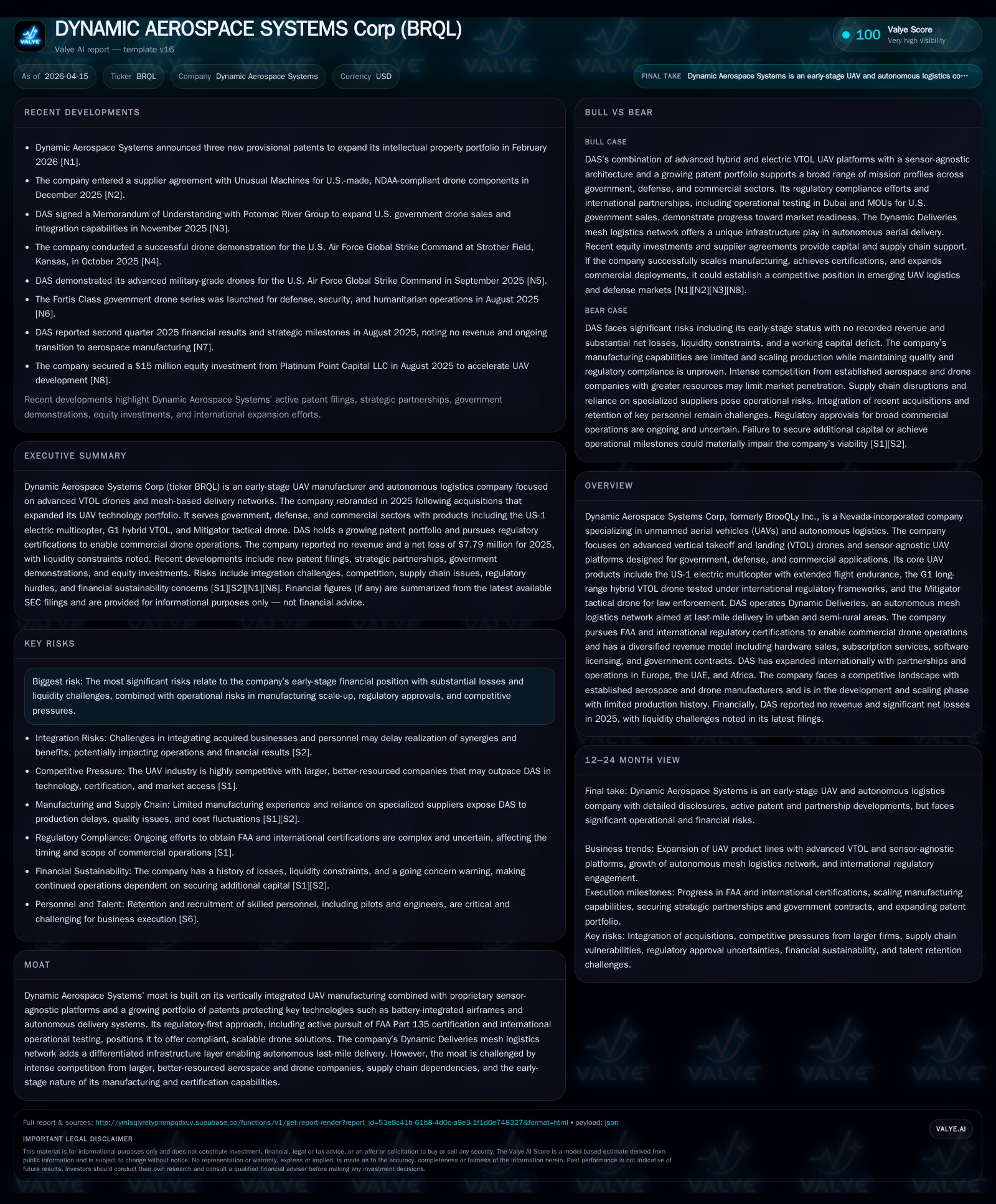
Dynamic Aerospace Systems Corp (BRQL) has developed advanced VTOL drone platforms and an autonomous logistics network, targeting government and commercial customers. However, its financials reveal a sharp revenue collapse to zero in 2025 amid mounting operating losses surpassing $6.6 million, reflecting early-stage commercial execution difficulties. The company’s growth hinges on achieving FAA certifications and scaling production, while capital constraints and integration risks pose significant challenges. Market competition and regulatory complexities loom as key hurdles going forward.
Historical Performance and Growth Drivers
Since its inception as MyTreat, Inc. in early 2021, Dynamic Aerospace Systems Corp (formerly BrooQLy Inc.) repositioned swiftly into a specialized UAV manufacturer focusing on electric multicopter and hybrid vertical takeoff/landing drones for government, defense, and commercial logistics markets [S1]. The brand evolution culminated with a strategic pivot in 2025 when it acquired core UAV technology assets from Vayu (US) Inc., Impossible Aerospace Corporation, and Global Autonomous Corporation through transactions with Alpine 4 Holdings [S1]. These acquisitions bolstered the company’s product suite including the battery-integrated airframe US-1 multicopter (notably designed with technology cues akin to Tesla’s battery innovation) offering over 70 minutes of endurance under payload, alongside the G1 long-range hybrid VTOL drone optimized for extended missions compliant with international airspace regulations.
Revenues have been negligible historically. The latest financial data shows a precipitous decline: total revenue collapsed from mere $266 in 2024 to zero reported sales in fiscal year 2025 [F1]. This stark reversal reflects the challenges Dynamic Aerospace faces in transitioning from R&D and prototyping phases into full commercial production and contract fulfillment.
Operating losses reflect significant upscaling costs—2025 operating expenses produced a loss of approximately $6.64 million compared to $537 thousand in prior year—a more than tenfold increase indicating heavy investments in manufacturing scale-up, certification processes, and platform development [F1]. Net income followed suit with a loss near $7.8 million, worsening from just over $1 million net loss in 2024 [F1].
Historical performance (annual)
| FY | Rev ($) | Net ($mm) | CFO ($) | OpInc ($mm) | Rev YoY | Net YoY |
|---|---|---|---|---|---|---|
| 2025 | 0 | -8 | -1928835 | -7 | -100.0% | -565.1% |
| 2024 | 266 | -1 | -34098 | -1 | +5220.0% | -236.3% |
| 2023 | 5 | 0 | -80826 | 0 | -99.5% | -11.9% |
| 2022 | 993 | 0 | -28327 | 0 |
Source: SEC companyfacts cache [F1].
Capital returns and efficiency (annual)
| FY | ROE% |
|---|---|
| 2025 | -74.6 |
| 2024 | 406.8 |
| 2023 | 452.6 |
| 2022 | 2915.7 |
Source: SEC companyfacts cache [F1].
Note: Revenue figures are nominal; revenue decline driven by shifts to focus on longer-term developmental stages rather than commercial sales currently.
Future Growth Prospects
Dynamic Aerospace's growth narrative depends heavily on maturing its technology offerings and gaining critical regulatory approvals—especially FAA Part 135 certification—for routine commercial autonomous flight operations [S1]. This certification would unlock broader market access for its Dynamic Deliveries mesh logistics platform that integrates UAVs into scalable last-mile delivery solutions across urban and semi-rural regions.
Moreover, ongoing enhancements to the sensor-agnostic architectures incorporated within its UAVs seek to differentiate DAS through flexibility across multiple payload types suitable for defense reconnaissance missions as well as law enforcement applications using their Mitigator tactical drone platform [S1].
However, these opportunities are counterbalanced by several constraining factors:
Integration Risks: The acquisitions driving technological capability expansion come loaded with integration challenges ranging from aligning manufacturing processes to retaining critical personnel [S2]. Failure to effectively meld these disparate technologies could delay product ramp-ups or escalate costs.
Competitive Intensity: The drone sector is crowded with established aerospace giants investing billions into UAV development alongside well-capitalized startups backed by venture capitalists focused solely on drone logistics [S1]. DAS’s early-stage size and limited resources position it at a competitive disadvantage.
Regulatory Complexity: International flight testing under varied jurisdictional frameworks adds complexity that could prolong time-to-market windows while increasing compliance expenditures.
Liquidity Constraints: Current financial metrics reflect extremely tight liquidity (current ratio near 0.02), imposing limitations on scaling without substantial new investment or debt refinancing [F1].
Forecasts and Milestones To Watch
As of available disclosures up to April 2026, the company has not issued explicit revenue or profitability guidance for upcoming fiscal periods publicly [N1][S3]. Investors should monitor key milestones including:
- Progress towards FAA Part 135 certification.
- Commercial launch dates for Dynamic Deliveries network deployments.
- Manufacturing scale-up indicators such as production capacity expansion announcements or supplier agreements.
- Successful integration outcomes from acquired entities’ operational capabilities.
- Cash runway updates or capital raise events signaling financing sufficiency to endure ongoing losses.
Capital Allocation and Returns
DAS is currently not generating positive cash flows; operating cash flow remains negative at approximately $1.9 million for FY25 versus modest negative levels previously [F1]. No dividends or share repurchase programs have been announced given ongoing liquidity challenges.
Equity transitioned from slightly negative net book value pre-2025 to approximately $10.4 million positive by year-end 2025 likely reflecting capital raises coincident with acquisitions [F1], but return on equity is deeply negative at about -75% calculated simply as net loss over ending equity indicating value erosion typical of an early-stage aerospace startup still pre-revenue commercialization.
Looking forward requires attention on how DAS manages cash burn rates relative to external financing options given ongoing R&D intensity coupled with operational scale plans [S1][N1].
Business Model Nuances and Industry Context (Analysis)
Dynamic Aerospace operates primarily as an OEM delivering cutting-edge UAV platforms complemented by software-driven service layers such as subscription management of their delivery networks. This dual hardware-software model aligns with sector trends where drone companies increasingly pursue recurring revenues through service contracts rather than one-time hardware sales alone—a model more sustainable yet requiring significant upfront investment before breakeven.
Furthermore, the company’s sensor-agnostic approach creates modularity advantages addressing diverse mission profiles—a recognized best practice within military-grade UAV design—while battery-integrated airframe technology aims at improved energy efficiency relevant especially given urban airspace endurance requirements.
However, the competitive landscape features heavyweight incumbents like AeroVironment and DJI alongside emergent firms institutionalizing route-to-market efficiencies via partnerships with logistics integrators such as FedEx (DAS has bolstered its board with FedEx expertise). This external expertise highlights recognition of complex supply-chain orchestration needs fundamental for autonomous delivery networks’ success but also underscores operational hurdles DAS must resolve internally.
Risk Summary From SEC Filings
Dynamic Aerospace consistently flags significant risks due to its nascent business stage marked by substantial historical losses and uncertain future profitability avenues [S1][S2]:
- Limited operating history impairs reliable performance forecasting.
- Substantial losses expected to persist given high capital demands for certification/sales ramp.
- Debt covenant compliance risk threatens financial stability.
- Acquisition integration may dilute focus or miss synergy targets.
- Intense competition may constrain pricing power or market share gains.
- Material weaknesses identified in internal control environments could impair timely reporting accuracy.
- Going concern doubts voiced by auditors risk lender confidence impacts.
- Regulatory dependencies mean delays could stall commercialization indefinitely.
- Illiquid public market making share resale difficult affects shareholder returns perception.
Conclusion
Dynamic Aerospace Systems Corp represents a compelling case study of a technically pioneering but financially strained aerospace startup wrestling with complex demands of UAV innovation melded with autonomous logistics ambitions. Its technical portfolio—anchored around extended-endurance electric multicopters and hybrid VTOLs—positions it strategically for emergent governmental and commercial segments poised for automation-driven disruption.
Yet absent reported revenue generation during calendar year 2025 amid escalating operating losses highlights stark execution challenges confronting this early-stage entity. Success hinges substantially on meeting stringent regulatory thresholds enabling lawful scaled operations coupled with smooth integration of acquired technological assets while maintaining sufficient liquidity to fund the transition out of R&D mode into repeatable commerce at volume. Ongoing monitoring of milestone achievements concerning FAA certification progressions alongside any subsequent shifts toward positive cash flow generation will be crucial barometers assessing DAS’s viability as a growing player attempting foothold within an intensely competitive aerospace ecosystem dominated by resource-rich incumbents.
This report is intended solely for informational purposes based on publicly available data as of April 15, 2026. It does not constitute investment advice or recommendations regarding any securities mentioned herein.
Disclaimer: This is research-only, informational analysis and not investment advice. It may include AI-generated interpretation and general industry context. Always verify important details using primary sources.

Comments