
Canaan Inc.: Surging Revenue Amid Persistent Profit Challenges
Examining Canaan's rapid revenue growth driven by ASIC innovations and Bitcoin mining expansion, alongside ongoing struggles to achieve profitability.
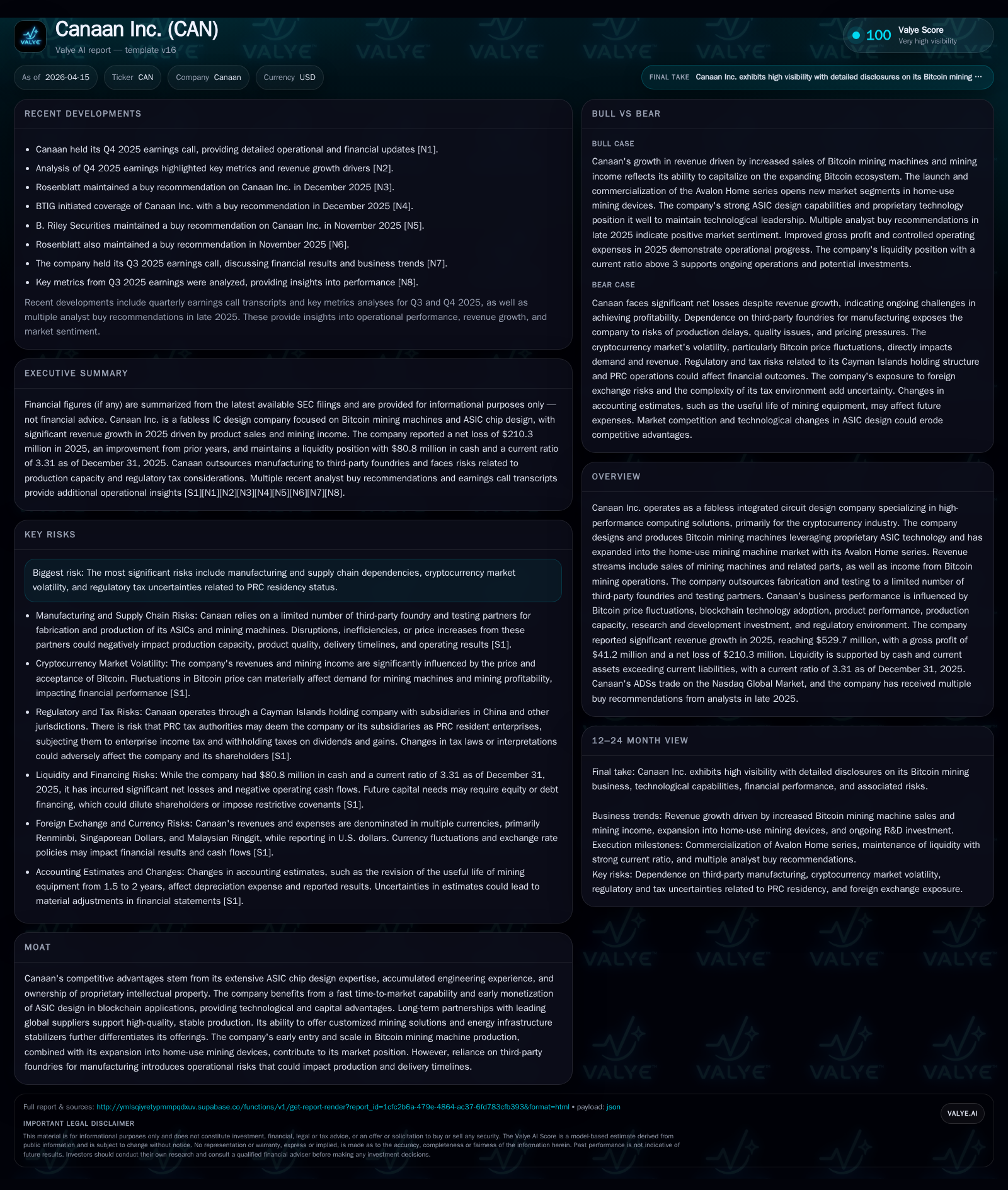
Canaan Inc. nearly doubled revenue from $269 million in 2024 to about $530 million in 2025, fueled by strong sales of industrial and home-use Bitcoin mining machines and scaling its Bitcoin mining operations. Despite this impressive revenue trajectory, the company continues to grapple with significant operating losses driven by high R&D and supply chain costs, as well as inventory management expenses. Persistent negative operating cash flows highlight challenges in converting revenue growth into sustainable profitability, compounded by dependencies on third-party foundries and regulatory uncertainty. Going forward, Canaan's expansion in home-use miners and strategic mining business development offer growth avenues, but margin recovery and operational stability remain key hurdles.
Revenue Evolution Fueled by Expanding Mining Solutions
Canaan Inc.'s revenue trajectory outlines a striking rebound after prior market softness. The company posted revenues of approximately $529.7 million for fiscal year 2025, nearly doubling its $269.3 million top-line in 2024 ([F1]). This robust surge was underpinned by vigorous sales of its Bitcoin mining machines across both industrial and home-use segments and supported by mounting income from expanded Bitcoin mining operations.
Specifically, revenue from the Bitcoin mining business itself experienced a significant leap from $44.0 million in 2024 to $113.2 million in 2025 ([S1]), highlighting an increasingly diversified income stream beyond hardware alone. Notably, the introduction and commercialization of the Avalon Home series marked Canaan’s deliberate move into the consumer-grade market segment; these compact, low-noise ASIC miners target individual users seeking accessible and energy-efficient Bitcoin mining solutions ([S1]).
Yet, this expansive revenue profile reflects more than just volume gains; it indicates effective capture of rising Bitcoin prices which historically drive higher selling prices and customer purchase behavior. However, such dependence on cryptocurrency cycles injects volatility into demand patterns.
Historical performance (annual)
| FY | Rev ($mm) | Net ($mm) | CFO ($mm) | OpInc ($mm) | Rev YoY | Net YoY |
|---|---|---|---|---|---|---|
| 2025 | 530 | -210 | -271 | -112 | +96.7% | +15.8% |
| 2024 | 269 | -250 | -199 | -227 | +27.4% | +39.7% |
| 2023 | 211 | -414 | -124 | -411 | -66.7% | -687.3% |
| 2022 | 635 | 71 | -246 | 44 |
Source: SEC companyfacts cache [F1].
Capital returns and efficiency (annual)
| FY | Buybacks ($mm) | FCF ($mm) | ROE% |
|---|---|---|---|
| 2025 | 5 | -296 | -48.1 |
| 2024 | 37 | -219 | -93.8 |
| 2023 | 37 | -127 | -118.9 |
| 2022 | 34 | -260 | 11.5 |
Source: SEC companyfacts cache [F1].
Table: Canaan's selected financial performance from FY2022-FY2025 [F1]
Technical Edge: ASIC Innovation and Product Diversification
A core pillar supporting Canaan's resurgence lies in its decade-long expertise in ASIC chip design dedicated primarily toward blockchain applications ([S1]). As a fabless IC design firm, Canaan leverages proprietary intellectual property accumulated over multiple generations of silicon architecture to deliver Bitcoin mining machines that balance hash rate efficiency with power consumption—a crucial competitive aspect given the energy-intensive nature of proof-of-work mining.
The Avalon Home series launched commercially in 2025 extends their portfolio into compact miner devices tailored for consumer environments prioritizing low acoustic profiles and user-friendly interfaces ([S1]). This diversification reflects strategic intent to democratize access to bitcoin mining while optimizing customer acquisition cost profiles relative to industrial-scale machines.
Further competitive differentiation arises from offering customized solutions ranging from tailored hardware modules to energy infrastructure stabilizers supporting stable operation under varying grid conditions—vital for large-scale clients such as cryptocurrency farms ([S1]). Such bespoke solutions enhance stickiness within client relationships amidst increasingly commoditized hardware markets.
Financial Performance: Navigating Sustained Losses Despite Higher Sales
Despite surging revenues, Canaan continues to operate at an elevated scale of losses—operating income losses for fiscal year 2025 stood at approximately $112 million—an improvement over prior years but still substantive ([F1]). This persistent unprofitability results partly from challenging operating leverage dynamics where growing fixed R&D expenditures offset gross profit improvements.
Research and development spending remains a significant line item as the company continuously invests in advancing ASIC designs amid fierce competition ([S5], [S15]). While inventory write-downs—a reflection of previous market demand softness—have dropped substantially from over $100 million levels in earlier periods down to under $20 million in 2025 ([S7]), they continue weighing on margins.
Additional complexity arises from adoption of updated accounting standards for cryptocurrency assets that require fair value measurement with periodic impairment considerations impacting reported results ([S5]). Supply chain constraints due to reliance on limited third-party foundry partners introduce further unpredictability around production yields affecting per-sample cost control ([S8]).
Negative operating cash flows also worsened year-over-year reaching approximately -$271 million despite increased sales volume (operating CFO minus capex suggests free cash flow near -$296 million), underscoring liquidity pressures accompanying aggressive scaling efforts ([F1]).
Bitcoin Mining Business: Growth Trajectory and Ecosystem Integration
In parallel with its hardware business, Canaan has stepped up operations directly mining Bitcoin via partnerships with farms and energy providers aiming to synergize vertically along the value chain ([S1], [S2], [S3]). This initiative generated revenues of $113 million in FY25 up from $44 million the prior year ([S1]), marking it as an increasingly vital second engine complementing equipment sales.
The company pursues enhancing deployed computing power metrics including energized hash rates, which directly translate to incremental block rewards and improved economic viability for its capital investments ([S1]). However, integration exposes earnings volatility linked tightly with Bitcoin price swings: lower prices compress expected economic returns reducing miner demand while higher prices stimulate new machine purchases.
Vertical integration challenges include managing operational complexities outside traditional fabless ASIC design capabilities such as energy sourcing optimization and farm uptime reliability—areas where partnerships mitigate risk thresholds ([S1]).
Capital Allocation: Investment, Cash Flow, and Shareholder Returns
Canaan has consistently allocated capital towards long-term growth foundations rather than near-term shareholder returns ([F1], [S6], [S13]). Capital expenditures rose meaningfully from roughly $19 million in FY24 to $24.6 million in FY25 primarily directed at equipment procurement necessary for scaling production capabilities and adding technical infrastructure ([F1]).
Operating cash flow remained negative (-$271 million), deepening liquidity requirements predominantly driven by working capital outlays including inventory buildup needed for order fulfillment ([F1]). To support expansion, Canaan secured secured loans totaling nearly $70 million with interest rates between approximately 2.5%–6.75%, enhancing liquidity buffers without immediate dilution risks but introducing fixed obligations ([S4]).
Share repurchases were relatively modest at around $5 million during FY25 compared with prior years’ elevated repurchase spending circa $37 million indicating cautious capital deployment prioritizing reinvestment over distributions ([F1], [S6], [S13]). Dividend payments remain nonexistent consistent with the company's emphasis on funding R&D pipeline advancements rather than immediate cash returns ([S6], [S18]). These factors combined yield an approximate negative return on equity near -48%, illustrating current value destruction while reinvestment hopes anchor future improvement prospects ([F1]).
Supply Chain Dynamics and Manufacturing Dependencies
As a fabless IC design entity, Canaan faces inherent operational risks tied closely to third-party foundry partners controlling actual production stages ([S8], [S10]). The company's reliance principally on two major foundries poses concentration vulnerability; any disruption or capacity bottleneck could delay deliveries or degrade product quality thereby adversely affecting revenues.
Final test yield metrics reflect not only Canaan’s chip architectural quality but also foundry process control efficiencies—failures here cause higher scrap rates raising per-unit production costs disproportionately during early ramp phases when tape-outs are immature or fabrication nodes face initial defects ([S8]). Additionally, required prepayments to secure production slots exert short-term working capital demands increasing financial strain under volatile demand settings.
Regulatory and Market Risks Facing Canaan's Business Model
Canaan operates within an environment characterized by regulatory unpredictability especially concerning digital asset taxation treatment linked to PRC residency issues given much management resides in China though the parent is Cayman-based ([S10], [S14], [S17], [S25], [S27]). Such ambiguities may lead to adverse tax exposures or disputes undermining reported earnings reliability.
Fluctuating acceptance levels of cryptocurrencies worldwide dictate machine demand cyclicality; sudden policy shifts banning crypto transactions or mining could sharply curtail addressable markets limiting equipment sales opportunities as seen historically across jurisdictions ([S10]). Cryptocurrency price volatility also affects expected economic returns impacting customer purchasing decisions.
Governments globally continue reviewing AML/KYC compliance impacting end-user onboarding potentially restricting ecosystem growth pace affecting overall sector liquidity conditions thus indirectly influencing Canaan's market forecasts.
Strategic Outlook: Opportunities and Constraints Ahead
Looking ahead, Canaan’s market positioning benefits from early entrance advantages cemented by years developing proprietary ASIC IP widely recognized within blockchain compute communities ([S1]). Its move into home-use miners via Avalon Home series attempts expansion horizontally into consumer markets less reliant on large scale farm economics offering potential margin leverage if scaled effectively.
Simultaneously nurturing its direct Bitcoin mining business diversifies revenue base insulating against pure hardware cyclicality but escalates operational complexity requiring careful execution across energy cost management and miner deployment efficiency metrics ([S1]).
Nevertheless, persistent net losses signal ongoing structural challenges balancing intense R&D expenditure against improving blockchain asset price cycles resiliently enough to push past breakeven thresholds appearing elusive so far ([F1], [S5], [S15]). Maintaining steady supply chain performance amid global semiconductor shortages remains critical while regulatory compliance regime shifts will demand agility.
Key milestones going forward include monitoring quarterly revenue retention momentum post-2025 spike, tracking margin expansions linked to inventory normalization efforts and observing successful tape-out rates sustaining product innovation cadence crucial for hashing competitiveness within ASIC markets.
This report is based exclusively on publicly available filings through April 15, 2026, including Form 20-F annual reports and relevant Form 6-K disclosures submitted by Canaan Inc., along with associated SEC interactive data as noted below.
Disclaimer: This is research-only, informational analysis and not investment advice. It may include AI-generated interpretation and general industry context. Always verify important details using primary sources.

Comments