
American Strategic Investment Co. Faces Liquidity and Operational Challenges After Strategic Pivot
The company’s transition away from REIT status marks a major inflection amid ongoing portfolio and debt issues.
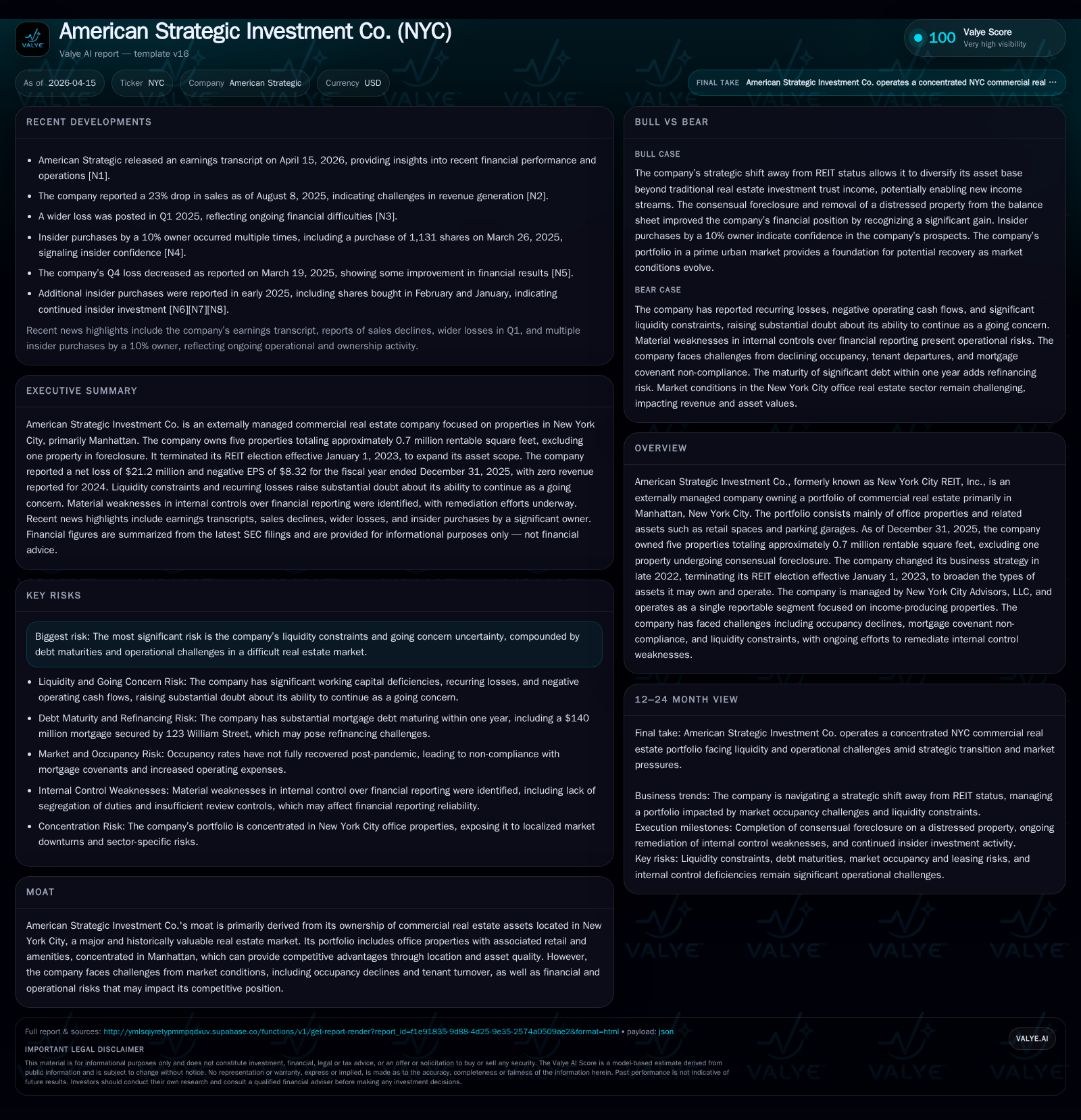
American Strategic Investment Co. owns a concentrated commercial real estate portfolio predominantly in Manhattan, totaling approximately 0.7 million rentable square feet as of end-2025. Since terminating its REIT election at the start of 2023, the company has expanded its asset scope but faces significant headwinds including mortgage covenant breaches and liquidity constraints. Despite recognizing a one-time $47.9 million gain from a consensual foreclosure of a major property in 2025, the company reported a net loss of $21.2 million and negative operating cash flows for the year. The capital structure is stressed with $251 million of mortgage notes payable, including accelerated debt and ongoing defaults on certain properties, raising substantial doubts about going concern. Watch for refinancing efforts, property disposals, and management’s ability to stabilize operational cash flows.
Business Overview and Historical Performance
American Strategic Investment Co., formerly New York City REIT, Inc., is an externally managed real estate investment company primarily owning commercial office properties in Manhattan with ancillary retail and parking assets. As of December 31, 2025, it held five core properties comprising roughly 700,000 rentable square feet; this excludes the landmark 1140 Avenue of the Americas property which entered consensual foreclosure in September 2025 [S1][S18].
The company elected REIT status from its taxable year ended December 31, 2014 until revoking the election effective January 1, 2023 to broaden permissible asset classes [S1]. This strategic pivot coincided with operational challenges including sustained mortgage covenant violations.
Financially, revenue was reported as zero for FY24 and FY25 due to accounting presentation [F1]. Operating income improved to approximately $4.4 million in FY25 from significant losses in prior years [F1]. Net losses narrowed from -$140.6 million in FY24 to -$21.2 million in FY25 [F1], reflecting impairment charges, interest expense from loan defaults, and other costs.
Operating cash flow remained negative at -$7.75 million in FY25, worsening nearly 94% year-over-year, underscoring persistent cash generation difficulties critical for servicing debt and maintaining properties [F1]. Dividends were suspended post-2022 reflecting cash preservation needs [F1].
Historical performance (annual)
| FY | Rev ($mm) | Net ($mm) | CFO ($mm) | OpInc ($mm) | Rev YoY | Net YoY |
|---|---|---|---|---|---|---|
| 2025 | -21 | -8 | 4 | +84.9% | ||
| 2024 | 0 | -141 | -4 | -121 | -32.7% | |
| 2023 | -106 | -7 | -87 | -947.8% | ||
| 2022 | 16 | -10 | 0 | -5 | +5298.7% |
Source: SEC companyfacts cache [F1].
Capital returns and efficiency (annual)
| FY | Div ($mm) | Buybacks ($) | ROE% |
|---|---|---|---|
| 2025 | 0 | -32.7 | |
| 2024 | 0 | 231000 | -164.3 |
| 2023 | 0 | 0 | -47.1 |
| 2022 | 3 | 0 | -3.4 |
Source: SEC companyfacts cache [F1].
Note: Revenue figures reflect GAAP presentation; operational focus remains on net earnings and cash flow metrics.
Capital Structure and Liquidity
As of December 31, 2025, total mortgage notes payable decreased to approximately $251 million from $347 million a year earlier following removal of foreclosed asset liabilities related to the disposed property at 1140 Avenue of the Americas (previously carrying $99 million principal) [F1][S4][S15]. The foreclosure disposal also generated a non-recurring gain of nearly $48 million.
Several loans remain in default or accelerated status:
- The mortgage on the foreclosed property was accelerated post-default.
- Loans secured by other properties such as the one at 400 E. 67th Street /200 Riverside Blvd have been accelerated or are under legal scrutiny following missed payments or covenant breaches.
- Certain loans face ongoing covenant violations triggering excess cash flow sweeps restricting operational flexibility [S6][S10][S15].
Unrestricted cash reserves stood at approximately $1.3 million at year-end with restricted cash around $6.8 million—insufficient against current liabilities nearing $99 million mid-year [F1][S8][S11]. These factors led auditors to express substantial doubt about the company's ability to continue as a going concern within one year after report issuance [S11].
Management actions include:
- Consensual foreclosure with lender cooperation for problematic assets.
- Negotiating refinancing or orderly disposition plans for key properties like 123 William Street.
- Issuing shares instead of cash for some management fees.
- Advisor indicating potential liquidity support. These initiatives have yet to fully resolve financing constraints or debt accelerations [S11].
Operational Challenges and Portfolio Risk Profile
The portfolio is concentrated exclusively within Manhattan's office market—a sector challenged by evolving work patterns post-pandemic causing elevated vacancies and lease turnovers . This pressures rental income stability essential for meeting fixed mortgage obligations.
Loss of control over foreclosed properties reduces revenue streams and may affect tenant confidence.
Significant impairment charges have been recorded on certain assets alongside depreciation reflecting aging or reduced valuations [S9][S17][F1].
The shift away from REIT status exposes the company to more diverse asset types but also potentially dilutes focus depending on execution success.
Capital Allocation Policy
Dividend payments ceased after fiscal year ended 2022 as part of liquidity preservation measures [F1]. No share buybacks occurred during fiscal year ended 2025 compared with minor repurchases previously indicating capital conservation priority [F1][S5].
Equity issuances occur occasionally tied to management fee payments made via stock awards rather than cash outflows easing near-term funding pressure while potentially diluting shareholders [S14][S20].
Capital deployment prioritizes debt servicing costs—including default interest—and necessary upkeep capex over shareholder returns or growth investments given ongoing net losses and negative operating cash flows.
Outlook Considerations
No explicit forward guidance is provided amid uncertainties around refinancing outcomes, leasing conditions, ongoing litigation related to foreclosures, and broader NYC commercial real estate market dynamics [N1][S11].
Key monitoring points include:
- Resolution of refinancing or sales for delinquent assets such as 123 William Street.
- Stabilization or improvement in occupancy across remaining buildings.
- Progress on foreclosure litigation affecting leverage.
- Management's ability to improve operational efficiency post-strategy change.
- Potential impact if further tenant bankruptcies trigger additional covenant breaches.
Auditor concerns about going concern highlight these risks as near-term existential challenges requiring active resolution rather than growth opportunities currently.
Disclaimer: Analysis based solely on documented filings and news disclosures without conjecture beyond stated facts; intended strictly for informational purposes without investment advice.
Disclaimer: This is research-only, informational analysis and not investment advice. It may include AI-generated interpretation and general industry context. Always verify important details using primary sources.

Comments