
Solidion Technology Posts Accelerating Revenue but Faces Growing Losses and Liquidity Crisis
The battery tech company shows promising growth in sales but contends with mounting deficits and financing challenges.
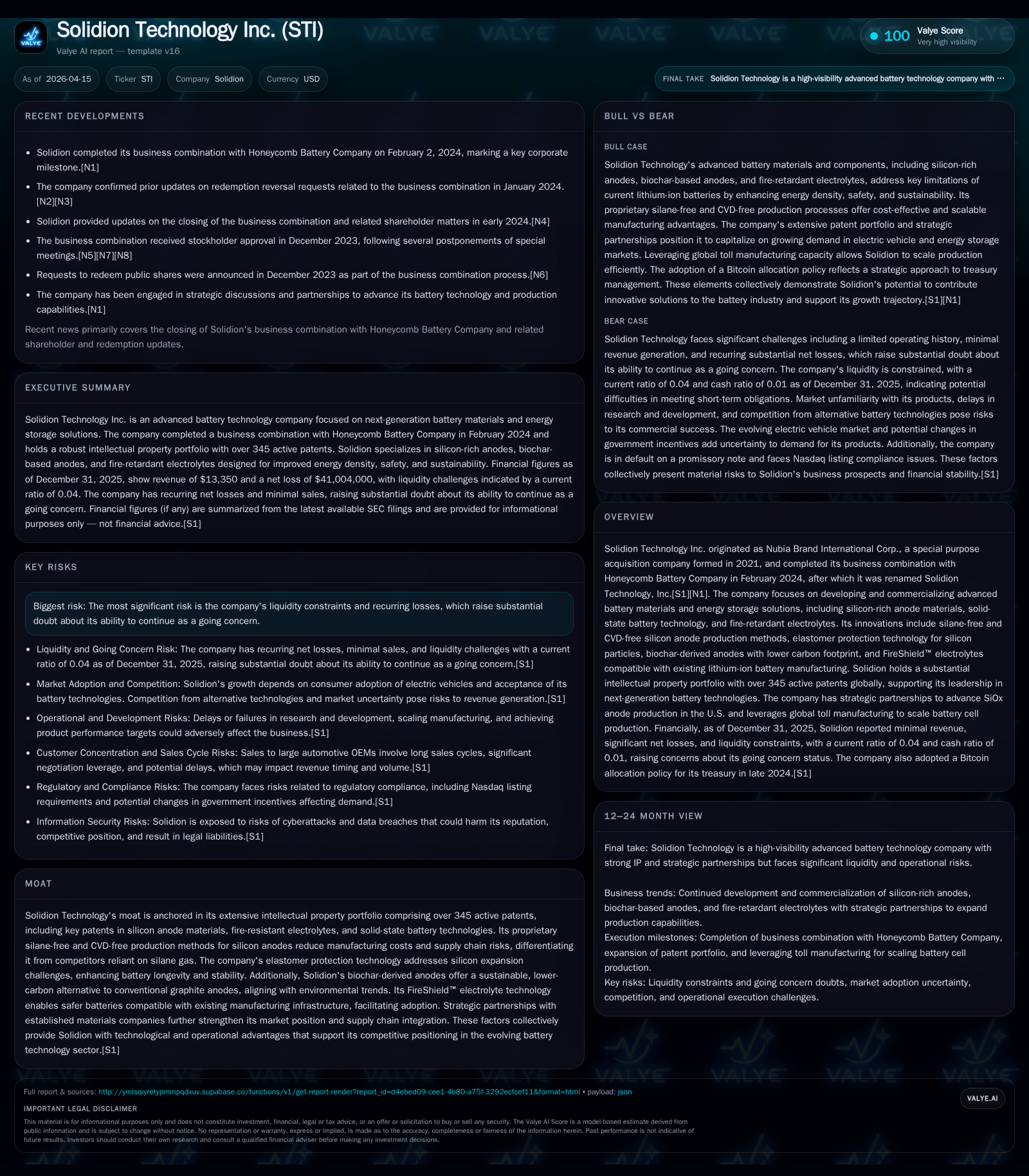
Solidion Technology Inc., formed via a SPAC merger in early 2024, has rapidly advanced its position in advanced battery materials, achieving a near doubling of revenue in 2025 driven by commercialization efforts. The company’s expansive patent portfolio and proprietary production methods underline its technological moat in silicon anodes and solid-state batteries. However, operating losses remained substantial despite revenue growth, fueled by high R&D and SG&A expenses as the company scales technology development and sales efforts. Cash runway is critically short, with only about $205,000 in cash reported at year-end and recurring negative cash flows raising serious concerns about going concern status. Solidion’s future growth hinges on successful scale-up with manufacturing partners and securing additional capital to fund accelerated expenditures. The ongoing liquidity constraints and lack of dividends or buybacks spotlight material financing risks ahead.
Company Background and Industry Position
Solidion Technology Inc. emerged from a special purpose acquisition company originally formed as Nubia Brand International Corp. Established in mid-2021, it completed its business combination with Honeycomb Battery Company (HBC) in February 2024, after which it was renamed Solidion Technology [S1]. The company focuses on developing next-generation battery materials including silicon-rich anode materials, solid-state battery cells, and proprietary fire-retardant electrolytes designed to improve energy density, safety, and manufacturability.
Headquartered in Dallas with R&D and manufacturing operations in Dayton, Ohio, Solidion’s technology portfolio includes silane-free production processes for silicon-based anode materials. The elastomer protection technology mitigates silicon particle expansion issues common in high-capacity anodes—addressing one of the critical failure modes in silicon anode battery cells [S1][S13]. Biochar-derived anodes offer a lower carbon footprint alternative contributing to sustainability trends within the EV supply chain.
Solidion’s FireShield™ electrolyte leverages polymer-based chemistry compatible with current lithium-ion manufacturing lines but adds fire-retardant properties to enhance battery safety—a growing concern as electric vehicles scale globally.
The company holds over 345 active global patents underpinning its competitive moat across key technological domains: advanced silicon anodes, solid-state electrolytes, manufacturing innovations, and safety enhancements [S1].
Historical Financial Performance
Since its rebranding following the merger in early 2024, Solidion has demonstrated accelerating revenue growth accompanied by persistent operating losses:
Historical performance (annual)
| FY | Rev ($) | Net ($mm) | CFO ($mm) | OpInc ($mm) | Rev YoY | Net YoY |
|---|---|---|---|---|---|---|
| 2025 | 13350 | -41 | -5 | -13 | +92.3% | -58.1% |
| 2024 | 6944 | -26 | -7 | -13 | ||
| 2022 | 1 | -1 |
Source: SEC companyfacts cache [F1].
Capital returns and efficiency (annual)
| FY | ROE% |
|---|---|
| 2025 | 570.6 |
| 2024 | 113.2 |
| 2022 | -15.2 |
Source: SEC companyfacts cache [F1].
Revenue nearly doubled (+92%) from approximately $6.94 million in 2024 to $13.35 million in 2025 as initial commercialization efforts progressed. Operating losses remained substantial but showed slight improvement (-$12.9 million vs. -$13.3 million), reflecting elevated fixed costs associated with research intensity and scaling overhead.
Net losses deepened considerably due primarily to non-cash charges from changes in fair value of derivative liabilities alongside increased general operating expenses.
Operating cash flow deficits improved moderately by approximately 39%, yet remain significant relative to the revenue base—indicative of ongoing cash burn typical for companies transitioning toward scale.
Cash reserves declined sharply from $3.35 million at the end of 2024 to roughly $205 thousand at the end of 2025—resulting in a critically low liquidity position with a current ratio around 0.04 as of December 31st [F1][S22], well below sustainable levels.
Growth Drivers and Future Outlook
Key factors influencing Solidion's growth trajectory include:
- Toll Manufacturing Partnerships: Collaborations with experienced third-party manufacturers such as Giga Solar and Bluestar enable scalable production without requiring significant capital expenditures directly from Solidion [S23].
- Commercialization of Silicon-Rich Anodes: Proprietary silane-free production processes reduce costs and safety risks compared to conventional methods using silane gas [S13].
- FireShield™ Electrolyte: This polymer-based fire-retardant electrolyte is designed for compatibility with existing lithium-ion manufacturing infrastructure providing enhanced safety benefits.
- Diverse Market Applications: Beyond electric vehicles, target markets include consumer electronics and grid energy storage systems where improved energy density offers operational advantages.
Risks tempering growth prospects include intense competition from automotive OEMs investing heavily in their own solid-state battery technologies; supply chain vulnerabilities; potential tariff impacts; and the challenge of converting partnerships into binding commercial agreements [S13][S16].
Capital Allocation and Financial Position
Solidion has not paid dividends or undertaken share repurchases since inception; capital allocation prioritizes investment into R&D focused on expanding intellectual property assets and refining core technologies [S5][F1]. Research & development expenses encompass personnel costs, testing fees, equipment maintenance, and materials [S4].
The company recorded an accumulated deficit exceeding $163 million through the end of 2025 with shareholders’ equity turning negative at approximately -$7.2 million due to sustained losses reflecting continued reinvestment into technology development [F1][S6].
Funding sources have included private placements totaling over $11 million primarily during 2024 along with convertible notes issuance during 2025 plus short-term notes nearing $2.65 million by year-end—all supporting working capital needs but contributing to leverage levels [S24][F1].
Liquidity is a critical concern as the company was noted as being in default on a promissory note accruing penalty interest at 24% per annum due to missed payments; management is actively negotiating amendments while pursuing additional financing options [S6][S8][S12].
Risks Summary
Substantial doubt regarding going concern status has been explicitly flagged by auditors given recurring net losses coupled with acute liquidity shortages that threaten operational continuity absent successful capital raises on acceptable terms [S8][S11][S16].
Competitive pressures stem from well-funded OEMs advancing alternative battery technologies potentially faster or more effectively than Solidion’s approach. Emerging energy solutions such as hydrogen fuel cells also pose long-term challenges [S13].[N#]
Trade policies including tariffs on imports could increase component costs affecting margins though no material impact has been reported thus far [S16].
Furthermore, governance oversight is required concerning related-party transactions under shared services agreements given potential conflicts that might affect operational independence [S19].
Conclusion
Solidion Technology exemplifies an advanced battery materials innovator experiencing rapid revenue scale alongside heavy R&D spending typical for companies transitioning from development into commercial production phases. Its extensive patent portfolio combined with differentiated silane-free silicon anode methodologies and fire-retardant electrolyte technology support its competitive positioning within evolving lithium-ion ecosystems.
However, persistent net losses coupled with critical liquidity constraints cast uncertainty on near-term viability pending successful capital raises or operational breakthroughs enabling positive cash generation. Reliance on toll manufacturing mitigates direct capital intensity but shifts execution risk onto partners necessitating close quality control.
Investors should monitor quarterly financial disclosures focusing on cash burn trends alongside industrial adoption milestones validating scalability while assessing management’s progress securing sustainable financing vital for long-term advancement within the highly competitive battery innovation landscape.
This analysis is based solely on publicly available SEC filings as of April 15, 2026.
Disclaimer: This is research-only, informational analysis and not investment advice. It may include AI-generated interpretation and general industry context. Always verify important details using primary sources.

Comments