
Drugs Made In America Acquisition Corp. Positions for AI-Focused Business Combination with Liquidity Risks
A blank check company formed in 2024, DMAA raised significant IPO proceeds but faces near-term financial uncertainties pending its inaugural acquisition.
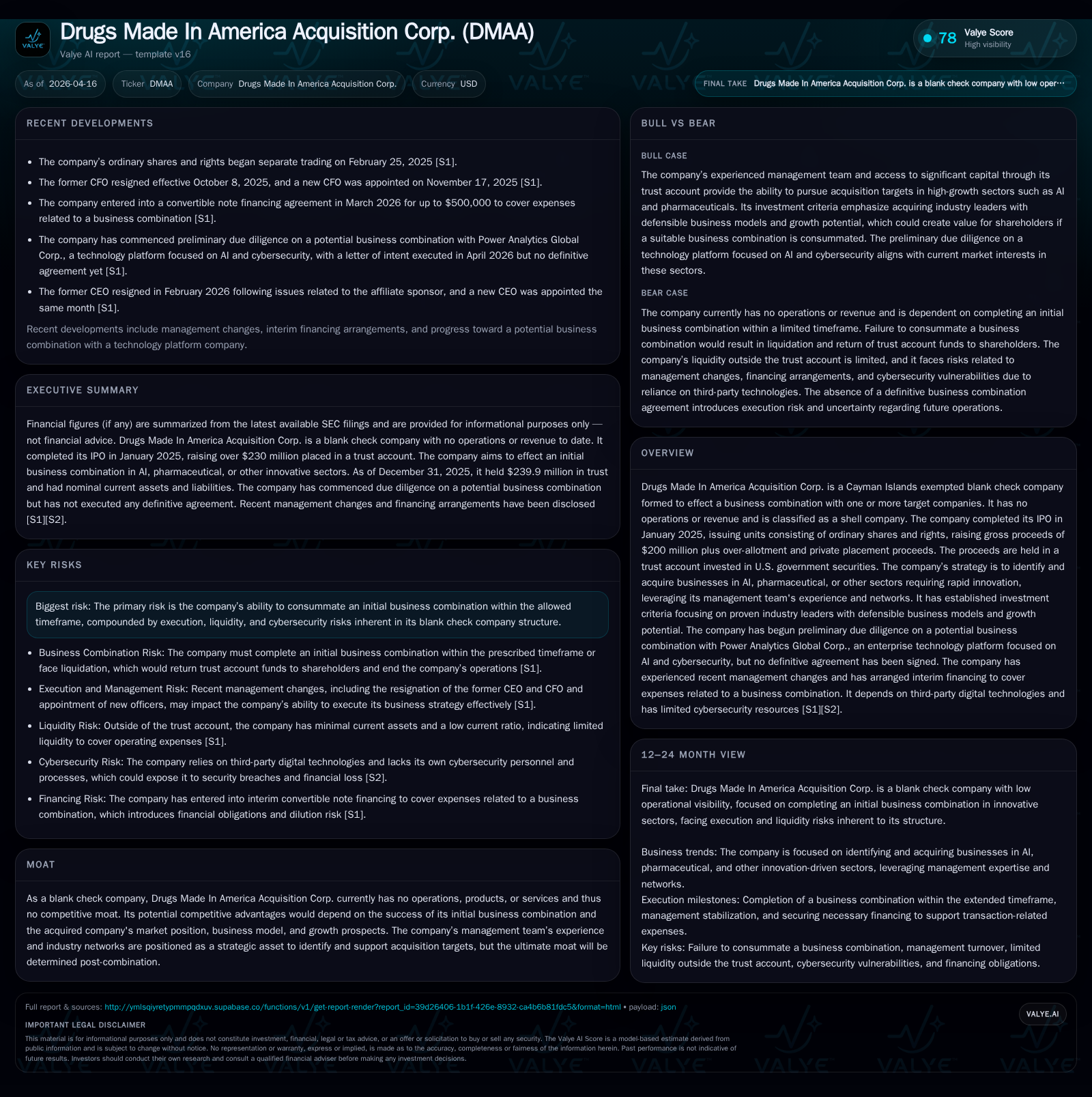
Drugs Made In America Acquisition Corp. (DMAA) is a Cayman Islands-incorporated blank check company that went public in January 2025, raising approximately $231 million through an IPO and private placement. The company has yet to consummate an initial business combination and currently holds all proceeds in a trust account invested in U.S. government securities. Its management targets acquisitions in AI, pharmaceutical, or other innovation-driven sectors, leveraging extensive industry networks. While DMAA reported positive net income primarily from trust interest income in 2025, operating cash flows remain negative and liquidity constraints pose significant risks ahead of its planned de-SPAC transaction with Power Analytics Global Corp.
Company Background and Structure
Drugs Made In America Acquisition Corp. (ticker: DMAA) was incorporated as a Cayman Islands exempted company on May 23, 2024. It operates as a special purpose acquisition company (SPAC), commonly called a 'blank check company,' formed solely to pursue an initial business combination with one or more target companies. The company does not conduct operations nor generate operational revenue until completion of this business combination [S1][S13].
Historical Financial Performance
DMAA completed its initial public offering (IPO) on January 29, 2025, issuing 20 million units priced at $10 per unit, generating gross proceeds of $200 million. The underwriters exercised their over-allotment option to purchase an additional 3 million units for $30 million, and the sponsor purchased private placement units totaling approximately $4.3 million, resulting in aggregate proceeds placed into the trust account of about $231.15 million [S1][S6].
During the year ended December 31, 2025, DMAA earned net income of approximately $5.94 million primarily attributable to interest earned on the Trust Account cash holdings amounting to roughly $8.76 million. This was offset by general and administrative expenses totaling approximately $2.82 million which included a non-cash share issuance expense related to issuance of founder shares valued at nearly $2 million [F1][S1].
Despite net profitability driven by investment income, operating cash flow was negative $539K in 2025 due to ongoing administrative costs and public company compliance expenses [F1]. The company had a working capital deficit at year-end as current liabilities ($376K) substantially exceeded current assets ($12K), yielding a current ratio of approximately 0.03—a structural liquidity constraint common among SPACs prior to their business combination [F1].
Historical performance (annual)
| FY | Net ($mm) | CFO ($) | Net YoY |
|---|---|---|---|
| 2025 | 6 | -539187 | +2222.8% |
| 2024 | 0 | -172265 |
Source: SEC companyfacts cache [F1].
Capital returns and efficiency (annual)
| FY | ROE% |
|---|---|
| 2025 | -81.8 |
| 2024 | 114.3 |
Source: SEC companyfacts cache [F1].
Note: Revenue is absent as the company has no operating activities; net income reflects interest income less costs.
Business Model and Acquisition Strategy
As a SPAC without commercial operations, DMAA’s ultimate value depends on the target acquired through its initial business combination [S13]. Management aims to leverage extensive networks and transactional experience to identify acquisition candidates that are industry leaders demonstrating consistent growth with defensible business models amid secular tailwinds.
Originally emphasizing pharmaceutical themes ('Drugs Made In America'), DMAA expanded focus to include artificial intelligence (AI), machine learning, quantum analytics, and cybersecurity platforms—industries characterized by rapid innovation and high growth potential [S8][S13]. This multi-sector approach widens candidate availability but also introduces competitive deal sourcing challenges.
Recent Developments and Forward Outlook
In March-April 2026, DMAA entered into an Investment Agreement for convertible note financing aimed at supporting transaction-related costs ahead of completing its business combination. The company initiated preliminary due diligence following signing a letter of intent (LOI) with Power Analytics Global Corp., a Delaware corporation specializing in enterprise AI technology solutions. This potential de-SPAC merger is tentatively valued at approximately $1 billion subject to standard adjustments following due diligence [S7][S10][S27].
Completion of this initial business combination is critical for transitioning beyond SPAC status toward generating substantive operational revenues.
Key forward-looking events include:
- Execution of definitive agreements relating to the acquisition of Power Analytics Global Corp.
- Financing arrangements secured to fund post-merger growth initiatives.
- Public shareholder approval processes for the proposed transaction.
- Regulatory scrutiny or procedural delays common in de-SPAC listings.
Given no definitive agreement had been executed as of April 2026 with ongoing negotiations anticipated [S26], timing remains uncertain.
Capital Structure and Liquidity Considerations
DMAA’s capital structure post-IPO primarily comprises ordinary shares issued via units (ordinary shares plus rights). Gross proceeds were largely deposited into a Trust Account invested in U.S. government securities that generated most non-operational income [S1][S6].
Structural liquidity challenges typical for SPACs pre-business combination include:
- Minimal unrestricted cash ($6K at December 31, 2025) limits operational flexibility.
- Working capital deficits reflect accrued legal and administrative fees plus deferred underwriting commissions totaling millions.
- Sponsor loans via subscription promissory notes have been used occasionally for working capital needs; principal repayable upon closing or dissolution [S9][S16].
- Deferred underwriting fees totaling approximately $6.9 million represent material future cash obligations reducing funds available for acquisition consideration [S12][S14].
The administrative services agreement paying monthly fees ($10K/month) to sponsor affiliates through March 2026 was terminated following management changes indicating cost rationalization efforts [S19][S24].
Interim loans outstanding under convertible note agreements provide limited additional funding (e.g., $100K outstanding as of early April 2026) with up to $500K commitments available [S7][S10], yet working capital remains constrained until business combination closes unlocking trust fund resources.
Returns Profile and Capital Allocation
ROE approximated by dividing net income by equity yields roughly -81.8%, reflecting negative equity balances principally due to deferred costs exceeding contributed surplus plus retained earnings ([F1]). This reflects SPAC accounting conventions where deferred underwriting fees accrue against equity despite substantial trust assets held separately.
No dividends or stock repurchase programs exist given transitional status prior to acquisition completion [S22]. Post-combination capital allocation policies remain uncertain but likely will focus on target growth investment.
Risk Factors Summary
Key risks include:
- Failure or delay consummating an initial business combination within required timelines could compel liquidation under NASDAQ rules.
- Competition for attractive targets may limit pricing advantages relative to strategic acquirers or other SPACs.
- Negative working capital necessitates ongoing reliance on sponsor loans or external financing exposing funding risk.
- Cybersecurity vulnerabilities arise from dependency on third-party infrastructure without dedicated internal defenses typical for operating companies [S2].
- Potential conflicts from management’s fiduciary duties elsewhere could affect deal exclusivity [S19].
- Market valuation volatility may impact shareholder support during approval stages post-announcement.
Conclusion
Drugs Made In America Acquisition Corp., having raised over $230 million as a blank check entity targeting innovative sectors such as AI and pharmaceuticals, remains at an inflection point ahead of an anticipated de-SPAC merger with Power Analytics Global Corp. While reporting positive net income driven by trust account interest gains rather than operations,[F1] pervasive liquidity constraints coupled with substantial deferred fees underscore execution risks before transitioning into an operating public entity.[S1][S26]
Investors should monitor finalization of definitive agreements regarding Power Analytics Global Corp., follow-on financing negotiations,[S7] shareholder vote outcomes, regulatory approvals, and any shifts in management strategy particularly regarding capital deployment priorities post-combination.
This analysis is provided solely for informational purposes without any investment recommendation or advice.
Disclaimer: This is research-only, informational analysis and not investment advice. It may include AI-generated interpretation and general industry context. Always verify important details using primary sources.

Comments